

Mumbai. Wednesday, 24 June 2026
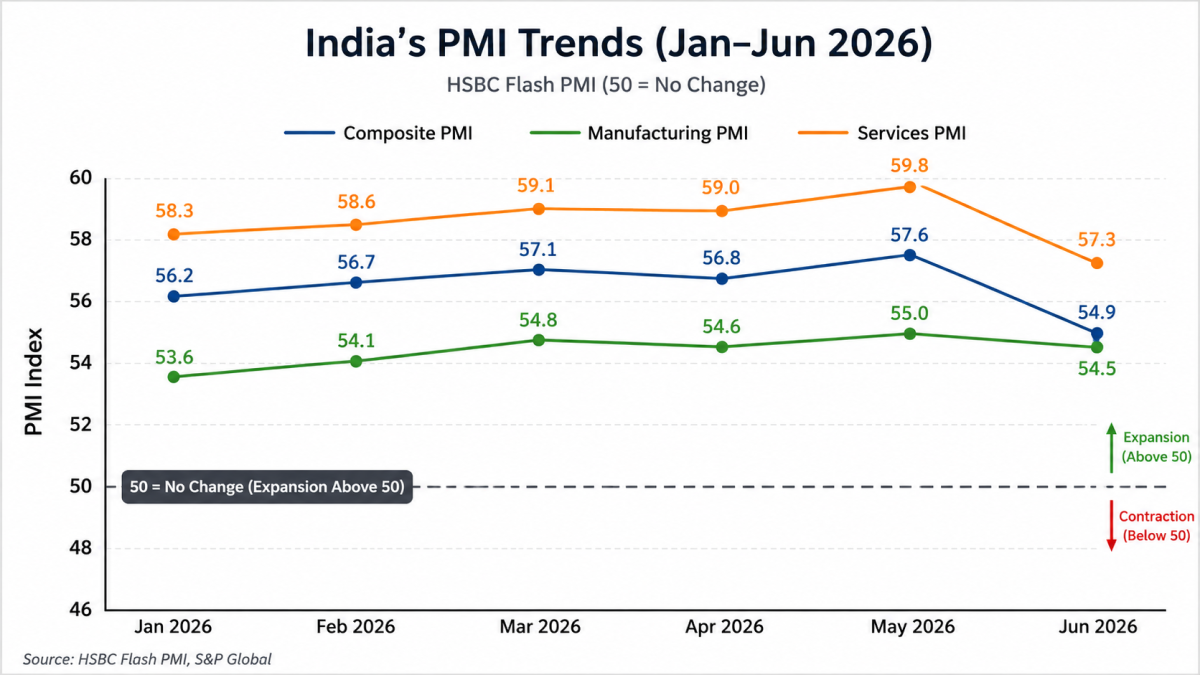
India’s private sector business activity continued to expand in June 2026, although the pace of growth slowed to its weakest level in three months. The latest HSBC Flash Purchasing Managers’ Index (PMI) survey indicates that both the manufacturing and services sectors remained firmly in growth territory, reflecting the structural resilience of the Indian economy amid rising costs and moderating demand.
While this expansion highlights strong underlying domestic fundamentals, the cooling momentum signals that the economy is shifting into a more measured, balanced phase of growth after several months of rapid acceleration.
What the Latest PMI Data Reveals
The HSBC Flash Composite PMI, which measures overall business activity across manufacturing and services, remained comfortably above the crucial 50-point mark in June. In PMI methodology, a reading above 50 indicates economic expansion, while a reading below 50 signals contraction.
Although economic activity continued to grow, businesses reported softer demand conditions and increasing input costs. This combination led to a slower expansion compared to previous months, highlighting the fine line companies are walking between scaling up and protecting their bottom lines.
Services Sector Growth Moderates
India’s services sector remained a key driver of economic growth but witnessed a noticeable slowdown during June. New business inflows grew at a slower pace as consumer demand moderated across several key industries.
Economists note that while the services sector continues to benefit from robust domestic consumption, businesses are becoming increasingly cautious. This hesitation is largely driven by persistent inflationary pressures and global economic uncertainties that make long-term forecasting more complex.
Manufacturing Sector Remains Resilient
The manufacturing sector continued to show its characteristic resilience despite challenging operational conditions. Factory output expanded during June, supported heavily by steady domestic demand and stable production levels.
However, manufacturers were not immune to macroeconomic headwinds. Companies reported rising costs for raw materials and logistics, which compressed profit margins and limited the overarching pace of sector expansion.
Rising Input Costs Put Pressure on Businesses
One of the key concerns highlighted in the June survey was the sharp increase in input costs. Businesses across all sectors reported paying higher prices for:
Raw industrial materials
Transportation and freight logistics
General operational expenses
While some companies successfully passed these costs on to consumers through higher selling prices, others absorbed the additional expenses to remain competitive, directly squeezing their profitability.
This emphasis on cost-containment aligns with broader structural changes across corporate India. For example, large conglomerates are increasingly prioritizing fiscal discipline over high-burn expansion, a shift visibly mirrored in recent corporate strategies. A prominent case is detailed by Matribhumi Samachar regarding the restructuring at Tata Group as they push toward profitability and cost-optimization in their consumer verticals.
Employment Growth Continues Amid Caution
Despite slower business activity, companies continued to hire workers during June. Employment growth remained positive as businesses sought to meet existing order backlogs and maintain everyday operational efficiency.
However, hiring activity was noticeably more measured than earlier in the year. This reflects growing caution among employers who prefer optimizing their current workforces over aggressive talent acquisition.
This environment makes government-backed capital cushions vital for sustaining long-term employment pipelines. As reported in depth by Matribhumi Samachar, initiatives like the newly notified Startup India Fund of Funds 2.0 aim to inject fresh capital into high-growth sectors, ensuring that businesses can scale up cleanly despite cautious corporate hiring cycles.
Impact on RBI Policy Outlook
The latest business activity figures are likely to be closely monitored by the Reserve Bank of India (RBI). Slower growth momentum combined with manageable inflation could provide policymakers with greater flexibility when considering future monetary policy and interest rate decisions. Financial markets will closely watch upcoming retail inflation, industrial production, and employment data for clearer signals about the economy’s second-half trajectory.
Conclusion
India’s business activity remained firmly in expansion mode during June 2026, highlighting the economy’s underlying structural strength. However, slower demand growth and rising costs indicate that businesses are entering a more cautious phase. While manufacturing and services continue to support economic growth, maintaining momentum will depend heavily on stable consumer demand, inflation trends, and broader global economic conditions.
Frequently Asked Questions (FAQ)
What does a PMI reading above 50 mean?
A Purchasing Managers’ Index (PMI) reading above 50 indicates that the sector is expanding compared to the previous month. A reading below 50 signals contraction, while a reading exactly at 50 indicates no change.
Why did India’s business activity slow down in June 2026?
The pace of growth slowed due to a combination of moderating consumer demand, slower new business inflows, and rising input costs for raw materials and logistics, forcing businesses into a more cautious operational stance.
How do rising input costs affect the general public?
When businesses face higher costs for transportation and raw materials, they often pass these expenses on to the public through higher retail prices, which can contribute to consumer inflation.
Disclaimer
The information provided in this article is for informational and educational purposes only. It does not constitute financial, investment, or legal advice. Economic data and market conditions are subject to change. Readers should consult with a certified financial professional or official policy documents before making any investment or business decisions based on this data.
