 Matribhumi Samachar English


Mumbai. Wednesday, 24 June 2026
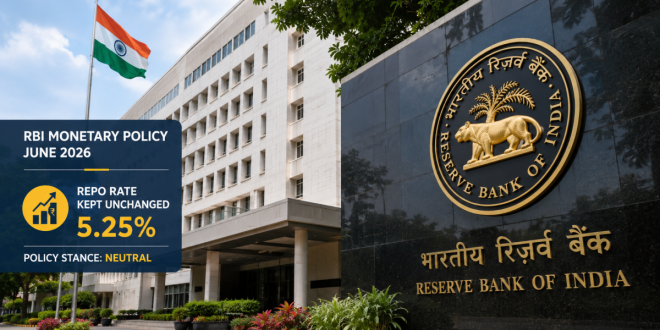
The Reserve Bank of India (RBI) continues to act as a crucial anchor for the country’s financial landscape. In its highly anticipated June 2026 review, the RBI’s Monetary Policy Committee (MPC) chose continuity over sudden shifts by maintaining the benchmark repo rate at 5.25% and retaining its neutral policy stance.
This balanced strategy signals cautious optimism: the central bank aims to keep a tight lid on persistent inflation risks while actively nurturing India’s domestic economic expansion. Let’s break down how this foundational policy decision directly impacts commercial banks, corporate credit, home loan borrowers, and routine savers across the nation.
1. Navigating the Core Tools of the RBI MPC
To maintain price stability and ensure predictable economic growth, the MPC utilizes key financial levers that determine how money flows through the economy:
-
The Repo Rate (5.25%): The interest rate at which the central bank lends money to commercial banks. Leaving it unchanged ensures that general borrowing costs across the economy don’t spike unexpectedly.
-
Cash Reserve Ratio (CRR): The mandatory percentage of liquid cash banks must hold with the RBI, acting as a crucial safeguard for systemic stability.
-
Liquidity Management Measures: Strategic interventions used to fine-tune credit availability so banks have enough capital to back ambitious business investments without fueling excess inflation.
The June 2026 review highlights a vigilant, data-driven approach. The committee remains heavily focused on mitigating global geopolitical uncertainties, supply chain disruptions, and volatile commodity prices.
2. The Ripple Effect on India’s Banking Sector
A Highly Stable Lending Environment
Because the cost of borrowing from the RBI remains flat, commercial banks face zero pressure to raise baseline interest rates immediately. This stability translates into a highly competitive marketplace, allowing financial institutions to steadily extend credit facilities to both consumers and corporate clients.
Healthy Systemic Liquidity
The banking sector continues to report adequate liquidity conditions. This means institutions are well-positioned to meet rising festive and industrial credit demands efficiently, keeping operational costs low and promoting stable economic expansion.
Boosting Foreign Currency Inflows
Recent, proactive policy measures intended to draw foreign currency deposits from Non-Resident Indians (NRIs) are yielding significant results. By streamlining access to overseas capital, banks have effectively strengthened their foreign exchange reserves and cushioned their overall balance sheets against external global shocks.
3. What This Stance Means for Homeowners and Buyers
For individuals managing floating-rate home loans or looking to enter the real estate market, the June 2026 announcement brings a welcome sigh of relief.
-
Steady Equated Monthly Installments (EMIs): Because domestic lending rates are closely aligned with the central bank’s repo rate, existing borrowers will see their monthly EMI outlays remain entirely stable.
-
Confidence in Long-Term Financial Planning: Aspiring homebuyers can map out long-term property investments with predictable numbers, completely free from the immediate anxiety of sudden interest rate spikes.
4. Driving Business Credit and Industrial Growth
A steady repo rate architecture serves as a massive pillar of support for corporate credit channels and entrepreneurial growth.
-
Seamless Access to Capital: Small and Medium Enterprises (SMEs) can lock in favorable, predictable borrowing structures. This financial safety encourages companies to scale operations, upgrade legacy technology, and commit to major infrastructure projects.
-
Fueling Manufacturing and Services: Sustained, affordable credit flows are essential to keeping India’s core manufacturing and service sectors competitive. This continuous industrial backing directly promotes robust job creation and broad-based national development.
5. The Outlook for Depositors and Everyday Savers
While borrowers enjoy predictability, fixed-income investors and conservative savers can expect a relatively steady phase:
| Deposit Type | Expected Short-Term Trend | Saver’s Strategy |
| Fixed Deposits (FDs) | Rates will likely hold steady; minor shifts may occur due to individual bank competition for retail capital. | Look out for specialized mid-term tenors offering competitive promotional yields. |
| Savings Accounts | Base interest rates will remain largely unchanged in the near term. | Keep standard emergency funds parked safely without worrying about eroding nominal returns. |
6. Forward Outlook: Balancing Growth and Inflation Risks
Moving deeper into late 2026, the RBI’s subsequent monetary trajectories will remain tightly tethered to shifting domestic and global indicators. The MPC is keeping a watchful eye on several key variables:
-
Crude Oil Dynamics: Shifting global oil parameters that have a direct bearing on domestic transport and logistics costs.
-
Weather and Crop Patterns: Climate anomalies impacting agricultural yields and localized food inflation.
-
Global Market Evolution: Shifting interest rate positions by central banks abroad and currency market stability.
If headline inflation comfortably settles into the RBI’s targeted safety band, the central bank is expected to maintain its practical, growth-supportive approach. However, any persistent structural price pressures could trigger tactical tightening measures down the line.
Frequently Asked Questions (FAQs)
Why did the RBI keep the repo rate unchanged at 5.25% in June 2026?
The RBI maintained the rate at 5.25% to foster a balanced economic environment. This neutral stance keeps borrowing costs steady to support domestic growth while allowing policymakers to closely monitor external inflation risks like volatile crude oil prices and global supply chain hiccups.
Will my home loan EMIs decrease anytime soon?
Since the repo rate was held steady rather than cut, your floating-rate home loan EMIs will likely remain flat for the immediate future. A reduction in EMIs would typically require the RBI to actively pivot toward a rate-cut cycle in upcoming policy reviews.
Is it a good time to lock in long-term Fixed Deposits?
Yes. Since the repo rate has stabilized at 5.25% and banks are actively competing for domestic capital, retail FD rates are currently hovering at highly attractive levels. Locking in high-yield tenors now secures these steady returns before any potential future rate revisions.
Disclaimer: This article is prepared strictly for informational and educational purposes based on macro-financial updates from June 2026. The financial data, interest trends, and policy outcomes discussed do not constitute direct investment, legal, or personal financial advice. Readers are strongly urged to consult certified financial planners or banking representatives before making specific loan or investment commitments.
External References
To keep track of late-breaking developments across national security, commercial markets, and trade policies, explore the latest English press updates directly from the regional desks at Matribhumi Samachar:
-
Read about crucial border defense strategy updates via the Matribhumi Samachar National Page.