

Mumbai. Wednesday, 24 June 2026
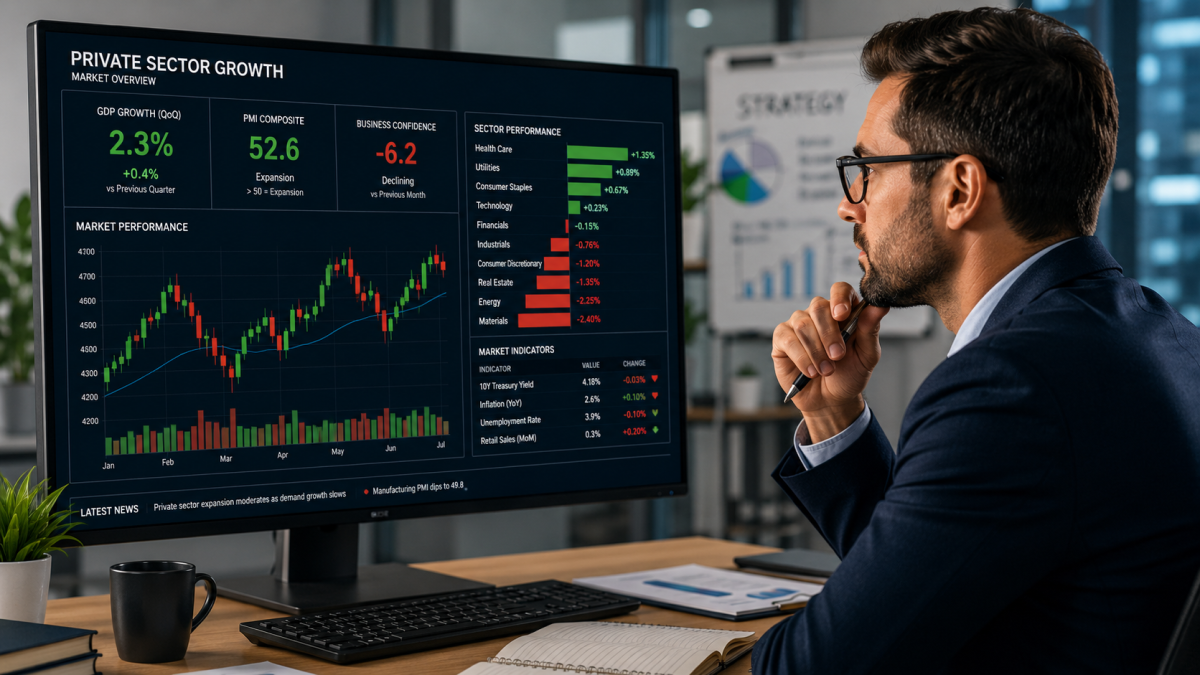
When economic indicators reveal that private sector growth is beginning to moderate after a prolonged period of expansion, a wave of anxiety often ripples through the investing community. However, a transition into a slower growth phase is not an automatic whistle blowing for an impending recession. Instead, it signals a natural maturing of the economic cycle.
The private sector—which spans vital non-government industries like manufacturing, technology, retail, services, and finance—is the engine of economic momentum. When forward-looking surveys like the Purchasing Managers’ Index (PMI) begin to dip, it often points to cooling consumer spending, softer export numbers, or rising business uncertainty. For an intelligent investor, this isn’t a cue to panic; it’s a cue to reposition.
1. The Stock Market: Navigating Earnings Pressure and Sector Rotation
A deceleration in private sector activity inevitably filters down to corporate bottom lines. When consumer demand softens, companies face slower sales growth and squeezed profit margins.
The Shift to Defensive Sectors
During rapid expansion, cyclical sectors like automobiles, industrial manufacturing, and construction thrive. When growth cools, these sectors experience heightened volatility. In response, institutional capital typically rotates into defensive sectors.
Industries such as healthcare, utilities, and consumer staples remain highly resilient during a slowdown because people still need medicine, electricity, and household goods regardless of the economic climate.
Re-evaluating Technology and Growth
Technology and high-growth stocks don’t lose their luster entirely, but the criteria for choosing them becomes much stricter. Investors stop pricing in speculative future growth and start favoring tech firms that possess:
Robust, consistent cash flows.
Sustainable business models insulated from short-term borrowing costs.
Strong positioning in long-term structural trends like Artificial Intelligence (AI) and digital infrastructure.
2. The Bond Market: Why Lower Yields Clear the Path for Fixed Income
While a cooling private sector presents hurdles for equities, it frequently creates a fertile environment for bond investors.
Slower economic momentum naturally dampens inflationary pressures. When inflation cools, central banks are highly likely to pause interest rate hikes or begin cutting rates to stimulate the economy.
The Golden Rule of Fixed Income: As interest rates and market yields fall, the prices of existing bonds go up.
Investors looking to shelter their capital from equity volatility often flood into government bonds and high-quality corporate bonds. These assets offer reliable risk-adjusted returns and act as an essential portfolio stabilizer when corporate earnings look uncertain.
3. Real Estate: Balancing Commercial Risks with Residential Support
The impact of moderated economic growth on real estate depends heavily on the specific sector:
Commercial Real Estate: This segment is tied directly to corporate expansion. When the private sector slows, companies scale back on scaling up, leading to reduced demand for new office spaces, retail storefronts, and industrial warehouses.
Residential Real Estate: Conversely, the residential sector often finds a floor during a economic slowdown. If central banks lower interest rates in response to the cooling economy, mortgage borrowing costs decline, keeping residential buyer demand stable.
Before allocating capital to real estate in this environment, it is crucial to meticulously analyze localized employment data and regional economic trends.
Strategic Opportunities: Where to Invest When Growth Slows
An economic slowdown does not mean an absence of opportunity. It simply requires a finer lens focused entirely on asset quality.
| Asset Class | Top Target Area | Core Investment Objective |
| Equities | Dividend-Paying Stocks | Securing consistent cash payouts with reliable history. |
| Fixed Income | High-Quality Bonds | Capital preservation and locking in attractive yields. |
| Structural Trends | AI, Renewable Energy, Healthcare | Capitalizing on long-term growth detached from short-term cycles. |
Crucial Risks Investors Must Monitor
To prevent your portfolio from being caught off-guard, keep a close eye on these macroeconomic red flags:
Sustained Drops in Business Confidence: Keep tracking monthly PMI reports; a deeper dive into contractionary territory alters the game plan.
Weakening Consumer Demand: Retail sales data will tell you exactly how tight everyday consumers are holding their wallets.
Spikes in Unemployment: A tightening job market instantly curtails consumer spending power.
Unexpected Inflation Shocks: If inflation surges despite slower growth (stagflation), central banks cannot easily cut rates.
Geopolitical and Trade Risks: Tariffs or international conflicts can instantly disrupt supply chains and compound domestic economic slowdowns.
Summary Strategy
Slower private sector growth is simply a change in weather, not an economic apocalypse. By prioritizing strict portfolio diversification, anchoring your capital in high-quality assets, and blocking out short-term market noise, you can comfortably navigate the transition and protect your wealth for the long haul.
For continuous global financial updates, market analysis, and breaking business news, explore the latest report coverages directly on Matribhumi Samachar English Business Section.
Frequently Asked Questions (FAQ)
1. Does slower private sector growth mean a recession is coming?
No. Slower growth simply means the economy is expanding at a more moderate, gentle pace compared to a previous boom period. A recession typically requires a sustained contraction in economic activity, not just a deceleration of growth speed.
2. Which stocks perform best when the private sector slows down?
Defensive stocks—such as those in healthcare, utilities, and consumer staples—traditionally outperform cyclical stocks during a slowdown. Companies with strong balance sheets and history of steady dividend payouts are also highly favored.
3. Why do bond prices usually rise when economic growth slows?
When growth moderates, inflation pressures generally ease, leading central banks to stop raising or to actively lower interest rates. Because bond prices move inversely to interest rates, falling yields trigger an increase in bond values.
Disclaimer: The information provided in this article is for educational and informational purposes only and does not constitute financial, investment, or legal advice. Investors should consult with a certified financial advisor and conduct their own due diligence before making any investment decisions based on macroeconomic trends.
