

New Delhi. Friday, 19 June 2026
Have you ever wondered what it takes to build artificial intelligence that truly understands India? Think about the sheer diversity—thousands of dialects, hyper-local agricultural conditions, and unique healthcare challenges. For a long time, early-stage developers and tech startups faced a massive roadblock: the world’s best data and raw computing powers were locked behind the walls of a few global tech giants.
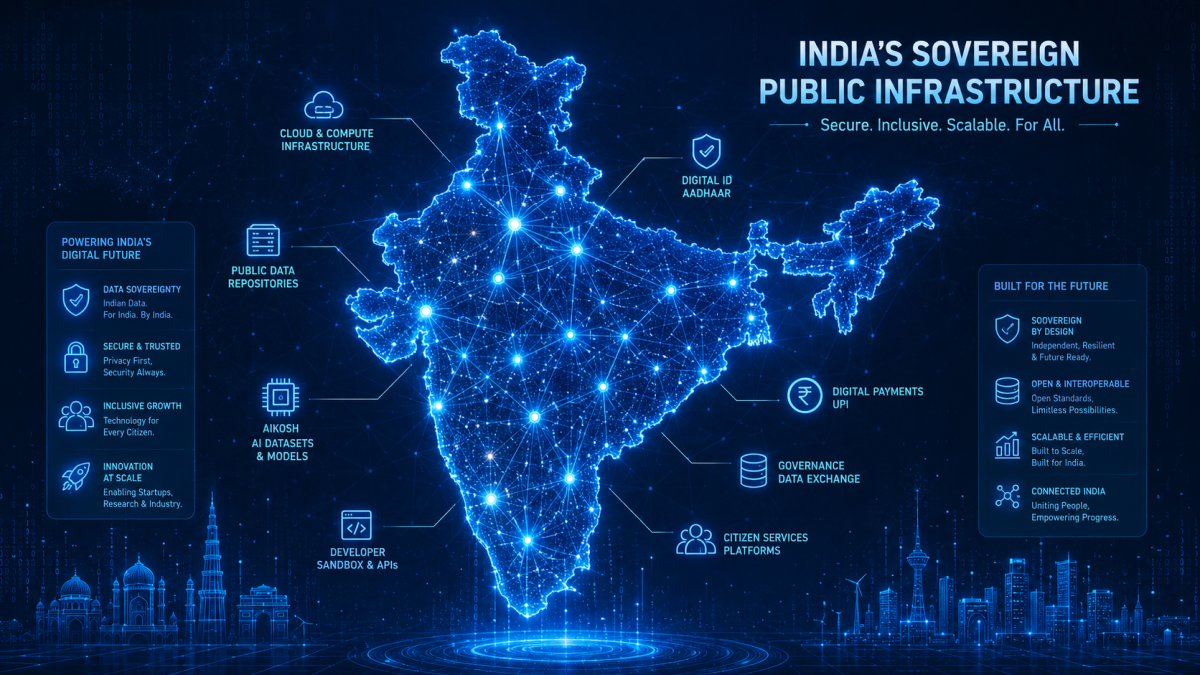
Enter AIKosh (AI Kosha). Developed under the Government of India’s massive ₹10,370 crore flagship IndiaAI Mission, this platform has officially transitioned from a promising blueprint into a live digital engine. Spearheaded by the Ministry of Electronics and Information Technology (MeitY), AIKosh is acting as the open-access “Digital Public Infrastructure” (DPI) for the intelligence age—doing for data what UPI did for digital payments.
What Exactly Is AIKosh?
AIKosh is a centralized, government-backed repository designed to host high-quality, curated, non-personal datasets, pretrained foundational AI models, specialized toolkits, and secure APIs.
Instead of forcing Indian researchers and startups to start training their algorithms from scratch—which costs millions of dollars—AIKosh provides a unified platform where innovators can discover, pull, and integrate localized data natively.
Key Pillars of the AIKosh Platform:
Massive Public Datasets: Clean, structured data across critical national sectors like healthcare, agriculture, and public governance.
The Indic Language Hub: Speech-to-text, text-to-speech, and translation datasets tailored to bypass the English-centric digital divide.
The AI Sandbox Environment: An integrated workspace allowing developers to experiment with models directly alongside live datasets.
Driven by the Numbers: The Scale of AIKosh
AIKosh is rapidly scaling to meet population-level demands. To understand its expanding footprint across the tech ecosystem, consider its real-time assets:
| Asset / Platform Metric | Current Active Status |
| Available Datasets | 12,050+ structured, non-personal datasets |
| Pretrained Foundational Models | 306+ vetted models (including advanced Indic LLMs) |
| Registered Platform Users | 25,400+ startups, scholars, and enterprise developers |
| Active Ecosystem Organizations | 500+ contributing state and private entities |
| Documented Toolkits & Use Cases | 220+ production-ready frameworks |
Breaking the Language Barrier: Sovereign Models in Action
One of the most profound elements hosted and accessed via AIKosh is its deep integration with indigenous foundational AI models. For generations, western models have stumbled over the nuanced cultural contexts and regional dialects of rural India.
AIKosh has become a primary distribution pipeline for advanced models like Sarvam-105B (an advanced Mixture-of-Experts model featuring billions of active parameters optimized for Indian regional languages), BharatGen, and Dhwani. These technologies layer voice-first accessibility over state infrastructure. For example, using over 1,600 hours of localized speech datasets derived from the state-backed BHASHINI Platform, an agritech startup can construct a voice assistant that allows a farmer to speak naturally in their native tongue to receive real-time crop management or pest control advice.
Leaning Into Compute: The Integrated GPU Sandbox
Data is only half the battle; training complex neural networks requires heavy-duty silicon hardware. AIKosh actively connects developers to subsidized high-performance processing networks through the IndiaAI Compute Portal.
Through an intuitive tier-based structure, users can run tasks directly within their cloud workspace:
CPU Only Tier: Fully free, anytime access meant for lightweight code testing and machine learning basics.
Basic GPU Tier: Free access to partitions of high-tier NVIDIA A100 GPUs for moderate AI experimentation.
Advanced GPU Tier: Priority access designed for intense generative AI workloads, backed by national supercomputing assets like AIRAWAT.
This leveling of the playing field ensures that a budget-constrained developer working out of a Tier-2 city has identical infrastructure capabilities to a multi-million dollar tech laboratory.
The Bigger Picture: Strategic AI Sovereignty
AIKosh represents a fundamental shift toward true computational self-determination. By prioritizing “Innovation Over Restraint,” Indian policymakers are steering clear of rigid, choking legal compliance for early-stage startups. Instead, they are building an elastic framework where data is open, computing power is subsidized, and national security is protected via permission-based access and data anonymization tools.
As massive generative models demand increasingly high amounts of energy and infrastructure, India’s push toward independent data frameworks ensures that its domestic digital economy remains resilient, innovative, and completely decoupled from volatile overseas cloud policies.
Frequently Asked Questions (FAQs)
1. Who is eligible to use the AIKosh platform?
AIKosh is primarily engineered for Indian citizens, including academic researchers, students, registered early-stage deep-tech startups, enterprises, and local government departments looking to build localized AI systems.
2. What types of datasets are hosted on AIKosh?
The repository hosts non-personal, metadata-standardized datasets across critical sectors such as healthcare diagnostics, precision agriculture, geospatial satellite imagery, education technology, and massive multilingual corpora for regional Indian languages.
3. How does AIKosh ensure data privacy and security?
AIKosh incorporates a responsible AI framework using advanced data anonymization tools, rigorous dataset quality assessments, privacy safeguards, and strict permission-based digital access controls to verify that citizen privacy is strictly maintained.
4. Is there a cost associated with downloading models or using the sandbox?
No. Basic access to the repository datasets, open-source foundational models, and introductory cloud computing configurations (CPUs and basic GPU slots) is entirely free to democratize innovation across the ecosystem. Advanced compute requires a formal application process.
Related Reading on India’s High-Tech Evolution
To understand the broader macroeconomic context powering this technological leap, consider exploring these detailed insights from Matribhumi Samachar:
Discover the philosophical and economic imperatives behind India’s new hardware architecture in Inside India’s Bold Push for AI Sovereignty: Compute, Culture, and the New Digital Public Infrastructure.
Analyze the massive multi-billion rupee private and state capital flows scaling high-density data arrays in The Backbone of the Digital Revolution: Unpacking India’s Sovereign AI Ecosystem and Infrastructure Boom.
Learn how satellite analytics, Earth observation telemetry, and multilingual voice engines are changing lives on the ground in The Digital Precision Agriculture Revolution: How Tech is Redefining Indian Farming.
Uncover how state governments are solving physical engineering limitations through green energy grids in The Hardware Boom: Inside the Relentless AI Data Center Infrastructure Growth in India.
Explore how India is looking beyond standard silicon architectures by pairing its machine learning mission with next-generation processing units in Beyond AI Sovereignty: How India is Engineering the Next Quantum Leap.
Disclaimer: This article is intended solely for educational and informational purposes. The parameters, asset counts, and operational frameworks related to the AIKosh platform and the IndiaAI Mission reflect open-source government project releases and independent tech reporting. Readers should verify official portal guidelines before applying for compute allocations.
