 Matribhumi Samachar English


New Delhi. Wednesday, 1 July 2026
The global matrix of modern warfare has undergone a permanent shift, moving away from conventional hardware and heavily toward automated systems. In 2026, India’s defense drone industry is entering a critical phase of rapid expansion. Driven by national security priorities, government funding, and aggressive private-sector innovation, the country is steadily constructing a domestic Unmanned Aerial Vehicle (UAV) ecosystem capable of decoupling itself from traditional foreign imports.
From persistent high-altitude surveillance to precision strike operations and tactical logistics, indigenous defense drones are solidifying their place at the center of India’s forward-looking military doctrine.
Why India Is Focusing on Indigenous Defence Drones
Over the past few years, India has heavily restricted foreign military hardware procurement under the landmark Atmanirbhar Bharat (Self-Reliant India) initiative. Modern geopolitical conflicts have underscored that relying on overseas supply chains for electronic warfare and surveillance assets presents a severe tactical vulnerability.
Several key structural drivers are accelerating domestic military UAV manufacturing:
-
Escalating Border Surveillance Needs: Continuous, real-time monitoring across contested mountain terrains and lengthy maritime zones.
-
Supply Chain De-Risking: Drastically reducing long-term dependence on imported systems that are prone to geopolitical sanctions or shipping blockages.
-
Agile Procurement Cycles: Sourcing directly from Indian vendors speeds up iterative testing, deployment, and localized upgrades.
-
Export Ambitions: Transforming India from a historical hardware importer into a major global supplier of cost-effective defense platforms.
-
The Deep-Tech Convergence: Rapid domestic breakthroughs in Artificial Intelligence, machine vision, and native multi-sensor integration.
Government Policies Structuring the Ecosystem
The expansion of the Indian defense UAV sector isn’t happening in isolation; it is actively shaped by coordinated policy interventions by the Ministry of Defence.
1. Advanced Defence Acquisition Reforms
The Defence Acquisition Procedure (DAP) now explicitly prioritizes procurement from categories like Buy (Indian-IDDM)—which stands for Indigenously Designed, Developed, and Manufactured. This legal framework ensures that local startups and defense houses get the first right of refusal before any global tenders are explored.
2. Production-Linked Incentives (PLI) & Tax Easing
The government has backed drone manufacturing and micro-component production with dedicated financial subsidies. Crucially, industrial barriers have been scaled back, such as slashing the uniform GST down to 5% for domestic drones and simulators, unlocking massive capital for research and development.
3. Deep-Tech and Capital Subsidies
Through initiatives like the Technology Development Fund (TDF) and the Innovations for Defence Excellence (iDEX) program, early-stage deep-tech startups receive non-dilutive grants to prototype military-grade hardware. This policy aligns with India’s wider strategy to deploy deep-tech resources internationally, a pivot showcased at global summits like Bharat Innovates 2026.
Tactical and Military Applications of Indian UAVs
Modern Indian-made UAVs have matured from simple remote-controlled cameras into fully network-centric combat and reconnaissance tools.
                  ┌──────────────────────────────────────────┐
                  │   MILITARY OPERATIONAL ROLES (2026)      │
                  └────────────────────┬─────────────────────┘
                                       │
        ┌──────────────────────────────┼──────────────────────────────┐
        ▼                              ▼                              ▼
 ┌──────────────┐               ┌──────────────┐               ┌──────────────┐
 │  ISR & Patrol│               │Tactical Cargo│               │ Lethal Strike│
 ├──────────────┤               ├──────────────┤               ├──────────────┤
 │ Continuous   │               │ Ammunition,  │               │ Loitering    │
 │ real-time    │               │ medical kits │               │ munitions    │
 │ intelligence │               │ to high caps │               │ & FPV drones │
 └──────────────┘               └──────────────┘               └──────────────┘
-
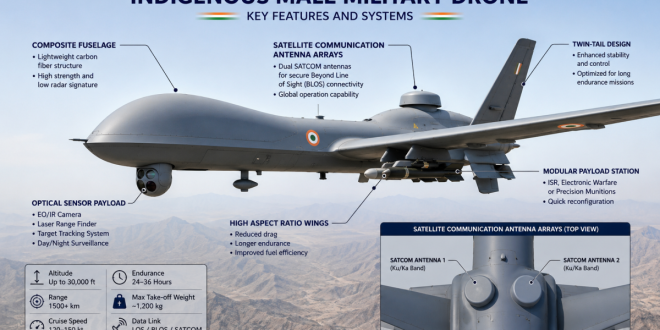
Intelligence, Surveillance, and Reconnaissance (ISR): Medium-Altitude Long-Endurance (MALE) drones provide strategic, persistent overwatch across rugged borders and sea lanes.
-
Precision Strike Missions: Weaponized UAVs and low-cost First Person View (FPV) kamikaze systems allow ground forces to hit hostile armor or assets without exposing infantry.
-
High-Altitude Logistics Support: Heavy-lift cargo drones routinely transport ammunition, blood bags, and critical cold-weather gear to isolated outposts in the Himalayas, bypassing dangerous mountain roads.
-
Disaster Response & Geospatial Mapping: Dual-use technologies allow defense drones to rapidly pivot into humanitarian assistance, damage assessment, and real-time mapping during natural emergencies. This capability is enhanced by India’s broader focus on combining drone data with satellite arrays, a practice known as Geospatial Earth Intelligence. For an understanding of how these macro data frameworks are built, read about India’s Sovereign AI Leap.
Key Market Players and Industrial Shifting
The Indian defense drone market features a dynamic mix of established public sector defense undertakings (DPSUs), massive multi-industry conglomerates, and agile tech startups:
| Company Type | Notable Entities | Core Technological Focus |
| Established State / Conglomerates | Hindustan Aeronautics Limited (HAL), Bharat Electronics Limited (BEL), Tata Advanced Systems, Adani Defence & Aerospace | Heavy MALE platforms, structural composite assembly, high-altitude surveillance, and system integration. |
| Deep-Tech & Specialist Startups | ideaForge, NewSpace Research & Technologies, Garuda Aerospace | Tactical swarm drones, autonomous loitering munitions, edge-AI image processing, and vertical takeoff (VTOL) logistics platforms. |
Beyond pure defense players, computer vision companies are increasingly optimizing software for automated warehouse inventory tracking and industrial surveillance, as seen in the scaling of private AI platforms like Assert AI’s Falcon system.
The Role of Artificial Intelligence and Sovereign Compute
Artificial Intelligence is changing defense aviation by reducing human operator workload and overcoming communication jamming. Modern Indian military drones utilize advanced algorithms for:
-
Autonomous Navigation: GPS-denied navigation using terrain-contour matching and optical flow.
-
Edge-AI Target Recognition: Real-time classification of military assets, personnel, and camouflage anomalies directly on the drone’s payload computer.
-
Swarm Coordination: Decentralized mesh networks where dozens of small drones communicate seamlessly with each other to overwhelm hostile air defenses without a central point of failure.
This edge-computing evolution relies directly on the growth of localized hardware. State-level initiatives are building the required computational foundations, including the expansion of specialized robotics and cybersecurity clusters through programs like the [Uttar Pradesh AI Mission](https://matribhumisamachar.com/en/2026/06/17/leapfrogging to-deep-tech-how-uttar-pradesh-is-positioning-itself-as-indias-next-artificial-intelligence-hub/).
Core Technical Gaps and Supply Chain Vulnerabilities
While the growth trajectory remains strong, industry analysts emphasize that achieving true strategic independence requires addressing deep-seated supply chain gaps:
The Semiconductor Bottleneck: The majority of high-end microcontrollers, Guidance and Navigation Units (GNUs), and specialized transceiver chips remain dependent on international silicon foundries.
-
Advanced Sensor Gaps: Developing domestic focal plane arrays for military-grade thermal and infrared cameras is still an active research challenge.
-
UAV Engine Manufacturing: Small, high-efficiency internal combustion engines and miniature gas turbines for long-endurance drones require unique materials science capabilities. To resolve this, programs like the Sintered Rare Earth Permanent Magnets Scheme are working to shore up the domestic production of materials vital for aerospace electronics and defense motors. Learn more about how India is securing these vital materials through the Sintered Rare Earth Permanent Magnets Initiative.
Outlook: The Next Phase of Automated Warfare
The coming years will see the deployment of next-generation unmanned defense hardware, including High-Altitude Pseudo-Satellites (HAPS) capable of flying continuously in the stratosphere for months, loyal wingman combat drones that fly alongside manned fighter jets, and comprehensive counter-UAV laser interception platforms.
As public policy, private capital, and deep-tech ecosystems align, India is steadily positioning itself to transform its defense industrial base from a model of import reliance into a globally competitive powerhouse of autonomous aviation.
Frequently Asked Questions (FAQ)
What is the primary focus of India’s indigenous defense drone initiative?
The primary goal is achieving absolute self-reliance (Atmanirbhar Bharat) in unmanned military technology. By developing local hardware, software, and assembly pipelines, the Indian Armed Forces can reduce their reliance on foreign OEMs, lower costs, protect data security, and customize equipment for specific regional environments.
How are Indian startups supported in developing military drones?
Startups receive funding, testing infrastructure, and direct incubation through government-led initiatives like the iDEX (Innovations for Defence Excellence) program and the Technology Development Fund (TDF). These programs provide non-dilutive capital and bridge the gap between initial research and procurement contracts with the armed forces.
What are the main technical challenges facing the Indian UAV industry?
The most critical challenges include an import reliance on high-end semiconductor chips, gaps in localized manufacturing of high-performance thermal imaging sensors, and the need to scale up domestic assembly of lightweight, fuel-efficient internal combustion engines for long-range tactical drones.
Disclaimer
This article is provided exclusively for informational, educational, and analytical purposes regarding defense industrial trends, corporate milestones, and aerospace technology updates in 2026. It does not contain, broadcast, or compromise any classified military procedures or restricted national security data.