 Matribhumi Samachar English


Mumbai. Sunday, 12 July 2026
The electronics manufacturing industry stands as one of the world’s most sophisticated industrial ecosystems. It fuses together advanced materials, semiconductor technology, precision engineering, automation, artificial intelligence, and global logistics. Every smartphone, electric vehicle (EV), medical device, and industrial robot relies on a highly integrated network involving thousands of companies across multiple countries.
As governments invest heavily in domestic resilience, understanding the complete electronics manufacturing value chain has become critical. Driven by major bilateral agreements like the India Australia CECA 2026, countries are securing critical mineral pathways to power domestic semiconductor fabrication, advanced packaging, and electronics manufacturing services (EMS) to reshape the global market.
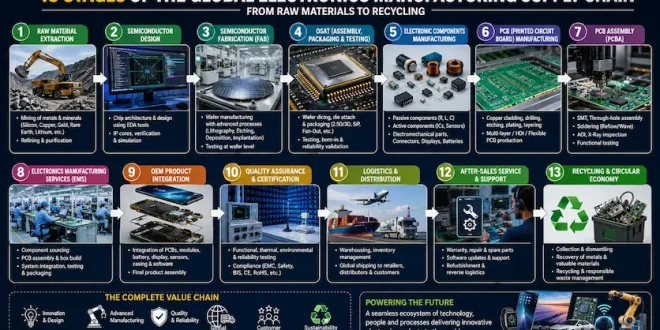
The 13 Stages of the Electronics Manufacturing Supply Chain
The journey from raw elements to a market-ready, recycled electronic device follows a strict 13-stage chronology.
[Raw Materials] ➔ [Semiconductor Design] ➔ [Wafer Fabrication] ➔ [OSAT] ➔
[Component Manufacturing] ➔ [PCB Manufacturing] ➔ [PCB Assembly] ➔ [EMS] ➔
[OEM Product Mfg] ➔ [Testing & Certification] ➔ [Logistics] ➔ [After-Sales] ➔ [Recycling]
1. Raw Materials
Every device begins with raw materials sourced from chemical and mining industries. This includes silicon for wafers, copper for traces, gold/silver for high-reliability contacts, and tin for soldering. Next-generation power electronics increasingly lean on Gallium Nitride (GaN) and Silicon Carbide (SiC), while EV batteries demand high-grade lithium, cobalt, and nickel.
2. Semiconductor Design
Before physical execution, engineers architect integrated circuits using specialized Electronic Design Automation (EDA) software. These chips are custom-built for smartphones, data centers, AI workloads, and automotive systems. India has long excelled as a primary design hub, hosting major multinational R&D centers.
3. Semiconductor Wafer Fabrication
Once designed, integrated circuits are manufactured on silicon wafers. Done inside ultra-clean environments where the slightest microscopic dust particle ruins production, fabrication processes include photolithography, chemical deposition, plasma etching, and ion implantation. Massive modern infrastructure leaps, such as the Tata Semiconductor Plant in Dholera, are shifting commercial fabrication from a dream into active production.
4. OSAT (Assembly, Packaging & Testing)
Outsourced Semiconductor Assembly and Testing (OSAT) units dice wafers into individual dies, package them, and verify reliability. As traditional silicon limits approach, advanced packaging technologies—like 2.5D/3D packaging, chiplet architectures, System-in-Package (SiP), and Fan-Out Wafer-Level Packaging (FOWLP)—play a definitive role in enhancing device performance and thermal efficiency. Strategic partnerships like the Tata-ASML Semiconductor Partnership act as anchors to secure these back-end capabilities.
5. Electronic Components Manufacturing
This phase produces the thousands of discrete parts making up a device:
-
Passive: Capacitors, resistors, and inductors.
-
Active: Microcontrollers, sensors, memory chips, and power management ICs.
-
Electromechanical: Connectors, switches, relays, and cooling systems.
-
Displays & Energy: OLED/MicroLED panels, rechargeable batteries, and Battery Management Systems (BMS).
To safeguard this stage against supply shocks, policy expansions like the Rare Earth Permanent Magnet Scheme provide heavy sales-linked incentives and capital subsidies to build crucial domestic component foundations.
6. Printed Circuit Board (PCB) Manufacturing
The PCB provides the mechanical framework and electrical paths connecting components. Manufacturing involves copper cladding, CNC drilling, imaging, etching, electroplating, and electrical validation. Technologies span single/double-layer boards to complex multi-layer, High-Density Interconnect (HDI), flexible, and rigid-flex designs.
7. PCB Assembly (PCBA)
Automated assembly lines deploy advanced robotics and machine vision to accurately place parts on the raw board. High-throughput lines leverage Surface Mount Technology (SMT), through-hole assembly, pick-and-place automation, and reflow/wave soldering. Quality checks rely on Automated Optical Inspection (AOI) and X-ray inspection.
8. Electronics Manufacturing Services (EMS)
EMS providers act as contract manufacturers for global brands. Rather than owning the final product IP, they optimize cost and scaling by managing component procurement, supply chain logisitics, PCB assembly, box-build integration, and initial product testing.
9. OEM Product Manufacturing
Original Equipment Manufacturers (OEMs) handle the final physical convergence. They combine the populated circuit boards, structural enclosures, displays, user interfaces, batteries, and operating software into consumer-ready form factors, transforming sub-assemblies into laptops, smartphones, or medical devices.
10. Quality Assurance and Certification
Before shipping to consumers, hardware undergoes extensive testing to prove field reliability and regulatory compliance. Procedures include thermal performance testing, environmental stress testing, and strict Electromagnetic Compatibility (EMC) and Electromagnetic Interference (EMI) evaluations.
11. Logistics and Global Distribution
Finished products move through intricate multi-modal logistics pathways, spanning secure warehousing, regional distribution hubs, international export terminals, and automated e-commerce fulfillment lines to balance global demand.
12. After-Sales Services
Device lifecycle management extends well past the initial purchase. Key services include warranty fulfillment, authorized product repairs, spare parts inventory management, continuous software/firmware patches, and hardware refurbishment.
13. Recycling and Circular Economy
Sustainability practices require formal electronics recycling networks. End-of-life units undergo processing to reclaim valuable precious metals (gold, silver, copper) and rare earth magnets, preventing environmental waste while feeding clean raw materials back to Stage 1.
Smart Factory Innovations
The modern electronics manufacturing floor is highly digitized, relying on five core pillars:
-
Industrial AI: Utilized for real-time, predictive quality control and optimizing cycle time.
-
Advanced Automation: High-speed pick-and-place systems paired with continuous machine vision inspection to catch microscopic assembly faults.
-
Digital Twins: Virtual replicas of lines used to stress-test workflows and simulate changes prior to physical updates.
-
IoT Analytics: Interconnected sensors that continuously log equipment health parameters to avoid manufacturing downtime.
-
Cloud Tracking: Cloud-based platforms providing instantaneous transparency into deep-tier supply dependencies.
India’s Dynamic Shift in the Supply Chain
Driven by Production-Linked Incentive (PLI) schemes and dedicated electronic manufacturing clusters, India is swiftly converting its historic strength in semiconductor design into broad hardware execution. By backing critical component manufacturing and setting up major industrial zones, the nation is actively resolving dependencies such as the Semiconductor Bottleneck in Defence Drones. This shift is positioning local infrastructure to support high-tech demands across consumer electronics, EV automotive sub-assemblies, medical electronics, and global hardware exports.
Frequently Asked Questions (FAQ)
What is the primary difference between PCB Manufacturing and PCB Assembly (PCBA)?
PCB Manufacturing is the raw fabrication phase where the composite, multi-layered insulation board is drilled, etched with copper pathways, and plated. PCB Assembly (PCBA) is the subsequent process where electronic components (like capacitors, resistors, and integrated circuits) are physically soldered onto that fabricated board.
Why is OSAT becoming more critical than traditional chip scaling?
As traditional silicon transistors approach physical limits, traditional scaling has slowed. OSAT and advanced packaging (like 3D chiplets) allow separate, specialized smaller chips to be tightly linked together in a single compact package, boosting processing speed and efficiency without relying entirely on smaller node geometry.
How do PLI schemes impact the electronics manufacturing ecosystem?
Production-Linked Incentive (PLI) schemes offer direct cash or tax incentives based on incremental sales scaling. This reduces the risk burden on local companies, offsets massive upfront capital costs, and draws international technology joint ventures to build high-tech factories domestically.
Disclaimer
The information provided in this article is for educational and informational purposes only. While every effort has been made to ensure the accuracy and reliability of industrial timelines and policy details as of 2026, readers should consult official ministry updates and corporate press releases for exact investment figures and ongoing project milestones.