

New Delhi. Wednesday, 15 July 2026
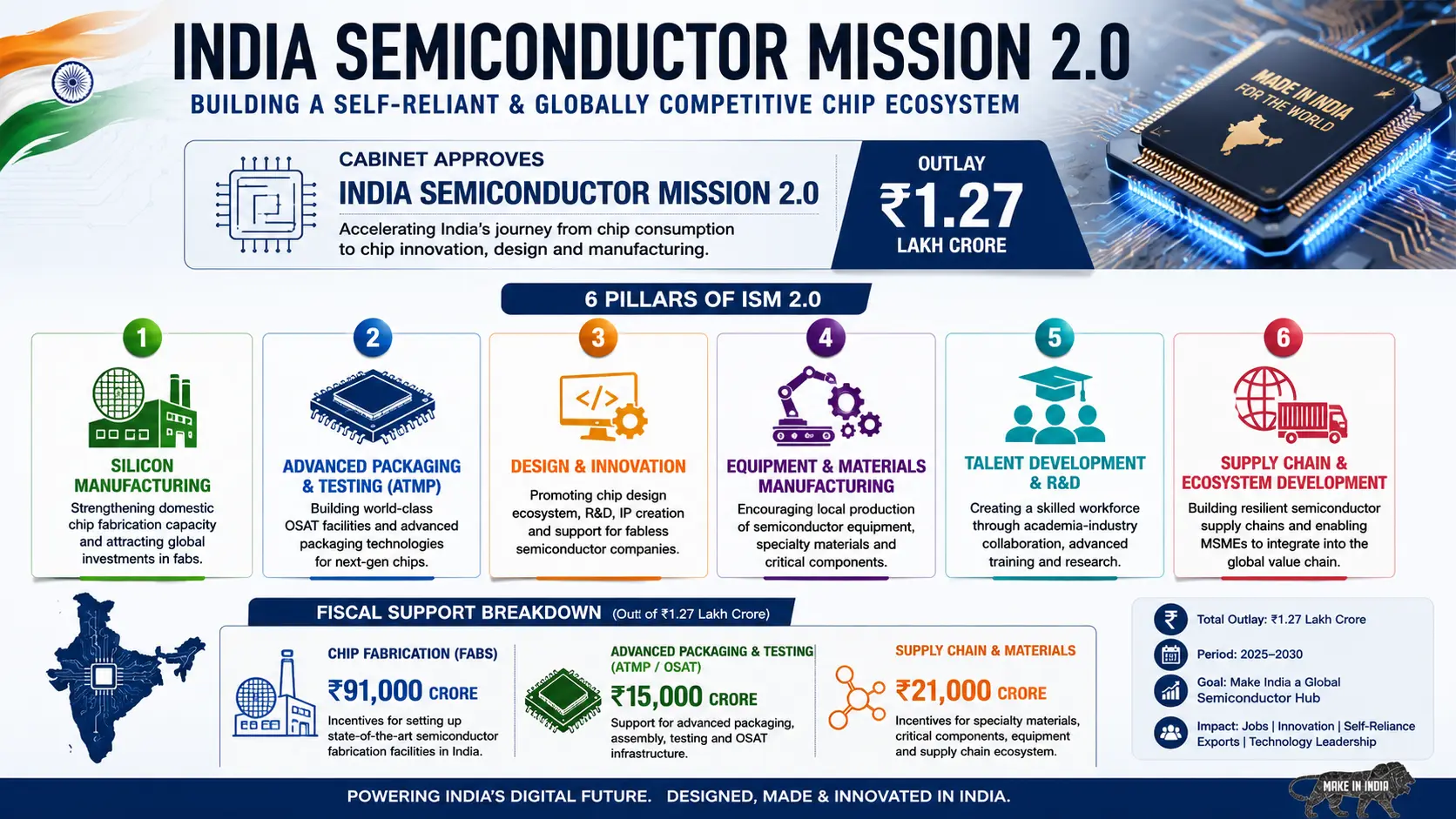
In a historic move to secure technological sovereignty and firmly integrate into the global electronics supply network, the Union Cabinet, chaired by Prime Minister Narendra Modi, officially approved India Semiconductor Mission (ISM) 2.0. Carrying a massive financial layout of ₹1.27 lakh crore ($15.2 billion USD equivalent), this expanded phase transitions India from a downstream manufacturing destination into an end-to-end global semiconductor ecosystem.
The policy intervention expands the original ISM 1.0 architecture into a robust, 12-year blueprint designed to insulate India from global supply chain shocks. It explicitly covers everything from foundational chip design and raw material processing to high-end silicon fabrication and advanced packaging.
According to Union IT Minister Ashwini Vaishnaw, the comprehensive program is projected to catalyze over ₹4 lakh crore in fresh investments, generate ₹2 lakh crore in localized domestic production, and drive ₹1 lakh crore in exports.
The Six Strategic Pillars of Semicon India 2.0
Unlike the inaugural scheme that focused heavily on attracting high-capital mega-fabs, ISM 2.0 tackles the entire chip-making value chain through six dedicated, specialized pillars:
| Pillar | Focus Area | Government Fiscal Support / Incentive Structure |
| 1. Chip Design | Commercial & Strategic IP Creation | Grants, equity co-investment, or royalty-based funding for domestic chips. |
| 2. Supply Chain | Tools, Gases, Chemicals & Raw Materials | 30% financial incentive for localized equipment and critical inputs. |
| 3. Core Fabrication | Silicon, Display & Compound Fabs | 40% fiscal support for Silicon Fabs; 35% for Display & Compound Fabs. |
| 4. Packaging | ATMP, OSAT & Advanced Node Integration | 35% incentive for Advanced Packaging; 25% for conventional ATMP/OSAT. |
| 5. Advanced R&D | 3nm/2nm Technology Roadmaps | Up to 75% combined funding from Central and State governments. |
| 6. Talent Pipeline | Cleanroom and EDA Tool Education | Up to 75% institutional assistance across 315+ universities. |
Rectifying Supply Chain Vulnerabilities
The multi-year extension to a 12-year runtime offers long-term policy predictability that leading multinational foundries demand before committing capital. During ISM 1.0, the government successfully sanctioned 12 massive projects—anchored by pioneers like Tata Electronics and Micron. However, the global landscape highlighted that manufacturing facilities mean very little if the underlying raw chemicals, specialized gases, and design licenses remain vulnerable to international borders.
By funding midstream supplies—including gases, high-purity chemicals, and minerals—ISM 2.0 directly links with other key supply chain security programs. This includes strategic bilateral treaties like the India Australia CECA 2026 for critical battery minerals, and the India REPM Manufacturing Scheme designed to secure localized rare-earth components for advanced automation.
Igniting High-Tech Jobs and Deep-Tech Startups
Semiconductor fabrication is highly knowledge-intensive. The revamped mission acts as a catalyst for high-skilled employment, generating thousands of jobs spanning VLSI design, cleanroom systems engineering, and advanced precision testing.
Furthermore, the design-linked incentives are explicitly tuned to support fabless startups developing indigenous architectures—such as the open-source RISC-V-based DHRUV64 processors. This creates a complete domestic loop: Indian startups design the architecture, domestic fabs cast the silicon, and localized assembly lines package the finished modules for everything from automotive electronics to autonomous defense drones.
Frequently Asked Questions (FAQ)
What is the total financial outlay for India Semiconductor Mission 2.0?
The Union Cabinet has approved a total fiscal outlay of ₹1.27 lakh crore, a massive increase from the ₹76,000 crore designated under the first phase.
How long will the Semicon India 2.0 policy remain active?
The government has extended the program’s policy horizon from 5 years to a long-term 12-year window to give international tech giants stable policy certainty.
What are the primary target incentives for silicon fabrication?
ISM 2.0 provides 40% fiscal support for setting up mainstream Silicon Fabs and 35% support for display and specialized compound semiconductor units on a pari-passu basis.
How does this policy address raw material shortages?
Pillar 2 of the mission introduces a new 30% financial incentive specifically for companies manufacturing chip equipment, cleanroom chemicals, industrial gases, and microchip minerals locally.
Disclaimer: This article is prepared strictly for educational and informational purposes based on official Union Cabinet announcements and IT Ministry briefings from July 2026. Investors and corporate entities seeking to apply for fiscal benefits should consult the official operational guidelines published by the Ministry of Electronics and Information Technology (MeitY), Government of India.
