

New Delhi. Saturday, 18 July 2026
India’s trajectory in electronics manufacturing reached a defining milestone when the Production Linked Incentive for Large Scale Electronics Manufacturing (PLI-LSEM) officially concluded on March 31, 2026. While the PLI scheme successfully elevated the country to the world’s second-largest smartphone manufacturer by volume—and turned smartphones into the nation’s largest export category—it left structural challenges unresolved.
To bridge these gaps, the Union Cabinet, chaired by Prime Minister Narendra Modi, approved the Mobile Phone Manufacturing Scheme (MPMS) with a massive budgetary allocation of ₹62,500 crore. Running from FY 2026-27 through FY 2030-31, this next-generation policy explicitly aims to shift the country from a baseline electronic assembly workshop into a globally competitive powerhouse for product design, local component sourcing, and domestic intellectual property (IP) creation.
Why MPMS Replaces the PLI Framework
The original PLI scheme built scale, attracted global electronic manufacturing service (EMS) heavyweights, and generated robust factory-floor employment. However, the domestic value addition stagnated between 18% and 20%. Critical operations, component manufacturing, and design protocols remained anchored overseas.
India faced four distinct challenges at the end of the PLI tenure:
High dependency on imported structural components (e.g., PCBs, display panels, camera modules).
Minimal domestic R&D and negligible global technology patents held by Indian entities.
Absence of highly visible, globally competitive Indian smartphone brands.
An ecosystem specialized primarily in “screwdriver assembly” rather than deep localization.
The newly cleared MPMS directly restructures the financial incentives to target these specific structural deficits.
Direct Structural Breakdown: MPMS vs. PLI Scheme
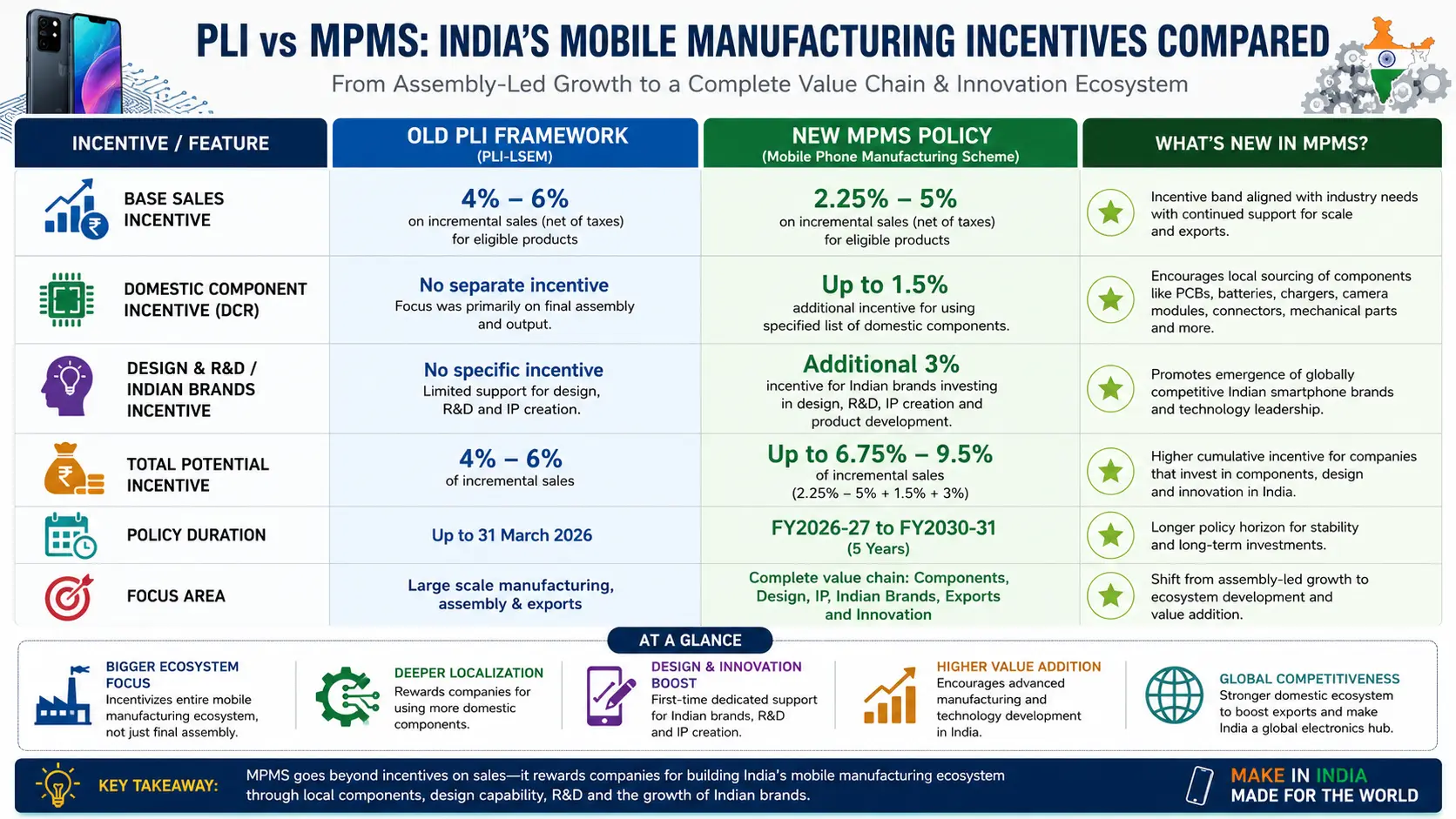
The core shift focuses on moving from volumetric assembly to structural supply chain depth. The policy utilizes tiered, stackable sub-incentives to push companies down the value chain:
| Feature | PLI Scheme (Concluded) | MPMS (FY 2026-27 to FY 2030-31) |
| Primary Objective | Increase global manufacturing output & volume | Build an integrated, resilient manufacturing ecosystem |
| Budget Outlay | Historic PLI allocations | ₹62,500 crore |
| Base Sales Incentive | Yes | 2.25% to 5% on eligible sales |
| Domestic Sourcing Bonus | Limited / Non-tiered | Additional up to 1.5% for local components |
| Design & IP Support | Minimal | Additional 3% for Indian-owned brands |
| Ecosystem Focus | Final product assembly & exports | Sub-components, design, IP, domestic brands |
Driving Deep Component Localization
Under the MPMS framework, manufacturers seeking maximum financial payouts must source highly complex components within the domestic boundary rather than importing semi-knocked-down (SKD) kits. The specialized supply chain development targets:
Printed Circuit Boards (PCBs) and component SMT integration
Camera modules and precision optical sub-assemblies
Display assemblies, mechanical housings, and structural parts
Lithium-ion battery packs and specialized charging circuits
Advanced semiconductor packaging (ATMP/OSAT) workflows
By localizing these sub-segments, the government projects cumulative production value to reach ₹39 lakh crore over the five-year block, alongside generating approximately 60,000 high-value direct engineering and production jobs.
The Push for Technological Sovereignty
The inclusion of an exclusive 3% additional incentive for Indian-owned brands investing in core R&D, product engineering, industrial design, and software stack integration signals a long-term goal. This buffer helps offset the historical cost disabilities local brands face against deeply entrenched global competitors. The objective is clear: ensuring Indian companies create globally relevant IP, capture greater domestic margins, and own the design behind the hardware.
FAQ (Frequently Asked Questions)
1. What is the total budget allocated for the new Mobile Phone Manufacturing Scheme (MPMS)?
The Union Cabinet has approved a dedicated budgetary outlay of ₹62,500 crore for the implementation of MPMS.
2. When does the MPMS take effect, and what is its total duration?
The scheme will be implemented over a five-year period, commencing in the fiscal year FY 2026-27 and running through FY 2030-31.
3. How do the additional incentives under MPMS work?
Beyond the standard base sales incentive of 2.25% to 5%, companies can earn an extra 1.5% incentive by sourcing key components locally. Furthermore, Indian-owned brands can claim an additional 3% incentive if they invest heavily in localized product design, R&D, and intellectual property creation.
4. What are the main differences between the old PLI scheme and the new MPMS?
While the old PLI scheme primarily incentivized production volume and smartphone assembly, MPMS introduces specific, stackable performance rewards for domestic component sourcing, localized software/hardware design, and the promotion of Indian technology brands.
For regional regulatory announcements and contextual reports on national manufacturing and trade updates, please visit the official English portal at Matribhumi Samachar.
Disclaimer
The information provided in this article is for educational and informational purposes only. Policy details, financial outlays, specific incentive structures, and projected growth figures are based on official government press releases, cabinet clearances, and industry projections valid as of July 2026. Readers should consult official notifications from the Ministry of Electronics and Information Technology (MeitY) for precise corporate eligibility frameworks.
