

Mumbai. Sunday, 19 July 2026
India’s aggressive transformation into a physical, deep-tech manufacturing powerhouse has crossed a critical threshold in 2026. Supported by the India Semiconductor Mission (ISM) and the newly active Semicon 2.0 initiative—backed by an expansive ₹1.27 lakh crore budget allocation—the nation is executing a major pivot to reduce its extreme reliance on foreign electronic imports.
While India boasts an established global dominance in chip design and engineering services, a granular audit of its overall supply chain reveals a striking contrast between rapid downstream assembly achievements and steep upstream infrastructure challenges.
The Mid-2026 Supply Chain Scorecard
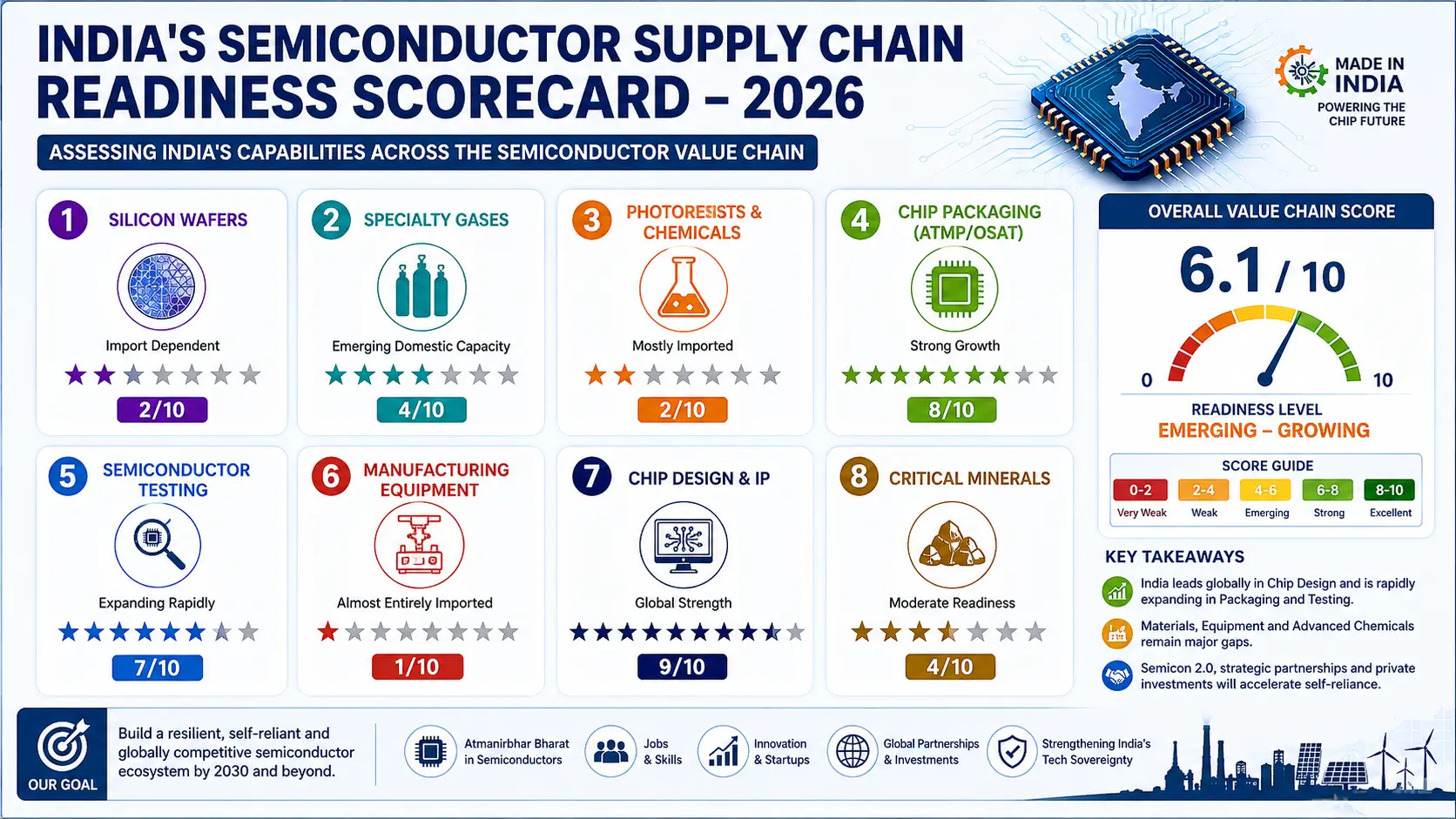
Evaluating India across the complete eight-segment chip ecosystem yields a current Overall Supply Chain Readiness Score of 6.1/10.
Chip Design & IP (9/10): Anchored by a massive engineering talent pool, local R&D centers, and expanding domestic design startups.
Chip Packaging / ATMP / OSAT (8/10): Catalyzed by multi-billion dollar domestic and foreign projects, transforming states like Gujarat and Assam into global packaging hubs.
Semiconductor Testing (7/10): Scaling seamlessly alongside downstream packaging facilities to cover wafer probing and reliability testing.
Specialty Gases (4/10): Backed by a massive domestic industrial gas sector, though semiconductor-grade refining infrastructure remains in early development stages.
Critical Minerals (4/10): Enhanced by strategic international partnerships—such as recent bilateral framework alignments with Australia—but localized high-purity processing capabilities are still evolving.
Silicon Wafers (2/10): Deep commercial scale has not yet materialized, leaving the country heavily reliant on imported raw wafers.
Photoresists & Semiconductor Chemicals (2/10): High-purity acids, solvents, and advanced photoresists are almost exclusively sourced from established partners like Japan and South Korea.
Manufacturing Equipment (1/10): Complex lithography systems, etching tools, and inspection hardware represent the highest technological hurdle, remaining completely import-dependent.
Breaking Down the Strategic Fault Lines
Downstream Momentum: Packaging and Design Dominance
India’s early victories are concentrated in downstream manufacturing and architecture design. Large-scale commercial projects managed by corporate giants like Tata Electronics and Micron have validated the region’s operational readiness. This downstream focus minimizes massive capital expenditure barriers while generating thousands of high-skilled industrial roles. Simultaneously, academic institutions and tech incubators have rolled out specialized semiconductor engineering pipelines to sustain these hubs.
Upstream Realities: The Materials and Machinery Choke Points
The critical challenge facing the India Semiconductor Mission 2.0 lies in upstream localization. A modern fabrication facility cannot function without extreme purity levels. Whether it is silicon crystal-growing technology or ultra-pure chemical agents, India’s domestic capabilities face steep lead times. Furthermore, semiconductor manufacturing equipment (such as advanced DUV or EUV lithography systems) is tightly held by global monopolies, making localized machinery fabrication a long-term goal rather than an immediate milestone.
What Lies Ahead for Semicon 2.0?
Semicon 2.0 shifts focus from initial ecosystem creation toward ecosystem consolidation. To pull its 6.1/10 readiness score higher before the end of the decade, the government is leaning heavily into deep-tech chemical purification, international resource alliances for mineral supply chains, and design-linked incentives. India is not looking to replace established global microchip centers overnight; rather, it aims to build an indispensable, resilient niche that secures national tech sovereignty while supplementing the global supply chain.
Frequently Asked Questions (FAQ)
Q1: What is the main objective of India’s Semicon 2.0 program?
A1: With a financial layout of ₹1.27 lakh crore, Semicon 2.0 aims to scale up the domestic chip manufacturing value chain. It expands on initial policies by actively subsidizing chip packaging (ATMP/OSAT), localizing high-purity manufacturing materials, supporting hardware R&D, and expanding chip design expertise.
Q2: Why does India score so low in semiconductor manufacturing equipment?
A2: Advanced chip fabrication relies on specialized lithography and etching machinery that takes decades of high-end proprietary research to engineer. Currently, these machines are exclusively produced by a few international corporations, creating a high barrier to entry for any new country.
Q3: How are critical minerals being managed under the current strategy?
A3: India is focusing on international partnerships, strategic processing projects, and international mining frameworks (such as technology alliances with Australia) to lock in steady reserves of gallium, cobalt, and lithium.
Disclaimer: The information provided in this article reflects the programmatic status, public sector budgets, and supply chain metrics of the Indian semiconductor industry as of mid-2026. The technical data, scores, and policy frameworks are intended for informational and educational purposes.
For more exclusive technical and industrial analysis, explore updates from the frontline of India’s manufacturing expansion at Matribhumi Samachar English.
