

New Delhi. Saturday, 18 July 2026
India’s aggressive push to transition from a software outsourcing destination into a physical, deep-tech manufacturing superpower has officially crossed a critical threshold. Under the structured backing of the India Semiconductor Mission (ISM), the newly active Semicon 2.0 programme, and robust Production-Linked Incentive (PLI) schemes, the country’s high-tech manufacturing landscape is experiencing a massive evolution. At the heart of this industrial paradigm shift is the precision manufacturing industry, which is rapidly scaling to meet micron-level accuracy demands across semiconductors, aerospace, electric vehicles (EVs), and medical technologies.
Why Precision Manufacturing Is Becoming More Important
Modern, high-value industries no longer operate on traditional tolerances. Advanced production lines require components engineered with strict quality standards to ensure flawless operation. As India expands its domestic manufacturing footprint, creating supply-chain harmony across high-torque EV traction motors, defense drone ecosystems, and commercial electronics, the need for hyper-accurate tooling is skyrocketing. Policy interventions and financial capital subsidies are heavily backing this transformation, driving local ecosystems to secure international quality certifications required to compete on the global stage.
Key Sectors Driving Growth
The rapid expansion of the precision engineering domain is structured across five major technological pillars:
1. Industrial Automation
To minimize operational overheads and boost throughput, manufacturing facilities are rapidly integrating automated workflows. Key high-growth components include:
CNC Machining Systems & Industrial Robots: The foundations of high-speed, repeatable component fabrication.
Vision Inspection Systems & AI-Powered Quality Control: Replacing manual checks with deep-learning algorithms to detect micro-flaws instantly.
Smart Manufacturing Software: Utilizing digital factory solutions to track real-time machine health and yield metrics.
2. Clean-Room Equipment
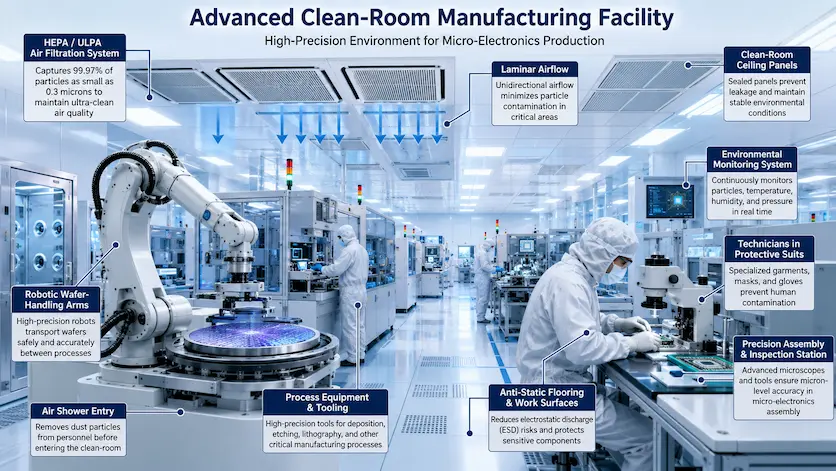
With the rollout of massive mega-fabs under the India Semiconductor Mission 2.0, creating dust-free environments is paramount. Even microscopic debris can ruin complex silicon architectures. The market is seeing high demand for:
HEPA and ULPA filtration systems paired with specialized HVAC equipment.
Clean-room panels, air showers, and contamination monitoring tools.
Process gas delivery networks and high-grade precision valves designed for chemical delivery.
3. Robotics
India’s industrial centers are scaling up deployment of advanced robotics. While heavy automotive assembly lines have long relied on traditional robotic arms, high-tech scaling has popularized Collaborative Robots (cobots). These flexible systems allow human-robot collaboration in medium-sized enterprises, boosting efficiency in electronics assembly, pharmaceutical sorting, and logistics automation.
4. Precision Engineering
High-value sub-assemblies depend on parts engineered down to the micron. Key manufacturing sectors include:
Tool & die manufacturing alongside custom mold development.
Industrial bearings and linear motion systems built to withstand high stress.
High-performance cutting tools and complex optical components for aerospace arrays.
5. Advanced Manufacturing (Industry 4.0)
Digital technologies are permanently reshaping factory floors:
Digital Twins: Virtual replicas of assembly lines that simulate production physics before physical execution.
Industrial IoT (IIoT) & Predictive Maintenance: Smart sensors that alert operators to machine fatigue before a breakdown occurs.
Additive Manufacturing (3D Printing): Enabling rapid prototyping of lightweight, complex geometries.
Core Industries Generating Massive Demand
The precision engineering ecosystem is feeling a strong pull from five primary commercial vertices:
Semiconductor Manufacturing: Requiring specialized wafer-handling automation, integrated precision robotics, ultra-clean piping, and chemical distribution systems.
Electronics Manufacturing: Fueled by massive investments in local smartphone and hardware supply chains, creating an immediate need for Surface Mount Technology (SMT) production lines and micro-assembly machinery.
Electric Vehicles (EVs): Driven by strategic material-sourcing initiatives like the Rare Earth Permanent Magnet (REPM) Scheme, localized EV manufacturing is accelerating the production of high-torque traction motors, battery assembly automation, and thermal management architectures.
Aerospace & Defence: Bolstered by national self-reliance initiatives and deep-tech drone manufacturing programs, demanding high-precision tooling, titanium machining, composite structures, and military-grade inspection rigs.
Medical Devices: Depending heavily on micro-manufacturing technologies, laser cutting, and sterile production systems for life-saving medical equipment.
Structural Opportunities for Indian MSMEs
Micro, Small, and Medium Enterprises (MSMEs) are optimally positioned to benefit from localization efforts aimed at reducing foreign import dependence. By upgrading their technological baselines, domestic MSMEs can integrate directly into global supply chains as key providers of:
Custom machine parts and precision components.
Specialized tooling solutions.
Localized robotics integration and maintenance services.
Quality inspection software and industrial edge computing tools.
Primary Challenges on the Horizon
Despite an optimistic outlook, the domestic precision manufacturing sector must navigate several structural hurdles to fully unlock its potential:
High Upfront Expenditures: Designing clean-rooms and purchasing advanced multi-axis CNC machines requires massive initial capital.
Skilled Workforce Shortage: A critical gap remains in specialized powder-metallurgy, complex chip design, and high-end robotic programming expertise.
Import Reliance: The ecosystem still faces gaps in the domestic production of high-end machine tools and core semiconductor components.
Global Competition: Competing efficiently against long-established, highly optimized manufacturing hubs overseas.
The Long-Term Outlook: India’s precision manufacturing sector is entering a era of sustained, high-value expansion. By continuously investing in advanced Industry 4.0 technology, expanding human talent infrastructure, and taking advantage of supportive governmental schemes, domestic companies will secure a highly competitive, indispensable position within the global industrial matrix.
Frequently Asked Questions (FAQ)
What is driving the sudden growth in India’s precision manufacturing sector?
The surge is primarily driven by national pushes into high-tech ecosystems like semiconductor fabrication, domestic EV motor manufacturing, defense aerospace self-reliance, and advanced electronics assembly under policies like Semicon 2.0 and active PLI frameworks.
Why are clean-room environments so vital for precision industries?
In fields like semiconductor fabrication and micro-electronics, even a single microscopic dust particle can disrupt circuit pathways and destroy product yields. Clean-rooms utilize advanced HEPA/ULPA filtration to guarantee contamination-free production zones.
How can Indian MSMEs participate in this technological phase?
MSMEs can leverage government localization goals to become vital tier-2 and tier-3 suppliers, offering custom precision components, tooling solutions, specialized industrial software, and third-party robotic integration services.
Disclaimer: This article is prepared strictly for educational and informational purposes. The insights regarding India’s industrial landscape, manufacturing frameworks, and high-tech policies are based on publicly available industrial reports and ministerial notifications up to mid-2026.
Relevant Links from Matribhumi Samachar:
To learn more about India’s overarching high-tech semiconductor ambitions, read about the India Semiconductor Mission 2.0 Ecosystem Shift.
Understand the critical materials backing local electric vehicle and robotics manufacturing via the India Rare Earth Permanent Magnet (REPM) Manufacturing Initiative.
Explore how localized manufacturing is transforming strategic equipment production in The Rise of Indigenous Defence Ecosystems.
