

Mumbai. Sunday, 19 July 2026
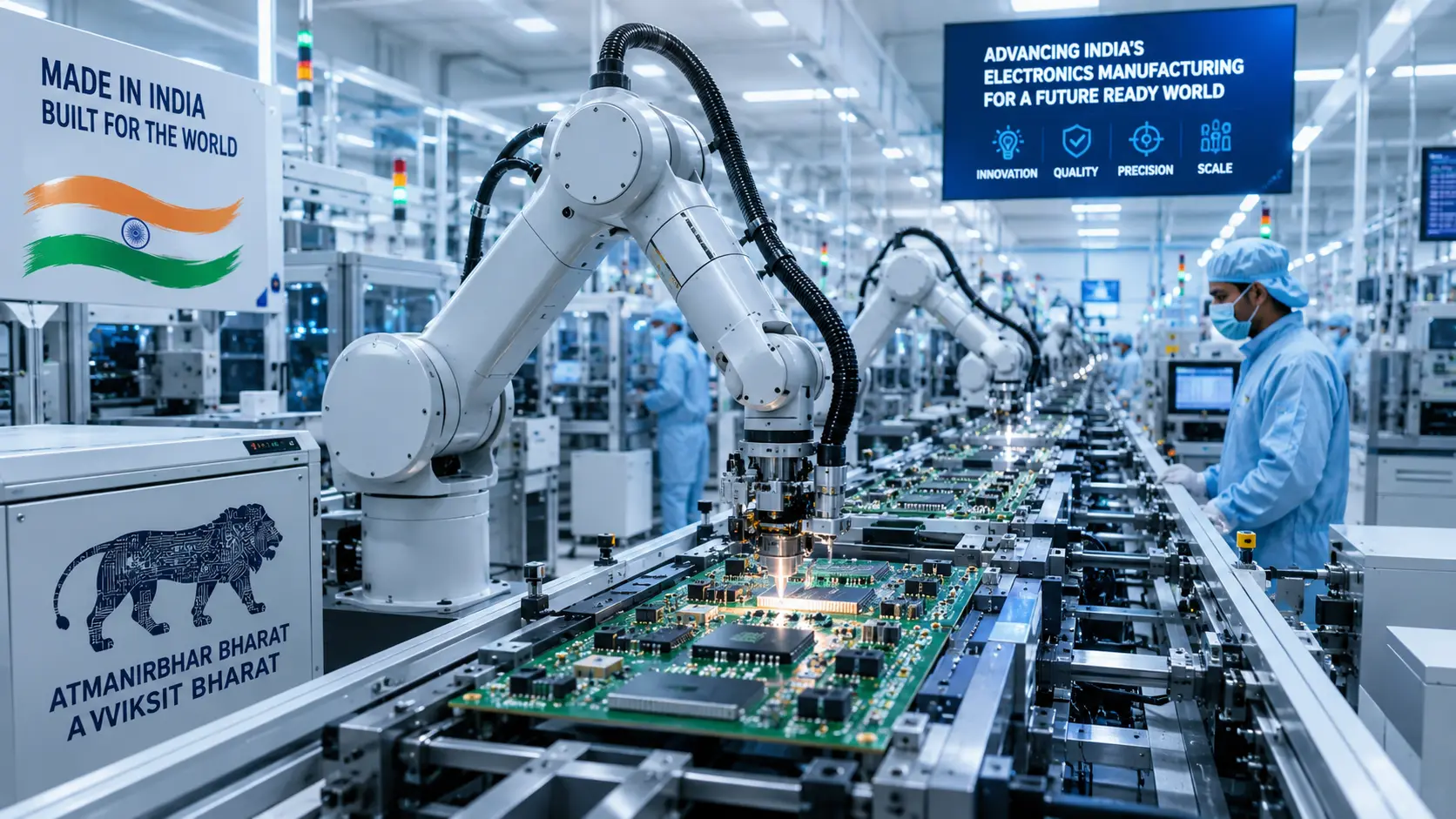
India’s electronics manufacturing trajectory has reached a defining milestone. Following the formal conclusion of the landmark Production Linked Incentive for Large Scale Electronics Manufacturing (PLI-LSEM), which firmly cemented the nation’s position as the world’s second-largest smartphone manufacturer by volume, a structural transformation is underway.
The Union Cabinet’s introduction of the massive ₹62,500 crore Mobile Phone Manufacturing Scheme (MPMS) signals a strategic shift: moving India from simple physical “assembly” to deep-tech “design” and IP creation. Policymakers, backed by the India Semiconductor Mission (ISM) and the newly active Semicon 2.0 programme, are aggressively expanding capabilities into high-margin, strategically vital segments. By diversifying into medical devices, defense systems, automotive electronics, telecom infrastructure, and industrial automation, India aims to permanently insulate its domestic industries from volatile global shocks and secure its technological economic sovereignty.
The 5 Strategic Pillars Reshaping India’s High-Tech Landscape
1. Medical Devices Electronics
Healthcare technology has emerged as one of India’s fastest-growing electronics frontiers. Historically dependent on international imports for precision diagnostic gear, domestic facilities are shifting toward producing:
Advanced patient monitoring systems and smart hospital infrastructure.
Diagnostic imaging equipment and portable, ruggedized ECG and ultrasound units suited for rural tier-2 and tier-3 medical centers.
Clinical-grade wearable health monitors.
The Catalyst: Expanding localized digital health infrastructure coupled with rising demands for affordable diagnostics across emerging economies is opening robust export opportunities.
2. Defence Electronics
Directly tied to national security, the indigenization of defense systems is paramount to ensuring hardware-level technology sovereignty. The sector produces highly specialized components:
Radar arrays, electronic warfare (EW) equipment, and secure communication systems.
Military sensors, missile guidance computers, and advanced drone electronics.
The Catalyst: Under rigorous initiatives like Atmanirbhar Bharat and the iDEX framework, domestic firms have first right of refusal for state tenders, reducing critical reliance on foreign original equipment manufacturers (OEMs).
3. Automotive Electronics & The EV Revolution
Modern mobility relies heavily on silicon rather than purely mechanical systems. With India’s electric mobility transition accelerating, automotive electronics are projected to become one of the largest captive consumers of domestically manufactured chips.
Electric vehicle (EV) power electronics and intelligent Battery Management Systems (BMS).
Advanced Driver Assistance Systems (ADAS), connected vehicle telematics, and digital instrument clusters.
The Catalyst: Strategic trade alignments, such as the comprehensive India-Australia CECA, ensure streamlined domestic access to critical mineral reserves like Lithium, Cobalt, and Nickel—the core foundation for localized EV battery arrays.
4. Telecom Hardware
Building secure, localized hardware for critical communication networks prevents digital espionage and strengthens cross-border network integrity. Production lines are actively scaling:
5G macro cells and early-stage future 6G radio equipment infrastructure.
Enterprise networking equipment, fiber-optic networking systems, and carrier-grade switches.
The Catalyst: Massive corporate network updates, surging broadband penetration, and strict security screenings for infrastructure components guarantee long-term captive domestic demand.
5. Industrial Electronics & Industry 4.0
Smart manufacturing has shifted factories from standard mechanical assembly lines into self-thinking, hyper-efficient digital ecosystems. This sector offers substantially higher margins and domestic value addition (DVA) than standard consumer electronics.
Programmable Logic Controllers (PLCs) and robotic controllers.
Industrial IoT (IIoT) devices, machine vision inspection modules, and smart sensors.
The Catalyst: The broad modernization of automated logistics, process industries, warehousing, and energy grids across India.
Ecosystem Growth Enablers vs. Remaining Bottlenecks
The structural paradigm shift from software outsourcing hub to a physical deep-tech manufacturing superpower rests on addressing key supply chain links.
[Semiconductor Fabs (Semicon 2.0)] ──> [Component Localization] ──> [Global Certification]
──> [High-Value Exports]
The Growth Enablers
Semiconductor Ecosystem Integration: Active rollouts under Semicon 2.0 are stabilizing localized chip availability.
Design-Linked Incentives (DLI): Promoting local engineering talent to retain and create domestic Intellectual Property (IP).
Regional Electronics Clusters: State-level developments, such as the strategic symbiosis of Silicon and AI clusters within northern manufacturing corridors, are establishing comprehensive production zones.
The Challenges to Overcome
Baseline Component Reliance: A lingering structural dependence on imported passive components (e.g., high-end resistors, multi-layer PCBs, capacitors).
Testing Infrastructure: A critical need to expand domestic, internationally accredited laboratories for specialized testing and aerospace/automotive certification.
Capital Intensity: High upfront investment requirements for advanced manufacturing machinery and long gestation periods for commercial fabrication lines.
Frequently Asked Questions (FAQ)
Q1: Why is India moving its electronics focus away from smartphones?
A: India is not abandoning smartphones; rather, it is diversifying its portfolio. While smartphone manufacturing established initial high-volume assembly pipelines, shifting toward sectors like defense, medical, and industrial electronics yields higher profit margins, creates high-skilled engineering jobs, and builds long-term economic resilience against market fluctuations.
Q2: What role does the India Semiconductor Mission (ISM) play in this expansion?
A: The ISM and its subsequent programs provide the financial subvention, policy guidelines, and structural backing required to establish domestic silicon fabrication units and packaging facilities. This ensures that high-value electronics sectors have a steady, secure supply of localized microcontrollers and power chips.
Q3: How do international trade pacts like CECA assist domestic automotive manufacturing?
A: Agreements like the India-Australia CECA grant Indian manufacturers direct, tariff-reduced access to critical minerals like lithium and cobalt. These are vital for manufacturing localized EV batteries and automotive-grade chips, dropping overall overhead production costs.
Q4: What is the main bottleneck facing India’s defense electronics indigenization?
A: The primary hurdle is the semiconductor bottleneck. While local assembly and system integration have scaled up rapidly, high-end Guidance and Navigation Units (GNUs) and specialized radar transceiver chips still rely significantly on international silicon foundries.
Related Coverage and Regulatory Blueprints
To understand policy transitions shifting India from assembly to local IP creation, see Beyond Assembly: How the MPMS Shifts India from ‘Made’ to ‘Designed’ in India.
Explore how state-level deep-tech infrastructure is scaling up via the Uttar Pradesh High-Tech Manufacturing Ecosystem Analysis.
Read more on localized component strategies in The Blueprint of Modern Tech: Mapping the Complete Electronics Manufacturing Supply Chain.
Review international critical mineral integrations via India Australia CECA 2026: Ushering a New Era in Trade, Tech, and Green Energy.
Disclaimer: The information provided in this article regarding policy frameworks, budgetary allocations, and market trajectories is intended for informational and analytical purposes only. While every effort has been made to maintain factual accuracy using contemporary industrial metrics, readers are advised to consult official gazette notifications from the Ministry of Electronics and Information Technology (MeitY) and related departments for definitive statutory guidelines.
