 Matribhumi Samachar English


Mumbai. Friday, 24 July 2026
Over the last decade, India’s electronics manufacturing landscape has experienced a monumental transformation. What was once a nation heavily reliant on imported finished goods has evolved into one of the world’s fastest-growing electronics manufacturing hubs. From smartphones and laptops to telecom infrastructure and consumer appliances, local assembly lines are humming at unprecedented speeds.
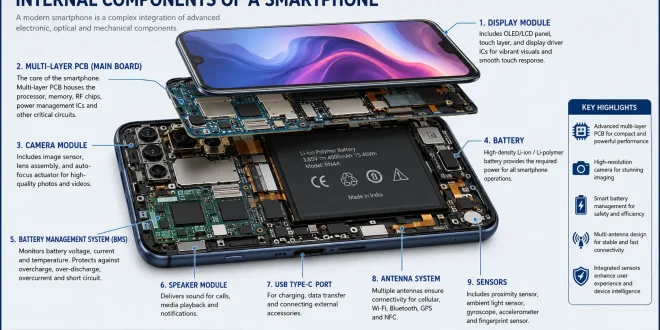
However, peeling back the outer casing of a “Made in India” smartphone reveals a critical gap: up to 80% of the internal value still comes from imported parts. Printed Circuit Boards (PCBs), display modules, camera sensors, and micro-connectors are overwhelmingly sourced from overseas suppliers.
To bridge this structural gap, the Ministry of Electronics and Information Technology (MeitY) launched the landmark Electronics Components Manufacturing Scheme (ECMS). Designed to build a deep, self-sustaining component ecosystem, ECMS is paving the way for true technological self-reliance.
Why India Needs ECMS Right Now
While final assembly creates immediate assembly-line jobs, real economic leverage and high profit margins sit deeper in the value chain. Right now, domestic value addition in finished products remains modest:
-
Smartphones: ~18% – 22% local value addition
-
Consumer Electronics: ~20% – 30% local value addition
-
Telecom Equipment: ~25% – 35% local value addition
Relying on imported sub-assemblies exposes manufacturers to foreign exchange risks, extended shipping timelines, and global supply chain disruptions. ECMS targets these exact pain points by incentivizing companies to manufacture bare components, sub-assemblies, and industrial machinery right here in India.
Core Objectives: Beyond Simple Assembly
The vision behind ECMS goes far beyond assembling pre-made parts. It seeks to re-architect India’s industrial base through several key goals:
-
Slashing Import Bills: Replacing imported parts with locally manufactured alternatives to protect national foreign reserves.
-
Expanding Domestic Value Addition: Raising local component integration across consumer devices and industrial hardware.
-
Integrating with Global Value Chains (GVCs): Connecting Indian component makers directly with multinational original equipment manufacturers (OEMs).
-
Empowering MSMEs: Creating a robust Tier-2 and Tier-3 supplier network specializing in precision tooling, plastic moulding, and metal stamping.
-
Generative Job Creation: Generating over 1.4 lakh direct engineering and technical jobs, alongside millions of indirect opportunities across support industries.
What Components Are Covered Under ECMS?
The scheme targets an expansive list of high-value components that make up nearly 90% of a typical device’s Bill of Materials (BoM):
-
Printed Circuit Boards (PCBs): High-Density Interconnect (HDI), multi-layer, and flexible boards.
-
Displays & Cameras: LCD and OLED display modules, camera sensor modules, and optical drivers.
-
Passive & Electromechanical Parts: Capacitors, resistors, inductors, micro-switches, relays, and heavy-duty connectors.
-
Power & Motion: Lithium-ion cells for digital devices, Battery Management Systems (BMS), power adapters, and cooling modules.
-
Sensors & Precision Mechanics: MEMS temperature and pressure sensors, precision metal enclosures, and heat sinks.
Latest Progress and Budget Highlights
Investor response to ECMS has exceeded initial expectations.
-
Budget Commitment Boost: Building on this momentum, the Union Budget enhanced the ECMS fiscal outlay to ₹40,000 crore.
-
Massive Investment Interest: The scheme has attracted over ₹1.15 lakh crore in investment proposals—nearly double the initial government baseline.
-
Production Projections: Projected component output over the six-year tenure is expected to surpass ₹10.34 lakh crore.
-
Synergy with ISM 2.0: ECMS acts as a crucial companion to the India Semiconductor Mission (ISM) by supplying the essential substrates, testing equipment, and packaging materials required to convert bare chips into functional electronics.
Overcoming Structural Challenges Ahead
While momentum is strong, scaling high-tech component manufacturing involves significant operational hurdles:
-
Capital Expenditure: Precision machinery and cleanroom setups require large initial capital investments.
-
Technological Capability: Complex multi-layer PCBs and advanced sensors require technical expertise and intellectual property partnerships.
-
Upstream Raw Materials: Specialized chemicals, high-purity copper foils, and silicon wafers still rely on global supply lines.
-
Skilled Workforce Demand: The industry urgently requires trained process engineers, automation experts, and quality control specialists.
Related Coverage from Matribhumi Samachar
To explore deeper insights on tech, trade, and India’s evolving industrial ecosystem, check out these related pieces:
- Discover how critical raw materials drive high-tech hardware in India Australia CECA: Ushering a New Era in Trade, Tech, and Green Energy.
Frequently Asked Questions (FAQ)
What is the main objective of the Electronics Components Manufacturing Scheme (ECMS)?
The primary goal of ECMS is to build a self-reliant domestic ecosystem for producing electronic components and sub-assemblies in India. By shifting focus from simple assembly to component manufacturing, the scheme helps reduce import dependency and increase local value addition.
How does ECMS complement the Production Linked Incentive (PLI) schemes?
While PLI schemes focus on generating high-volume assembly of finished goods (like mobile phones and laptops), ECMS targets the internal components that go inside those devices. Together, they build a complete end-to-end manufacturing chain.
Who is eligible to apply for incentive support under ECMS?
Companies or Limited Liability Partnerships (LLPs) investing in greenfield or brownfield projects within designated component segments (such as bare PCBs, camera modules, sensors, or capital equipment) can apply through the official MeitY portal.
Disclaimer
This article is published for general educational and news information purposes only. Scheme outlays, eligibility guidelines, and financial projections are subject to policy updates issued by the Ministry of Electronics and Information Technology (MeitY), Government of India.