

Mumbai.
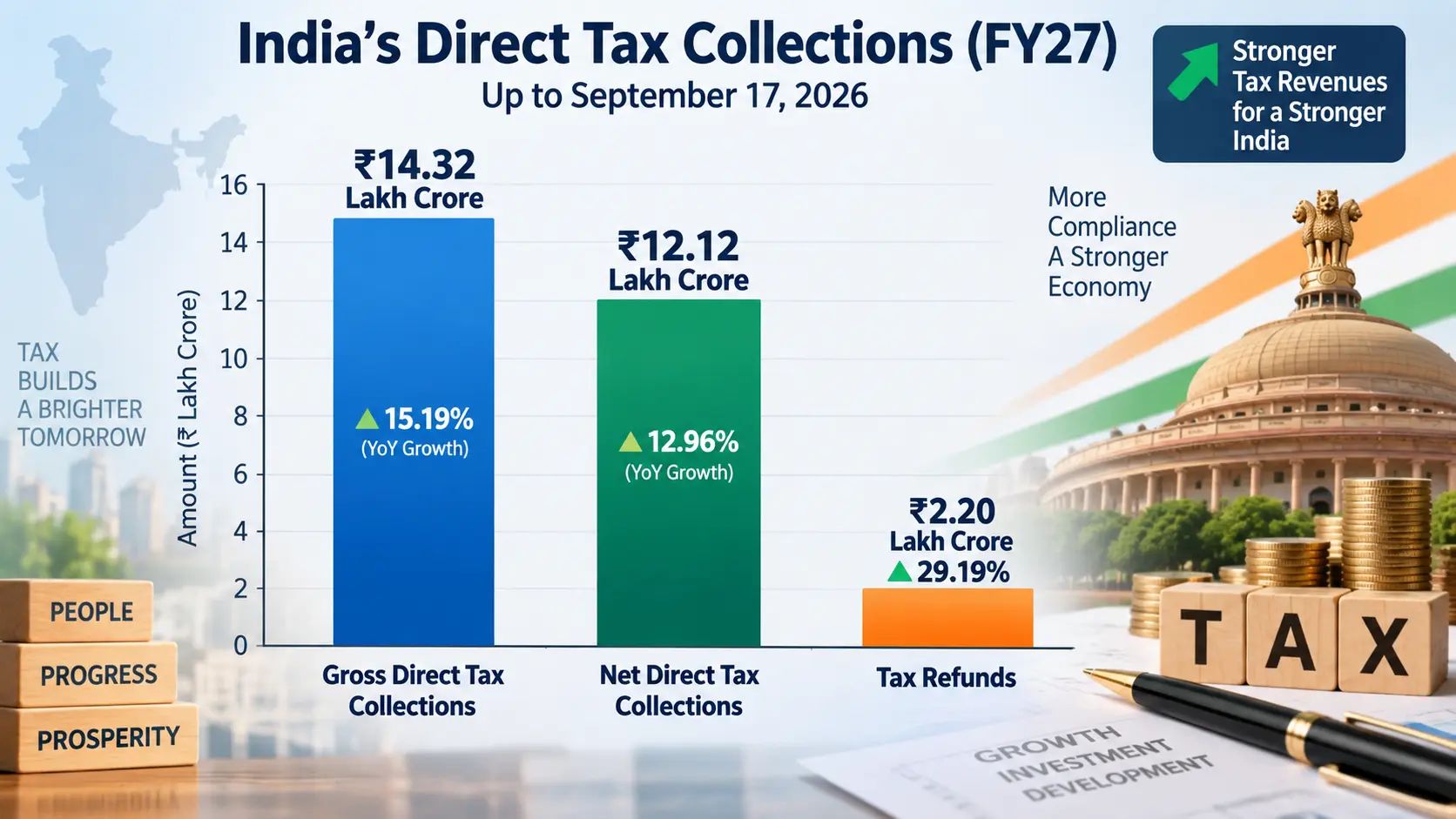
India’s net direct tax collections reached ₹12.12 lakh crore by September 17, 2026, registering a 12.96% year-on-year (YoY) growth compared to the ₹10.73 lakh crore collected during the corresponding period of FY26. Provisional data released for the financial year 2026–27 shows robust momentum in corporate tax, advance tax, and capital market receipts, balanced by a sharp rise in tax refunds.
Direct Tax Collection Snapshot (FY27 up to September 17)
| Fiscal Indicator | FY27 Collections | YoY Growth Rate |
| Net Direct Tax | ₹12.12 lakh crore | 12.96% |
| Gross Direct Tax | ₹14.32 lakh crore | 15.19% |
| Tax Refunds Issued | ₹2.20 lakh crore | 29.19% |
| Total Advance Tax | ₹5.22 lakh crore | 16.18% |
| — Corporate Advance Tax | ₹4.16 lakh crore | 18.09% |
| — Non-Corporate Advance Tax | ₹1.06 lakh crore | 9.24% |
| Net Corporate Tax | ₹5.56 lakh crore | ~19.50% |
| Securities Transaction Tax (STT) | ₹40,214 crore | ~52.90% |
Corporate Tax Emerges as Key Growth Engine
Net corporate tax collections jumped to approximately ₹5.56 lakh crore, up from ₹4.65 lakh crore in the corresponding period of FY26.
A major portion of this growth stems from strong corporate advance tax receipts, which surged 18.09% to ₹4.16 lakh crore. Advance tax payments—paid in scheduled installments throughout the financial year rather than after assessment—provide a real-time health check on corporate profitability and cash flow.
Advance Tax Growth Comparison (YoY):
├── Corporate Advance Tax    : [████████████████████] +18.09%
└── Non-Corporate Advance Tax: [██████████]           +9.24%
Why Net Collection Growth Trails Gross Growth
Gross direct tax collections increased 15.19% to ₹14.32 lakh crore. However, net collections settled at 12.96% due to a steep increase in tax refunds.
Refunds issued by the Income Tax Department rose 29.19% to ₹2.20 lakh crore. Far from signaling administrative weakness, higher refunds reflect faster, automated processing of legitimate taxpayer claims.
Capital Markets Drive 53% Surge in STT Receipts
Securities Transaction Tax (STT) collections recorded a massive jump, reaching ₹40,214 crore compared to ₹26,306 crore during the same timeframe last year. This ~53% YoY surge highlights expanding domestic equity participation, high trading volumes, and the structural impact of revised STT rates introduced in April 2026.
FY27 Budget Target Trajectory
The Union Budget set a total direct tax collection target of ₹26.97 lakh crore for FY27.
- Collected to date: ₹12.12 lakh crore
- Target achieved: ~45%
Because direct tax inflows are seasonal—peaking around the third and fourth advance tax deadlines in December and March—achieving 45% of the target by mid-September keeps the Central Government comfortably on track to meet its annual fiscal goals.
Related Coverage on Matribhumi Samachar
Frequently Asked Questions (FAQ)
What is the difference between gross and net direct tax collection?
Gross direct tax collection is the total revenue collected by the tax authority before issuing refunds. Net collection is the final revenue retained by the government after subtracting tax refunds paid out to taxpayers ($Net = Gross – Refunds$).
Why is corporate advance tax growth important?
Advance tax is paid in installments during the financial year based on estimated annual income. High growth in corporate advance tax (18.09% in FY27) indicates strong business profitability, revenue visibility, and robust economic activity.
How much direct tax revenue has the Indian government targeted for FY27?
The Union Budget set a direct tax revenue target of ₹26.97 lakh crore for FY27. As of September 17, 2026, the government has realized approximately 45% (₹12.12 lakh crore) of this target.
Disclaimer
This article is published for informational and educational purposes only, based on provisional fiscal data released for FY27 up to September 17, 2026. Readers and financial analysts should consult official notifications from the Income Tax Department and Ministry of Finance for formal reporting and updates.
