

Washington D.C.
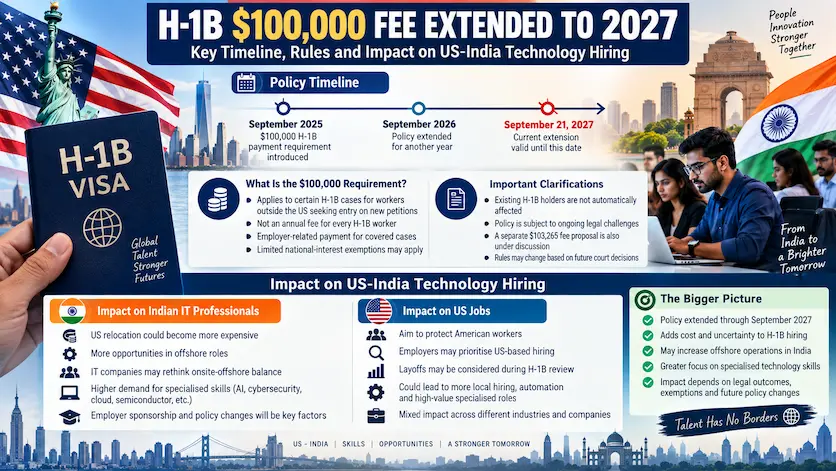
The US administration has officially extended its controversial $100,000 H-1B payment requirement until September 21, 2027. The decision keeps ongoing policy uncertainty alive for technology enterprises, staffing firms, and foreign professionals who rely heavily on the H-1B specialty occupation visa program.
The extension is accompanied by additional presidential actions ordering federal agencies—including the Department of Labor (DOL) and Department of Homeland Security (DHS)—to increase scrutiny on sponsoring employers that have carried out or planned US workforce layoffs.
+-----------------------------------------------------------------------------------+
|                            H-1B POLICY SNAPSHOT (2026-2027)                      |
+-----------------------------------------------------------------------------------+
| Policy Action       | Extension of $100,000 Payment Requirement                  |
| Target Expiry       | September 21, 2027                                        |
| Primary Coverage    | New petitions for workers outside the US (Consular)      |
| Exclusions          | Existing H-1B extensions inside US; F-1/OPT transitions  |
| Enforceability      | Subject to ongoing US Federal Court appeals               |
| Related Proposals   | $103,265 DHS cap-subject fee proposal & Wage-based lottery|
+-----------------------------------------------------------------------------------+
What Is the $100,000 H-1B Payment Requirement?
The $100,000 payment requirement applies to specific H-1B cases involving individuals who are outside the United States and seeking entry via covered new H-1B petitions.
- Not an Individual Worker Fee: It does not represent an annual blanket tax or individual fee that every H-1B professional pays out-of-pocket.
- Employer Deployment Cost: The policy functions as an additional employer-borne cost attached to initial petition filings and entry deployment.
- National-Interest Exemptions: The Secretary of Homeland Security retains discretionary authority to grant national-interest exemptions for specific individuals, critical companies, or key industrial sectors.
Key Implications for Indian IT Professionals & Global Staffing
Because Indian nationals historically account for over 70% of approved H-1B visas, any structural change to petition costs directly impacts domestic IT service giants (such as TCS, Infosys, Wipro, and HCLTech) and American tech multinationals operating in India.
              +-------------------------------------------------+
              |  $100,000 Entry Fee Policy Extended to 2027     |
              +------------------------+------------------------+
                                       |
        +------------------------------+------------------------------+
        |                                                             |
        v                                                             v
+-------------------------------+                             +-------------------------------+
|    US Onsite Operations       |                             |   Offshore & Global Staffing  |
+-------------------------------+                             +-------------------------------+
| • Higher cost to deploy       |                             | • Expansion of India GCCs     |
|   workers from abroad         |                             | • Offshore Development        |
| • Increased local US hiring   |                             |   Centres (ODC) priority      |
| • Focus on niche skills (AI,  |                             | • Remote global delivery and  |
|   Cybersecurity, Chips)       |                             |   automation integration      |
+-------------------------------+                             +-------------------------------+
1. Shift Toward Offshore Delivery & Global Capability Centres (GCCs)
Deploying technology staff directly from India to client sites in the US carries a significantly higher financial barrier. To mitigate overhead, global enterprises are accelerating investments in Offshore Development Centres (ODCs) and expanding Global Capability Centres (GCCs) across Indian tech hubs like Bengaluru, Hyderabad, and Pune.
2. Evolution of IT Staffing Models
Indian IT service organizations are adapting their traditional hybrid staffing model (onsite-offshore ratio) by leveraging:
- Expanded Offshore Teams: Handling core software development, engineering, and maintenance remotely.
- Local US Talent Acquisition: Scaling up direct hiring of US citizens, green card holders, and local university graduates.
- Advanced Automation & AI: Replacing lower-tier tech support or routine development roles with automated workflows.
- Specialized Onsite Roles: Reserving US H-1B deployment strictly for high-value niche roles in Artificial Intelligence, Cloud Architecture, Cybersecurity, and Semiconductor Engineering.
What Existing H-1B Holders and Students Need to Know
A crucial operational distinction separates workers currently in the US from new offshore applicants:
- Existing H-1B Holders: Foreign professionals already living in the United States on valid H-1B status who file extensions, employer changes (transfers), or amendments are not subject to the $100,000 entry payment.
- US University Graduates (F-1/OPT): International students in the US changing status from F-1/OPT to H-1B from within the country remain outside the scope of this specific entry requirement.
- Offshore New Hires: The primary burden falls on overseas candidates seeking new H-1B consular processing for initial US deployment.
Legal Enforceability and Separate Fee Proposals
                      +------------------------------------------+
                      |   DUAL H-1B POLICY TRACKS IN THE US      |
                      +--------------------+---------------------+
                                           |
            +------------------------------+------------------------------+
            |                                                             |
            v                                                             v
+---------------------------------------+     +---------------------------------------+
|    $100,000 Executive Entry Fee       |     |     $103,265 DHS Proposed Cap Fee     |
+---------------------------------------+     +---------------------------------------+
| • Targets entry from outside US       |     | • Targets all cap-subject petitions   |
| • Extended to Sept 21, 2027           |     | • Proposed regulatory rulemaking      |
| • Blocked by Federal Court (In Appeal)|     | • Subject to public comment process   |
+---------------------------------------+     +---------------------------------------+
Ongoing Court Challenges
While the administration extended the order, the practical enforcement of the $100,000 requirement remains entangled in the federal court system. A U.S. District Court in Massachusetts previously vacated the implementing guidelines, ruling that the fee exceeded executive statutory authority. The administration has appealed the ruling to the First Circuit Court of Appeals. As a result, employers must consult immigration counsel regarding current USCIS filing compliance while appeals proceed.
Clarification: $100,000 Fee vs. Proposed $103,265 DHS Charge
The executive extension should not be confused with a separate Department of Homeland Security (DHS) regulatory proposal involving a $103,265 fee for annual cap-subject H-1B petitions. The DHS rule remains a distinct regulatory measure moving through separate administrative channels.
Frequently Asked Questions (FAQ)
Does every H-1B visa holder have to pay $100,000?
No. The requirement is an employer-related fee structure directed at certain covered new H-1B petitions for workers who are outside the United States seeking initial entry. It does not apply as an individual tax or fee to all H-1B holders.
Are existing H-1B workers currently in the US affected by this extension?
Existing H-1B professionals inside the US who are renewing status or changing employers are not subject to the $100,000 entry payment requirement.
Can companies apply for exemptions under this policy?
Yes. The Department of Homeland Security can issue national-interest exemptions for specific individuals, companies, or industry sectors deemed critical to US economic or national interests.
Is the $100,000 payment requirement currently being collected?
Enforcement remains subject to ongoing judicial proceedings. A federal court struck down the fee’s initial implementation guidelines, and the case is under review by a federal court of appeals.
Disclaimer
This article is provided for informational and educational purposes only and does not constitute legal or formal immigration advice. Immigration policies and court rulings are subject to rapid updates. Sponsoring employers and candidates should consult certified US immigration attorneys for case-specific guidance.
Related International Coverage & Updates
- For coverage on global economic news, trade policies, and diplomatic updates, visit Matribhumi Samachar English Edition.
