 Matribhumi Samachar English


New Delhi. Tuesday, 28 April 2026
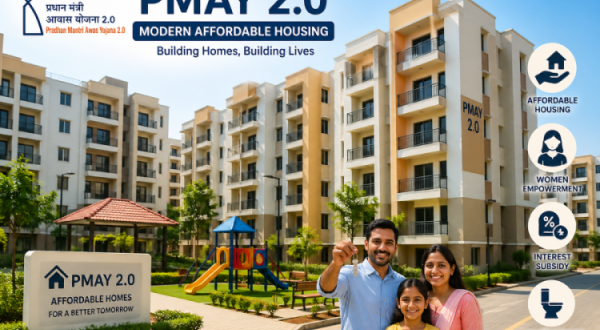
The Pradhan Mantri Awas Yojana (PMAY) 2.0 represents the most ambitious expansion of India’s housing policy to date. Running through 2029, this phase bridges the gap between rural necessity and urban aspiration, specifically targeting the “missing middle”—urban renters who have long been excluded from traditional subsidy models.
🏘️ What’s New in PMAY 2.0? (The 2026 Shift)
Unlike the first version of the scheme which primarily addressed slum redevelopment and basic shelter for the destitute, PMAY 2.0 is a “lifestyle transition” program.
Key Improvements:
-
Urban Renters Focus: A new segment specifically targets those living in expensive urban rentals, providing them with financial pathways to ownership.
-
Interest Subsidy Re-entry: After a brief hiatus, the Credit Linked Subsidy Scheme (CLSS) is back with a refined focus on loan amounts up to ₹8 lakh.
-
Technology Integration: Construction now utilizes Green Building technologies and Light House Projects (LHPs) to ensure faster delivery and climate resilience.
🌆 PMAY-Urban 2.0: Detailed Benefits
For city dwellers, the scheme operates primarily through the Interest Subsidy Scheme (ISS).
-
Financial Relief: A 4% interest subsidy is provided on home loans. While you can take a larger loan, the subsidy only applies to the first ₹8 lakh of the principal.
-
Direct Benefit Transfer (DBT): In a move to increase transparency, the subsidy is now frequently released in 5 yearly installments rather than a single upfront lump sum, ensuring the beneficiary maintains the loan account in good standing.
-
Ownership Rights: To promote gender-led development, the house must be registered in the name of at least one female member of the family.
🌾 PMAY-Gramin: Scaling Rural Infrastructure
In rural India, the target has been pushed to 4.95 crore houses by 2029. By mid-2026, nearly 3 crore houses have already been completed using local materials and sustainable designs.
-
Financial Package: Beneficiaries receive approximately ₹1.20 lakh (plains) to ₹1.30 lakh (hilly/difficult areas).
-
Convergence Benefits: You don’t just get a house; you get a home. This includes ₹12,000 for a toilet (Swachh Bharat) and mandatory 90-95 days of labor wages under MGNREGA to assist in building your own home.
📊 Eligibility & Income Criteria (2026 Updated)
The government has streamlined categories to ensure the “creamy layer” does not siphon off benefits intended for the needy.
| Category | Annual Family Income | Primary Benefit |
| EWS (Economically Weaker) | Up to ₹3 Lakh | ₹2.5 Lakh Direct Assistance |
| LIG (Low Income Group) | ₹3 Lakh to ₹6 Lakh | 4% Interest Subsidy |
| MIG (Middle Income Group) | ₹6 Lakh to ₹9 Lakh | 4% Subsidy on ₹8L Loan |
Mandatory Condition: No family member (husband, wife, or unmarried children) should own a pucca house anywhere in India. This is verified via Aadhaar-linked land records.
💻 How to Apply: A Step-by-Step Guide
For Urban Applicants:
-
Online Portal: Visit the Official PMAY-U Portal.
-
Citizen Assessment: Choose the category that fits your status (e.g., “In-situ Slum Redevelopment” or “Credit Linked Subsidy”).
-
Aadhaar Verification: Enter your Aadhaar details. The system will cross-check with the national database.
-
Application ID: Once submitted, save your 15-digit Application ID to track status.
For Rural Applicants:
-
Selection: Beneficiaries are identified via the Socio-Economic Caste Census (SECC) and Awaas+ lists.
-
Verification: The Gram Sabha verifies the list of potential beneficiaries.
-
App Tracking: Use the AwaasApp to upload geo-tagged photos of your construction progress to trigger payment installments.
📑 Mandatory Documentation
-
Identity: Aadhaar Card (linked to an active mobile number).
-
Financial: Income Certificate/Salary Slips and last 6 months’ Bank Statement.
-
Legal: An affidavit stating that you do not own any other permanent property in India.
-
Land: If applying for self-construction, valid land ownership documents are required.
🔗 Relevant Links from Matribhoomi Samachar
Stay informed with deep dives into the 2026 housing market and financial guidelines:
-
Financial Planning: Home Loan 2026: Why a 750+ CIBIL Score is Your Ticket to 7.1% Interest Rates
-
Market Trends: Ready-to-Move vs Under-Construction Property: 2026 Homebuyer’s Guide
⚠️ Important Warning
PMAY is a pro-people government initiative. There are no “agents” authorized to collect money for registration. If any portal asks for a payment to “process” your subsidy, it is a scam. Only use official .gov.in websites or authorized Common Service Centres (CSCs).
Disclaimer
The information provided in this article regarding the Pradhan Mantri Awas Yojana (PMAY) 2.0 is for general informational and educational purposes only. While we strive to provide the most accurate and up-to-date details for 2026, government policies, eligibility criteria, subsidy percentages, and income slabs are subject to change based on official Ministry of Housing and Urban Affairs (MoHUA) notifications.