 Matribhumi Samachar English


New Delhi. Wednesday, 29 April 2026
The syllable Om is often described as the “primordial sound of the universe.” While its roots are deeply embedded in the Vedic traditions of India, modern science is increasingly validating what yogis have claimed for millennia: that this specific sound frequency has a profound impact on human physiology and mental health.
🧠 1. Neurological Impact: Beyond the “Placebo”
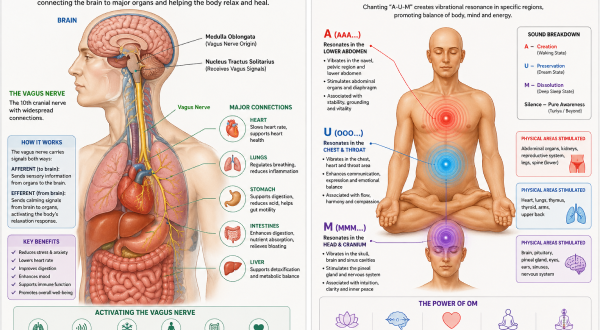
Recent studies using Functional Magnetic Resonance Imaging (fMRI) have shown that chanting Om leads to a significant decrease in activity in the amygdala—the brain’s “fear center.” This is likely due to the stimulation of the auricular branch of the vagus nerve.
-
Vagal Tone: Chanting increases vagal tone, which directly balances the autonomic nervous system.
-
Alpha Waves: Regular practitioners often exhibit increased alpha brain wave activity, which is associated with “relaxed alertness.”
🌬️ 2. Respiratory Efficiency and Nitric Oxide
Chanting Om is essentially a form of prolonged exhalation. In a typical “Om” cycle, the exhalation is roughly 2–3 times longer than the inhalation.
-
Carbon Dioxide Regulation: This slow exhale helps stabilize the $CO_2$ levels in the blood, preventing the “fight or flight” response triggered by shallow breathing.
-
Nitric Oxide (NO) Production: The humming “M” sound increases the production of Nitric Oxide in the paranasal sinuses. NO is a vasodilator, meaning it helps lower blood pressure and improves oxygen uptake in the lungs.
🎯 3. Mental Clarity: The “A-U-M” Resonance
The mantra is traditionally divided into three phonetic components, each vibrating in a different part of the body:
| Sound | Resonance Area | Psychological Benefit |
| A (Aaa) | Abdomen & Solar Plexus | Grounding and physical presence. |
| U (Ooo) | Chest and Throat | Emotional clearing and openness. |
| M (Mmm) | Cranium and Sinuses | Mental clarity and calming of “chatter.” |
🧘 4. Possible Corrections and Common Misconceptions
To get the most out of the practice, it is important to address a few common mistakes:
-
It’s Not Just “Omm”: Many beginners chant a flat “O.” The power lies in the dipthong transition from A to U to M.
-
Volume vs. Vibration: You don’t need to shout. The internal vibration is more important than the external volume. Even a whisper (upanshu) or mental chanting (manasa) is effective.
-
The Fourth State: The most important part of the chant is the silence that follows. This silence represents Turiya (pure consciousness).
🛠️ Practical Guide for Daily Focus
-
Posture: Sit with a neutral spine to allow the vagus nerve to signal freely to the brain.
-
The 1:2 Ratio: Inhale for 4 seconds, and chant “A-U-M” for 8–12 seconds.
-
Frequency: 108 repetitions is traditional, but even 12 repetitions can reset your nervous system during a stressful workday.
🔗 Related Resources from Matribhumi Samachar
For more insights into holistic health, traditional wisdom, and spiritual practices, explore these related articles:
Disclaimer
While practices like meditation and chanting are generally considered safe, individuals with certain conditions—such as severe respiratory issues, cardiovascular disorders, or clinical mental health conditions—should consult with a qualified healthcare professional before beginning a new practice. Never disregard professional medical advice or delay seeking it because of something you have read in this article.