 Matribhumi Samachar English


New Delhi. Updated on : Sunday, 9 August 2026
For many women, losing a spouse brings not only deep emotional trauma but also severe financial vulnerability. To bridge this gap, the Government of India, through the National Social Assistance Programme (NSAP) alongside individual state governments, runs the Widow Pension Scheme (also known as the Indira Gandhi National Widow Pension Scheme – IGNWPS or Vidhwa Pension Yojana).
In 2026, the application infrastructure has undergone a massive digital transformation. With integrated e-Governance portals, Aadhaar-based face authentication, and swift Direct Benefit Transfer (DBT) protocols, securing financial independence has become faster, more transparent, and paperless.
Whether you are applying for yourself or helping a family member, this detailed guide maps out the latest eligibility rules, documentation, and dynamic online/offline processes for 2026.
1. Core Eligibility Criteria for the Widow Pension Scheme (2026 Updates)
To ensure that financial assistance reaches those who need it most, applicants must satisfy a blend of central and state-level parameters:
-
Marital Status: The applicant must legally be a widow. Under 2026 rules across almost all states, if a beneficiary remarries, she becomes automatically ineligible for future disbursements.
-
Age Benchmarks:
-
Central Scheme (IGNWPS): Covers women aged 40 to 79 years. Upon reaching 80, beneficiaries are seamlessly transitioned into the Old Age Pension database to receive higher monthly allocations.
-
State-Specific Schemes: Recognizing early vulnerability, several states (such as Delhi and Uttarakhand) have lowered their lower age limit, allowing widows to apply starting from 18 years of age.
-
-
Economic Background: The applicant must belong to a Below Poverty Line (BPL) household or meet the state’s maximum annual income cap (for instance, $\leq$ ₹1,00,000 in urban sectors like Delhi, and lower thresholds in rural zones).
-
Residency: The applicant must be a permanent resident of the specific state or Union Territory where the pension application is being processed.
-
Exclusion Rule: To prevent duplication of funds, the applicant must not actively be receiving any other form of government pension or provincial financial aid.
2. Essential Documents Checklist
Before initiating your application, compile clear copies of the following documents to avoid processing delays:
| Document Category | Purpose & Verified Formats |
| Identity & Residence Proof | Aadhaar Card, Voter ID, or active Ration Card showing local address. |
| Proof of Husband’s Demise | Original Death Certificate issued by the local Registrar of Births and Deaths. |
| Income Substantiation | Valid BPL Certificate or an official Income Certificate issued by the regional Tehsildar/Revenue Department. |
| Age Verification | Birth Certificate, School Leaving Certificate, or verified Aadhaar parameters. |
| Financial Routing (DBT) | Passbook copy of a singly-operated bank account linked to your biometric identity. |
| Photographs | 2–3 recent passport-size photographs (or clear digital uploads for online forms). |
3. How to Apply Online: The 2026 Paperless Routine
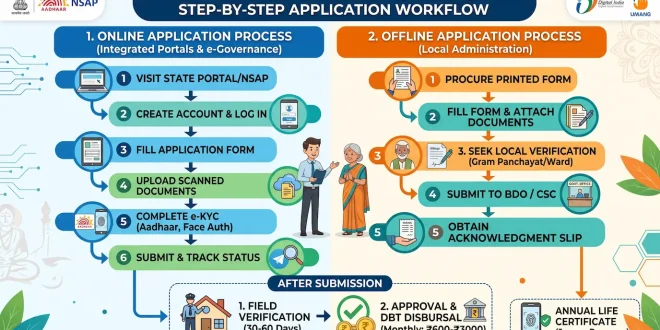
Digital enablement via systems like Service Plus and the UMANG app has cut down standard waiting windows dramatically. Follow these steps to complete an online submission:
-
Access the Portal: Head to the official central clearing site (nsap.nic.in) or navigate to your specific state’s social welfare portal (e.g.,
ssp-up.gov.infor Uttar Pradesh orwcd.delhi.gov.infor Delhi). -
Account Registration: Register using an active mobile number and initialize your profile.
-
Form Completion: Search for the “Widow Pension Application” link. Fill out all essential data fields carefully—including personal parameters, your late husband’s death details, income data, and exact bank credentials (IFSC code and account number).
-
Secure Document Upload: Attach high-resolution scanned copies of the required documents from the checklist above.
-
Aadhaar-Based e-KYC: Complete the instant verification step. In 2026, this can be done rapidly via a mobile One-Time Password (OTP) or via the face-authentication module on the UMANG application.
-
Submission and Acknowledgment: Submit the form and securely save the generated Application Reference Number to monitor your file.
4. The Offline Application Route
If you lack access to smart devices or reliable internet connectivity, the traditional offline pathway remains fully operational across local administrative tiers:
-
Procure the Form: Collect the official printed copy of the Vidhwa Pension Yojana form free of cost from your nearest Gram Panchayat Office, Block Development Office (BDO), or District Social Welfare Office.
-
Local Attestation: For rural applications, it is helpful to have your form cross-verified and recommended by your local Gram Pradhan or Panchayat Secretary. In urban spaces, a Ward Councilor’s signature serves a similar purpose.
-
Counter Submission: Turn in the filled application form alongside self-attested document photocopies at your nearest Common Service Centre (CSC) or direct BDO counter.
-
Receipt Gathering: Always demand a physical acknowledgment slip stamped with the official submission date.
5. Behind the Scenes: Verification and DBT Disbursal
Once submitted, the administrative lifecycle typically takes between 30 to 60 days:
-
Field Inspection: A local Revenue Officer, Patwari, or Social Welfare Inspector may visit your registered residence to confirm the accuracy of your declared BPL status and living metrics.
-
Direct Benefit Transfer (DBT): Following approval, you will receive a confirmation text message. The financial aid is then credited directly into your single bank account. In 2026, pension payments scale anywhere from ₹600 to ₹3,000 per month, scaling upward depending on how much individual states contribute on top of the central baseline.
-
The Annual Life Certificate: To maintain uninterrupted monthly credits, every beneficiary must complete an annual verification (Jeevan Pramaan) between November and December. This is highly simplified in 2026; you can do it via biometric verification at a local CSC or entirely from home using the official central government face-authentication mobile app.
Tracking Status and Resolving Rejections
If your payments stall, use your Application Reference Number or Aadhaar details on the state social welfare dashboard to track progress. If an application is flagged as “Rejected,” the portal will explicitly state why (e.g., Incomplete Income Documents). This transparent mechanism allows you to file an appeal or re-upload corrected papers without starting the process from scratch.
For more news on national welfare initiatives and government schemes, explore Matribhumi Samachar English.
Frequently Asked Questions (FAQ)
What happens to my widow pension when I turn 80?
You do not need to reapply. The National Social Assistance Programme (NSAP) system automatically triggers an internal upgrade to move you into the Senior Citizen Old Age Pension bracket, which typically yields a higher monthly payout.
Can a widow working in a private firm apply for this pension?
Eligibility rests entirely on your total annual family income. If your earnings fall below your state’s specified poverty line index and you do not receive any other institutional pension benefits, you can legally qualify.
What should I do if my pension payment is delayed?
Log into your state’s social welfare portal or visit the central NSAP track window. Enter your application number to locate bottlenecks. If there is a processing error with your bank account link, visiting your local branch to ensure your account is properly active for Direct Benefit Transfers (DBT) usually resolves it.
Disclaimer
This article is for informational purposes only. Eligibility structures, mandatory documentation thresholds, and monthly pension allocations fluctuate extensively based on distinct state jurisdictions and localized Union Territory policies across India. Applicants are strongly encouraged to verify localized frameworks on their respective state’s official Social Welfare Department portal prior to final filing.