

New Delhi. Wednesday, 17 June 2026
Artificial Intelligence has officially transitioned from basic software-centric applications and chatbots into a critical national asset—ranking alongside defense infrastructure, energy grids, and telecommunications. As global geopolitical landscapes shift, the concept of Sovereign AI infrastructure in India has emerged as a cornerstone of digital self-reliance.
The nation is rapidly strengthening its position in the global artificial intelligence race, witnessing the emergence of nearly 20 indigenous foundation models under a broader vision of technological self-reliance. Rather than being mere “rule-takers” or consumers of foreign-trained models, Indian startups, research institutions, and technology companies are aggressively building their own capabilities.
Why India Is Investing in Sovereign AI
Sovereign AI focuses on a nation’s independent capability to develop, control, and deploy AI technologies using its own infrastructure, datasets, and regulatory frameworks. Relying heavily on foreign AI providers or processing national data on overseas servers exposes domestic startups to volatile international regulatory shifts and unpredictable cloud pricing models.
Furthermore, global, foreign-trained AI models frequently prioritize dominant Western languages, inadvertently inheriting the cultural biases and viewpoints of their host countries. With more than 1.4 billion people and hundreds of languages and dialects, India presents unique challenges that global AI models often struggle to address effectively. To preserve algorithmic and cultural self-determination, India’s ecosystem is deploying tools optimized for Indian languages, cultural contexts, governance requirements, and local industries.
For a deeper look into the macroeconomic shifts driving this hardware revolution, explore Sovereign Scale: Inside India’s Trillion-Rupee AI Infrastructure Revolution.
The Pillars of India’s Homegrown AI Architecture
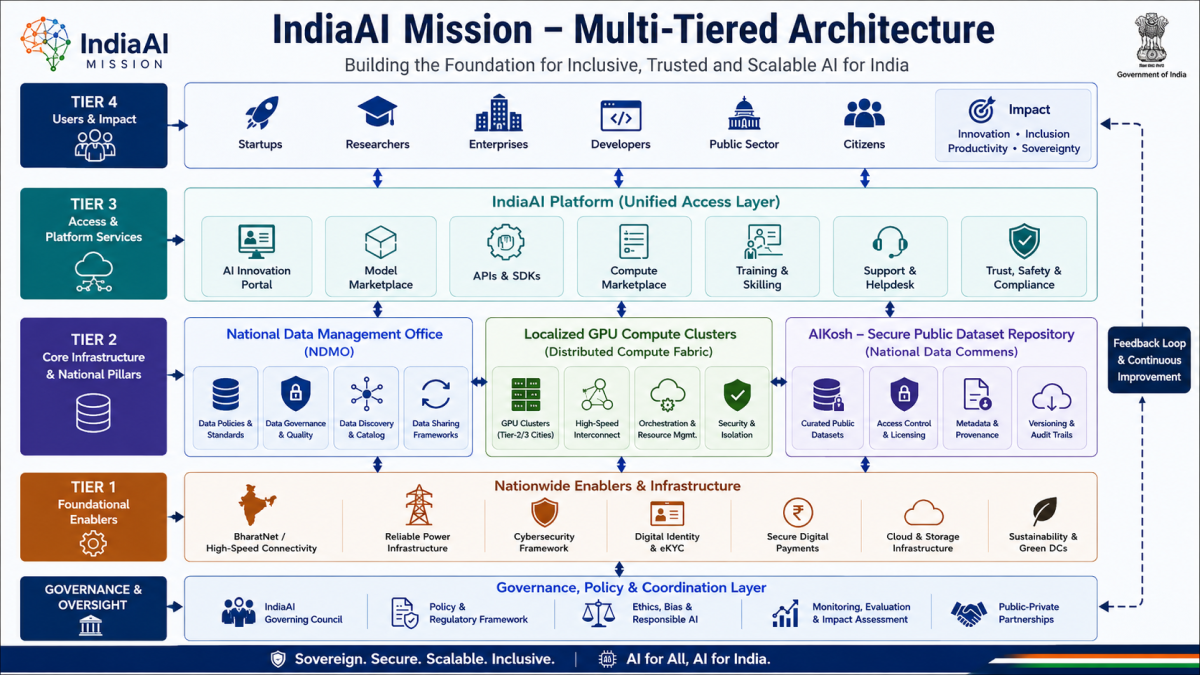
India’s strategy stands out globally because it does not treat AI as an isolated software stack. Instead, the country is executing a precise, multi-tiered roadmap that interconnects hardware, regional language data, and public infrastructure.
1. The IndiaAI Mission & AIKosh
Backed by a robust government budgetary allocation exceeding ₹10,371 crore, the IndiaAI Mission functions as the structural bedrock for the country’s deep-tech ecosystem. The mission targets structural bottlenecks by expanding national Graphics Processing Unit (GPU) clusters to lower computing costs for resource-constrained developers. Alongside compute subsidies, a specialized repository known as AIKosh collects high-quality, secure datasets spanning multiple local sectors for model training.
2. Breaking the Language Barrier via BHASHINI
To achieve true linguistic equity, the ecosystem utilizes the open-access BHASHINI Language Platform alongside custom regional Large Language Models (LLMs). Instead of isolating language solutions within proprietary walls, BHASHINI provides centralized APIs for text-to-speech, machine translation, and speech recognition across Indian languages. To understand how this framework is democratizing technology at a grassroots level, read Breaking the Language Barrier: Inside India’s Revolutionary Multilingual AI Framework.
3. Homegrown Indigenous Foundation Models
To build true technological self-reliance, the Indian ecosystem is rolling out indigenous foundation models designed from scratch with custom tokenizers to address localized computational gaps. Prominent examples include:
Ola’s Krutrim: Designed to handle complex Indian contexts natively.
BharatGen: An academic-led initiative and the world’s first fully government-funded multimodal LLM framework explicitly tasked with transforming public service delivery.
Sarvam AI’s Indus LLM: Engineered for conversational, voice-first efficiency across regional dialects.
The Physical Compute Race: AI Factories & Infrastructure
A physical computing race requires unprecedented physical infrastructure. Deep learning processes depend on heavy matrix calculations that run non-stop, generating massive heat that renders traditional air conditioning entirely insufficient.
This has triggered a massive transition toward advanced facilities built specifically for relentless generative AI workloads, incorporating custom fluid dynamics loops and direct-to-chip liquid cooling systems. To review how these facilities operate under heavy electrical loads, see The Hardware Boom: Inside the Relentless AI Data Center Infrastructure Growth in India.
A monumental milestone illustrating this shift is the historic, built-to-suit alliance between global tech leader Meta and Reliance Industries in Jamnagar, Gujarat. This facility features a planned capacity of 168 megawatts (MW) and aims to leverage nearly 1 gigawatt (GW) of renewable energy resources to run sustainable, hyper-dense AI workloads natively on Indian soil.
Cross-Sector Transformations: From Earth Observation to Governance
The integration of sovereign compute capabilities is creating significant opportunities for Indian startups across critical real-world sectors:
| Target Sector | Core Sovereign AI Application | Impact Dimension |
| Agriculture | Localized predictive crop indexing, soil moisture analysis, and voice bots layered over backend systems. | Empowering smallholder farmers to receive context-specific advice on pest management and market pricing in their native dialects. |
| Public Governance | Multi-dialect voice agents integrated directly into local administrative systems. | Streamlining citizen access to welfare schemes and healthcare delivery without literacy or cognitive barriers. |
| Geospatial Intelligence | AI-powered Earth observation models combining high-frequency satellite imagery and drone data. | Optimizing climate risk predictive software, disaster response (e.g., flash flood tracking), and urban development plans. |
To discover how localized machine learning models are transforming downstream data applications in space-tech, check out India’s New Space Race: Rockets, Venture Capital, and the AI Revolution Transforming the Final Frontier.
Technical Challenges Ahead
Despite rapid progress, several critical hurdles remain for long-term growth:
Hardware Dependency: While local chip packaging and edge-AI designs (such as Netrasemi’s 12nm A2000 Edge AI chip) are accelerating, the ecosystem remains dependent on importing advanced semiconductor nodes.
Grid Strain and Energy Demands: High-density AI server farms consume massive amounts of continuous electricity, pushing states like Maharashtra to roll out dedicated Green Integrated Data Centre Policies.
Talent Development: India must expand its pool of skilled GenAI professionals who specialize in Retrieval-Augmented Generation (RAG), vector databases, and prompt engineering. If you are looking to build a career path in this booming space, refer to The Ultimate 2026 Guide to AI Career Opportunities in India: Roles, Salaries, and Roadmap.
Outlook: Shifting From Consumer to Creator
The development of approximately 20 indigenous foundation models signals a fundamental shift from being a primary consumer of AI technology to becoming an active architect of advanced AI systems. By blending its foundational Digital Public Infrastructure (DPI) with state-backed compute subsidies and highly targeted regional language architectures, India is anchoring its position as an independent, self-reliant global computing anchor over the coming decade.
Frequently Asked Questions (FAQ)
What is Sovereign AI?
Sovereign AI refers to a nation’s independent capability to develop, train, deploy, and govern its own AI technologies without relying heavily on foreign technology providers, volatile overseas supply chains, or shifting cloud policies.
What is the budget allocation for the IndiaAI Mission?
The IndiaAI Mission is backed by a robust government budgetary allocation of over ₹10,371 crore, targeting structural bottlenecks like GPU procurement and high-quality data curation.
Why do standard global AI models struggle in India?
Standard global models frequently prioritize Western languages and data, causing “context drift” and algorithmic bias when applied to India’s unique landscape of 22 official languages and hundreds of regional dialects.
What are some examples of indigenous Indian foundation models?
Prominent examples include Ola’s Krutrim, the academic-industry framework BharatGen, and Sarvam AI’s Indus LLM.
Disclaimer: The information provided in this article is for educational and informational purposes only. While every effort has been made to ensure the accuracy and reliability of the data presented as of 2026, readers are advised to consult official policy updates from the Ministry of Electronics and Information Technology (MeitY) and the respective technology partners for real-time adjustments.
