 Matribhumi Samachar English


Mumbai. Friday, 22 May 2026
India’s digital payments landscape has been a masterclass in global financial innovation. From street vendors accepting micro-payments to seamless peer-to-peer transfers, mobile wallets and prepaid cards have become a vital part of daily life. However, a wave of caution is sweeping through the fintech ecosystem.
The Reserve Bank of India (RBI) recently issued draft guidelines aimed at tightening the rules for Prepaid Payment Instruments (PPIs), including mobile wallets and prepaid cards. While the central bank’s primary mission is to protect consumers and tighten security, digital payment companies are raising flags over how these strict limits might impact small businesses, casual users, and overall growth.
Let’s unpack what these rules mean, why the fintech sector is seeking a compromise, and how it could change the way you move your money.
Why the Shifting Focus?
At first glance, it might seem like regulators are putting a brake on a highly successful system. But from the RBI’s standpoint, rapid growth brings unseen vulnerabilities. The central bank is increasingly focused on eliminating systemic loopholes, particularly tracking the digital paper trail to combat money laundering and tax evasion.
Additionally, the regulator wants to address popular workarounds, such as using credit cards to load wallets simply to transfer cash back into bank accounts—essentially avoiding standard credit card cash-advance fees.
The Big Changes: Current Rules vs. Proposed Draft
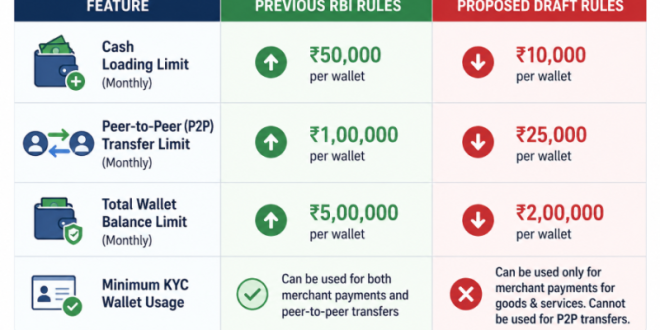
The proposed regulations introduce clear guardrails that directly target transaction flexibility and cash-loading capabilities. To see exactly how things might change, here is a breakdown of the draft limits compared to previous standards:
| Payment Feature | Previous Rules | Proposed Draft Framework |
| P2P Transfer Cap (Full-KYC) | Up to ₹2 Lakh for pre-registered peers | Strictly capped at ₹25,000 per month |
| Max Cash Loading Limit | ₹50,000 per month | Slashed to ₹10,000 per month |
| Minimum-KYC Wallets | Allowed basic peer-to-peer transfers | Strictly restricted to merchant payments only |
| Cross-Border Use | Allowed for specific outward remittances | Completely prohibited (Domestic use only) |
The Fintech Industry’s Core Concerns
Fintech executives and industry groups are actively coordinating to present a unified feedback framework to the central bank. Their main worries fall into three categories:
-
Slowing Down Small Merchants: Many micro-entrepreneurs and gig workers rely heavily on quick peer-to-peer wallet transfers to pay suppliers or receive payouts. The ₹25,000 monthly cap could disrupt their day-to-day operations.
-
The Death of Minimalist Wallets: By restricting minimum-KYC wallets exclusively to merchant transactions (buying goods and services) and entirely banning them from sending money to friends or family, casual users face significantly higher friction.
-
Rising Operational Strains: Upgrading legacy compliance systems, redesigning user interfaces, and auditing existing customer databases to fit the new rules will require a heavy tech and financial investment.
Because of these hurdles, industry leaders are pushing for an extension of 6 to 12 months on the implementation timeline to properly re-engineer their systems without causing sudden downtime for consumers.
The Silver Lining: Greater Integration
It isn’t all bad news for digital wallet providers. To balance out the stricter transaction ceilings, the RBI has offered significant upgrades to help Full-KYC wallets act more like traditional bank accounts.
Under the new guidelines, wallets will feature mandatory third-party app discovery. This means a user could easily view their independent wallet balances inside centralized platforms like Google Pay or BHIM. Furthermore, full interoperability ensures that verified wallets can seamlessly scan any standard UPI QR code, stabilizing their position in the retail payments ecosystem.
Moving Forward Responsibly
The public consultation phase gives the industry a critical window to negotiate. The ultimate goal for both sides isn’t to stop digital payments from thriving, but to ensure they grow on an incredibly secure foundation. A reasonable compromise—perhaps a slight increase in the P2P transfer cap and a clearer grace period for technology upgrades—could give India’s fintech sector the stability it needs to keep innovating safely.
Related Links for Readers
To stay updated on India’s evolving financial landscape and business policy shifts, explore our dedicated coverage:
-
For analysis on national regulatory changes, visit Matribhumi Samachar National News.
-
To read more about how technology is shifting Indian markets, head over to Matribhumi Samachar Business & Tech.