

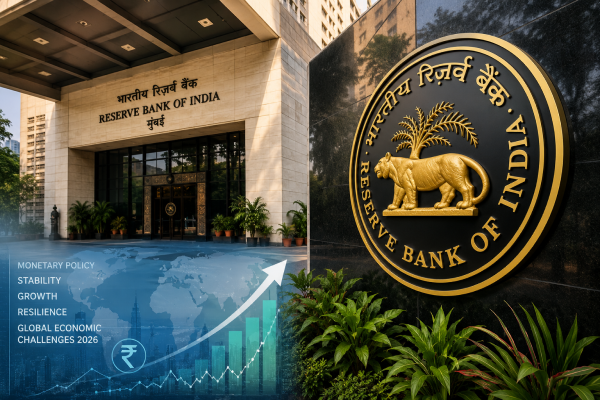
New Delhi | Friday, 29 May 2026
In an increasingly unstable global environment, the Reserve Bank of India’s (RBI) newly released Annual Report for FY 2025-26 provides a reassuring blueprint for the nation’s financial trajectory. Despite escalating geopolitical tensions in West Asia threatening international trade corridors, India’s robust domestic economic architecture is safely driving its status as the world’s fastest-growing major economy.
While warning signs regarding global fuel volatility loom large, the central bank highlights structural resilience across corporate and banking balance sheets as the country’s primary defense mechanisms.
Macroeconomic At-A-Glance: FY 2025-26 vs. FY 2026-27 Projections
To understand where India’s economy stands against incoming global headwinds, the RBI details critical shifts across GDP, fiscal planning, and inflation targets:
| Economic Indicator | FY 2024-25 (Actual) | FY 2025-26 (Estimated) | FY 2026-27 (Projected) |
| Real GDP Growth Rate | 7.1% | 7.6% | 6.9% |
| CPI Inflation Rate | — | 2.1% | 4.6% |
| Gross Fiscal Deficit (% of GDP) | — | 4.4% | 4.3% |
| RBI Policy Repo Rate | — | 5.25% (Neutral) | 5.25% (Held) |
1. Domestic Fundamentals Fueling the Growth Engine
The RBI projects real GDP growth at 6.9% for FY 2026-27. While this marks a deliberate, cautious stabilization from the high-flying 7.6% recorded in FY 2025-26, the underlying fundamentals tell a story of immense strength.
Several key structural pillars are shielding domestic growth:
Corporate & Banking Health: Non-Performing Assets (NPAs) are hovering at historic lows, allowing financial institutions to safely back aggressive domestic credit expansions.
Government Capital Expenditure (CapEx): Ongoing state allocations into massive infrastructure programs continue to act as a vital catalyst for secondary markets.
Consumption Power: Steady consumer behavior across middle and lower-income classes continues to keep manufacturing and service lines open, independent of slowing export metrics.
2. Decoupling the West Asia Crisis: The New Inflation Challenge
The true core of the RBI’s caution steps from the unstable geopolitical landscape in West Asia. The ongoing conflict has transformed from an isolated regional crisis into an active economic risk factor for structural market routes, primarily via supply-side pressures.
[West Asia Conflict Escalation]
             │
             ▼
[Red Sea/Maritime Route Disruptions] ──► [Surging Freight & Shipping Insurance Costs]
             │
             ▼
[Volatile Crude Oil & Energy Prices] ──► [Input Cost Surge for Indian Industries]
             │
             ▼
[Projected CPI Inflation Escalation from 2.1% to 4.6% in FY27]
As illustrated above, shipping bottlenecks force transport carriers around longer alternative maritime channels, triggering high freight premiums. Coupled with energy fluctuations, consumer price index (CPI)-based inflation is modeled to touch 4.6% in FY 2026-27, rising sharply from the 2.1% low enjoyed throughout FY 2025-26. Industrial operators face elevated base material prices, threatening a ripple effect onto consumer commodity margins.
3. Monetary Prudence: Why the RBI is Holding the Line
After an active FY 2025-26 where the Monetary Policy Committee (MPC) actively trimmed the key repo rate by 100 basis points to mirror diving consumer price indices, the central bank has hit the brakes.
In April 2026, the MPC voted unanimously to anchor the repo rate at 5.25%, alongside a staunchly “neutral” stance.
Expert Insight: The RBI’s refusal to cut rates further is a preemptive shield. By sustaining a 5.25% repo rate, the central bank maintains essential currency market intervention buffers, protecting the Indian Rupee from global volatility while preventing premature capital outflows.
4. Uncompromising Fiscal Discipline
Complementing the RBI’s monetary caution is the Union Government’s precise approach to public finance.
India successfully compressed its gross fiscal deficit down to 4.4% of GDP in FY 2025-26, soundly beating out its long-standing 4.5% target. For FY 2026-27, fiscal managers are targeting an even narrower 4.3% limit. This continuing path toward consolidation prevents overcrowding in credit avenues, ensuring private enterprises can acquire expansion funds affordably without compounding systemic inflation.
Closing Outlook: A Shielded Trajectory
While prolonged instabilities in external markets present genuine threats to import bills, India is tackling the uncertainty from a position of relative security. Supported by robust consumer spending, healthy banking lines, and strict macroeconomic planning, the nation remains distinctly capable of navigating the complex global crosscurrents of 2026.
