

New Delhi. Monday, 15 June 2026
Indian agriculture is undergoing a massive structural transformation. As the nation tackles modern environmental bottlenecks like unpredictable climate shifts, groundwater depletion, and degrading soil health, data-driven farming methods have evolved from experimental pilot projects into necessary national strategies.
By integrating Artificial Intelligence (AI), satellite imagery, and unmanned aerial vehicles (UAVs or drones), India is pioneering a highly efficient precision farming ecosystem. This shift optimizes resources, reduces input costs, and protects crop yields, building long-term food security.
The Convergence of Space, Air, and Edge AI
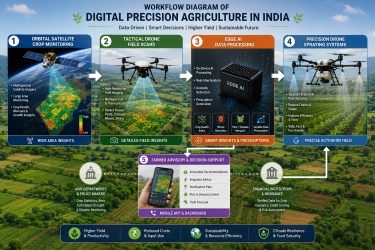
Precision farming moves away from treating an entire field uniformly. Instead, it leverages a continuous digital feedback loop that connects orbital data down to individual plants on the ground.
┌───────────────────────────────────────────────────────────┐
│              1. ORBITAL SATELLITE MONITORING              │
│  Continuous wide-scale scans detect structural anomalies  │
└─────────────────────────────┬─────────────────────────────┘
                              │
                              ▼
┌───────────────────────────────────────────────────────────┐
│               2. TACTICAL DRONE DEPLOYMENT                │
│  High-resolution aerial surveys target designated hot spots│
└─────────────────────────────┬─────────────────────────────┘
                              │
                              ▼
┌───────────────────────────────────────────────────────────┐
│               3. SOVEREIGN EDGE AI ANALYSIS               │
│ Actionable advice delivered to smartphones in local dialects│
└─────────────────────────────┬─────────────────────────────┘
                              │
                              ▼
┌───────────────────────────────────────────────────────────┐
│             4. PRECISION INPUT EXECUTION                  │
│ Drones perform hyper-targeted chemical or water spraying │
└───────────────────────────-───────────────────────────────┘
1. Satellite Imagery: The Macro View
Earth observation satellites offer real-time, wide-scale insights into large-scale agricultural operations. Instead of manually inspecting thousands of hectares, government bodies and cooperative farming networks utilize satellite data to track regional soil moisture levels, map groundwater depletion zones, and estimate crop acreage. This macro data proves indispensable for identifying early-stage regional droughts and validating insurance claims after extreme weather events.
2. Agricultural Drones: Targeted Operations
While satellites look at the big picture, drones handle the details. Equipped with multispectral and thermal sensors, drones map precise field variations in minutes.
Spotting Crop Stress: Drone telemetry flags micro-level anomalies like pest infestations, weed patches, or localized irrigation leaks before any damage is visible to the naked eye.
Precision Spraying: Rather than blanket-spraying an entire field, drone-mounted systems apply fertilizers and pesticides exclusively over affected plants. This dramatically minimizes chemical runoff, reduces overall input costs, and protects the surrounding environment.
3. Artificial Intelligence: The Analytical Engine
AI connects the entire ecosystem together. Machine learning algorithms process historical crop records, meteorological trends, and incoming field telemetry to predict localized crop yields months ahead of time. This helps smallholders adjust their sales strategies and allows supply chains to adapt effectively.
2026 Context: Overcoming Structural Bottlenecks
While standard technology models rely heavily on continuous internet connectivity and English-centric software, India’s agricultural ecosystem is deploying unique localized adaptations. Recent technological developments highlight a few critical corrections and upgrades to the classic smart-farming model:
Breaking the Language Barrier: Standard translation software often fails to capture the subtle regional dialects used across rural India. To bypass this issue, modern platforms layer voice-first applications over state-backed multilingual infrastructures like the BHASHINI Platform and the IndiaAI Mission. This structural change allows farmers to speak naturally into their smartphones to receive precise, real-time advice on pest control or crop management in their native tongue.
Overcoming Connectivity Gaps with Edge AI: Unreliable internet access in remote rural areas frequently stalls conventional cloud-based analytics. The contemporary tech ecosystem circumvents this via specialized hardware breakthroughs, such as 12nm Edge AI chipsets. These processors allow drones and smart cameras to analyze complex datasets natively on-site, operating completely independent of external cloud servers.
DPI 2.0 Integration: Modern agricultural tools are moving away from isolated, standalone applications. They are increasingly integrated directly into India’s evolving Digital Public Infrastructure (DPI 2.0). This securely links data from field sensors to unified open credit and digital banking systems, helping smallholders effortlessly qualify for formal credit, crop insurance, and state subsidies based on verified farm health metrics.
Core Challenges on the Horizon
Despite rapid progress, achieving widespread, nationwide adoption requires overcoming distinct socio-economic hurdles:
| Challenge | Impact on Adoption | 2026 Strategic Solution |
| High Initial Costs | Upfront investments for drones and multi-spectral sensors remain prohibitive for smallholder farmers. | State-backed drone adoption initiatives, local agritech startup subsidies, and shared community hiring centers. |
| Digital Literacy | Complex software dashboards can alienate older or less tech-savvy rural demographics. | Transitioning to voice-first assistants that speak local dialects, dismantling literacy barriers entirely. |
| Data Isolation | Fragmented data silos prevent different sensors and applications from communicating smoothly. | Integrating farm databases under standardized open-source repositories like AIKosh to unify digital tools. |
The Road Ahead
The future of Indian agriculture hinges on data-driven, intelligent decision-making. As foundational computing hardware becomes more accessible, regional hubs—such as advanced tech laboratories in inland states—are securing investments to process agritech data closer to the fields.
By scaling up domestic manufacturing and weaving advanced tools into open public infrastructure, India is creating a resilient agricultural ecosystem. This model ensures that high-tech precision farming remains accessible, practical, and highly beneficial for millions of smallholder farmers nationwide.
Related Reading & Technical Sources
To learn more about the underlying sovereign digital infrastructure, regional tech manufacturing investments, and inclusive language frameworks driving these changes, explore these detailed deep-dives:
Learn how India’s independent technology frameworks protect rural workflows in The Sovereign AI Revolution: How India is Building Its Independent Digital Backbone.
Discover how digital public structures are evolving to support small-scale enterprises and rural economies via the Viksit Bharat 2047 Roadmap: How NITI Aayog is Engineering India’s Leap into a Developed Economy.
Explore how local hardware manufacturing and edge processing support agritech tools in Silicon, Sovereignty, and Scale: How Uttar Pradesh is Rewriting Its High-Tech Manufacturing Story.
Unpack how open data frameworks are lowering computing costs for agricultural innovations by reading about the Sovereign Scale: Inside India’s Trillion-Rupee AI Infrastructure Revolution.
Dive into how voice-first applications are actively dismantling rural digital barriers in Breaking the Language Barrier: Inside India’s Revolutionary Multilingual AI Framework.
