

New Delhi. Monday, 15 June 2026
India’s agricultural sector is undergoing a profound technological transformation. For decades, farming decisions depended largely on experience, seasonal patterns, and manual observation. Today, Artificial Intelligence (AI), satellite imagery, remote sensing, drones, and advanced data analytics are reshaping how crops are cultivated, monitored, and harvested.
As India moves toward becoming a global leader in digital public infrastructure and indigenous AI development, agriculture is emerging as one of the most critical sectors benefiting from these innovations. Supported by state-led frameworks like the IndiaAI Mission, the subcontinent is shifting from basic digital inclusion to a high-tech, self-reliant farming ecosystem.
1. The Urgent Need for AI in Indian Agriculture
Agriculture supports the livelihoods of nearly half of India’s population, yet the sector faces a volatile combination of structural and environmental challenges:
Unpredictable weather patterns and climate variability
Acute water scarcity and receding water tables
Accelerating soil degradation and nutrient depletion
Sudden pest and disease outbreaks
Rising input costs alongside highly fragmented land holdings
Traditional farming methods often struggle to address these compounding issues efficiently. By processing vast datasets from satellites, sensors, weather stations, and field observations, AI-powered systems provide farmers with real-time, localized clarity, converting agricultural uncertainties into predictable operations.
2. Space-Based AI and Satellite Intelligence
Modern Earth observation satellites continuously capture high-resolution imagery of agricultural landscapes. However, raw data downlinks have traditionally suffered from extreme latency constraints.
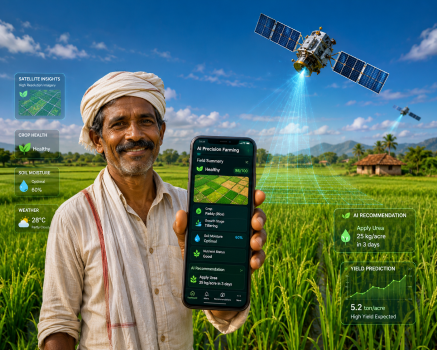
A massive paradigm shift is currently unfolding: the emergence of Space-Based AI Computing. Next-generation Low Earth Orbit (LEO) satellites now leverage custom-engineered hardware to process unstructured multi-spectral telemetry on-site. Instead of sending massive raw data files down to earth, space-qualified accelerators execute complex matrix variations locally in orbit to run real-time anomaly detection, vegetation growth tracking, and crop classification.
Using machine learning algorithms, this space-based intelligence analyzes spectral signatures to detect hidden stresses:
[Raw Multi-Spectral Telemetry]
              │
              ▼ (Processed via Space-Based Edge AI Hardware)
[Instant Spectral Signature Detection]
        ┬───────────────┼───────────────┬
        ▼               ▼               ▼
[Nutrient Deficits] [Water Stress] [Disease Outbreaks]
This allows farmers and agricultural agencies to intervene early, weeks before the damage becomes visible to the human eye, avoiding devastating crop losses.
Explore Further: Learn more about how orbital processing architectures are dismantling terrestrial constraints in the full report on The Next Frontier: Scaling Space-Based AI Computing and Orbital Data Infrastructure.
3. Precision Farming and Soil Intelligence
The primary objective of precision agriculture is optimization—delivering the right input at the exact right location and time. Instead of applying fertilizers, pesticides, and irrigation uniformly across an entire field, AI platforms isolate specific zones requiring immediate attention.
AI-Powered Soil Intelligence & Smart Irrigation
Healthy soil is the foundation of farm productivity. AI models integrate soil testing logs, historical yield databases, and weather forecasts to generate precise soil health assessments. Farmers receive hyper-customized schedules for fertilizer application and targeted soil restoration practices.
Simultaneously, smart irrigation loops analyze real-time soil moisture sensors, weather predictions, and crop evapotranspiration rates. Automated systems determine exactly when and how much water to supply, yielding:
Significant water conservation in drought-prone regions.
Drastically reduced energy consumption for pumping.
Minimized chemical runoff, preserving local ecology.
4. Drones and Autonomous Crop Protection
Agricultural drones have graduated from simple remote-controlled cameras to intelligent, edge-computing UAVs (Unmanned Aerial Vehicles). Equipped with localized, high-efficiency processors, these autonomous drones can survey expansive plots of land rapidly, capturing hyper-detailed field intelligence.
When a crop disease or leaf infection is detected via automated machine learning models, these drones execute precise, targeted pesticide spraying. By treating only the affected stress zones rather than blanketing the whole field, input costs drop drastically, protecting the farmer’s bottom line and ensuring cleaner food supply chains.
5. DPI 2.0 and the Multilingual AI Revolution
A common misconception is that advanced AI can only benefit large-scale commercial farms. India is actively correcting this imbalance by uniquely embedding AI directly into its foundational Digital Public Infrastructure (DPI) layers, stepping into the era of DPI 2.0 (Livelihood-Led Growth).
                  ┌────────────────────────────────────────┐
                  │          India's DPI 2.0 Layer         │
                  └───────────────────┬────────────────────┘
                                      │
          ┌───────────────────────────┴───────────────────────────┐
          ▼                                                       ▼
┌───────────────────────────────────┐   ┌───────────────────────────────────┐
│     The AIKosh Data Repository    │   │      The BHASHINI Platform        │
│  (Aggregates crop, soil, weather) │   │ (Local language voice-first bots) │
└───────────────────────────────────┘   └───────────────────────────────────┘
Through the state-backed IndiaAI Mission, centralized repositories like AIKosh aggregate high-quality, local agronomic datasets. Crucially, to bridge the digital literacy divide, this infrastructure leverages the BHASHINI Language Platform.
Standard translation software frequently fails to interpret dialectical nuances used in rural farming communities. The integration of indigenous foundation models trained on regional scripts allows smallholders to speak into a basic smartphone in their native tongue. Farmers receive voice-assisted, context-specific advice on pest mitigation, market pricing, and dynamic weather warnings in their local dialect.
Explore Further: Read the in-depth investigative article on how regional LLMs are democratizing public services: Breaking the Language Barrier: Inside India’s Revolutionary Multilingual AI Framework.
6. Systemic Bottlenecks to Mass Adoption
Despite incredible technological milestones, scaling these tools evenly across India’s 140+ million farmers requires addressing persistent structural friction points:
| Challenge Domain | Real-World Impact | Strategy for Resolution |
| Connectivity Gaps | Inconsistent internet access in remote rural pockets disrupts real-time cloud data sharing. | Utilizing Edge AI chips that process data locally on the hardware without a continuous web connection. |
| Financial Viability | Advanced drone deployments and IoT sensor networks are too expensive for marginal farmers. | State-backed compute subsidies under the IndiaAI Mission and “Equipment-as-a-Service” rental models. |
| Data Scarcity | AI models inherit biases if trained solely on foreign datasets that mismatch Indian soil profiles. | Curation of localized data via AIKosh and multi-sector digital registries under NITI Aayog’s 2047 roadmap. |
7. The Road Ahead: A Connected Intelligence Network
The future of Indian agriculture lies in the absolute convergence of space-based AI computing, ground-level IoT sensors, indigenous language models, and robust digital public infrastructure. This closed-loop network optimizes every stage of production: satellites monitor crop health from space, localized AI models interpret the data, smart mobile platforms deliver voice-based directives, and farmers make highly informed decisions.
By prioritizing high-tech manufacturing, indigenous algorithmic design, and inclusive techno-legal frameworks, India is creating a resilient agricultural ecosystem that serves as a global blueprint for sustainable, climate-resilient food production.
Related Global Tech Frameworks: To understand how these localized initiatives align with national tech roadmaps and international policy standards, read:
