

New Delhi. Monday, 15 June 2026
Artificial Intelligence (AI) has officially transitioned from basic software-centric applications and chatbots into a critical national asset—ranking alongside defense infrastructure, energy grids, and telecommunications. As global geopolitical landscapes shift, the concept of Sovereign AI has emerged as a cornerstone of digital self-reliance. Nations are no longer content with being mere “rule-takers” or consumers of foreign-trained models; they are aggressively building their own capabilities.
At the very forefront of this movement is India. By fusing its massive digital population with aggressive state-backed initiatives and private capital, the subcontinent is transforming from a tech back-office into a premier global computing engine.
What is Sovereign AI?
Sovereign AI refers to a nation’s ability to independently develop, train, deploy, and govern its own AI technologies without relying heavily on foreign technology providers, volatile overseas supply chains, or shifting cloud policies.
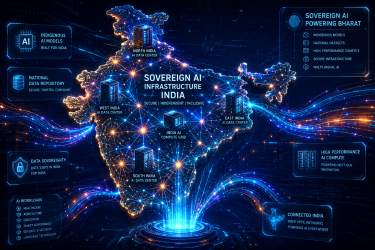
True AI sovereignty requires a cohesive, multi-tiered hardware and software stack:
National AI Compute Infrastructure: Large-scale, state-backed processing networks.
AI-Enabled Data Centers: Advanced facilities built specifically for relentless generative AI matrix calculations.
Indigenous AI Models: Base foundation models and Large Language Models (LLMs) built natively by domestic teams.
Local Data Repositories: Secure, high-quality, and culturally compliant datasets.
Techno-Legal Governance: Regulatory frameworks that protect citizens while fueling local innovation.
Real-Time Infrastructure (2026)
When dealing with high-speed digital expansion, it is easy for outdated numbers or generalized projections to distort the ground reality. Here are the essential corrections and facts shaping the sovereign tech landscape as of mid-2026:
1. The Real GPU Metrics
Early infrastructure estimates frequently conflated total projected multi-year targets with currently active hardware. According to the latest data, India currently possesses over 38,000 operational GPUs distributed across public and private enterprise facilities. To supercharge this, the state-backed IndiaAI Mission is actively processing procurements to inject an additional 25,000 chips directly into the ecosystem, explicitly subsidizing access for domestic startups, researchers, and academic labs.
2. The Liquid Cooling Architectural Shift
A common pitfall when evaluating data center setups is treating them like traditional server farms meant for static text files or standard web apps. Deep learning models run non-stop parallel calculations that generate immense thermal loads. Traditional air conditioning is completely insufficient. The modern wave of infrastructure involves a total pivot toward specialized layout architectures, custom fluid dynamics loops, and direct-to-chip liquid cooling systems to prevent catastrophic hardware drops.
3. Energy Grid Continuity vs. Green Initiatives
High-density AI server clusters put a massive, uninterrupted strain on conventional electrical grids. To prevent voltage fluctuations from destroying advanced silicon nodes, operators are rapidly transitioning toward captive green grids. A monumental 2026 milestone illustrating this is the Reliance Industries’ Massive Shift: Powering India’s AI Infrastructure and Sovereign Compute Capabilities, where a built-to-suit alliance with global tech leader Meta in Jamnagar, Gujarat (boasting a 168 MW capacity) is tapping into separate, newly announced solar and wind projects designed to funnel nearly 1 Gigawatt (GW) of clean energy into sustainable operations.
The Strategic Pillars of India’s Sovereign AI Ecosystem
India’s strategy stands out globally because it does not treat AI as an isolated software stack. Instead, the country is executing a precise, multi-tiered roadmap that interconnects hardware, regional language data, and public infrastructure.
┌─────────────────────────────────────────────────────────┐
│              INNOVATION OVER RESTRAINT POLICY           │
│   (MeitY's Techno-Legal Framework, IndiaAI Mission)     │
└────────────────────────────┬────────────────────────────┘
                             ▼
┌─────────────────────────────────────────────────────────┐
│             INDIGENOUS LANGUAGE MODEL LAYER             │
│    (BHASHINI Platform, Regional LLMs: Hindi, Tamil)     │
└────────────────────────────┬────────────────────────────┘
                             ▼
┌─────────────────────────────────────────────────────────┐
│            DIGITAL PUBLIC INFRASTRUCTURE (DPI)          │
│    (Identity Rails, Open Payments, AIKosh Datasets)     │
└────────────────────────────┬────────────────────────────┘
                             ▼
┌─────────────────────────────────────────────────────────┐
│            SOVEREIGN COMPUTE & HARDWARE                 │
│  (38K+ Active GPUs, 12nm Edge AI Chips, Liquid Cooling) │
└─────────────────────────────────────────────────────────┘
The IndiaAI Mission & AIKosh
Driven by the Ministry of Electronics and Information Technology (MeitY), the country is bypassing slow-moving bureaucratic regulatory boards. Instead, the focus remains on “Innovation Over Restraint.” Through the IndiaAI Mission, the government actively funds compute acquisitions while curating open-source data repositories via platforms like AIKosh, ensuring that resource-constrained developers have an active hand in building models. To explore how this coordinates with international tech frameworks, read about Scaling Responsible Innovation: The Evolution of Global AI Governance and India’s Strategic Path.
The BHASHINI Platform and Local Language Models
Global, foreign-trained AI models frequently prioritize dominant Western languages, inadvertently inheriting the cultural biases and viewpoints of their host countries. To preserve algorithmic and cultural self-determination, India’s ecosystem utilizes the BHASHINI Language Platform alongside custom regional LLMs optimized for Hindi, Tamil, Telugu, Bengali, Marathi, Gujarati, Punjabi, and more. This linguistic equity allows localized AI tools to be deployed seamlessly into rural healthcare diagnostics, precision agricultural forecasting, and digital banking access. For a deeper breakdown of this structural growth, review The Backbone of the Digital Revolution: Unpacking India’s Sovereign AI Ecosystem and Infrastructure Boom.
Post-Silicon Validation and Edge AI Hardware
An independent ecosystem cannot survive by relying solely on foreign semiconductor fabs. While multi-billion-dollar mega-fabs (such as the Tata-PSMC facility in Dholera) are actively scaling out long-term capacity, the domestic hardware layer is achieving massive milestones via Assembly, Testing, Marking, and Packaging (ATMP) processing. Breakthroughs like Netrasemi’s 12nm A2000 Edge AI chip allow hardware like drones, ruggedized smart cameras, and medical tools to process datasets natively on-site, entirely isolated from external cloud latencies or geopolitical trade halts. Learn more about this industrial metamorphosis in Silicon, Sovereignty, and Scale: How Uttar Pradesh is Rewriting Its High-Tech Manufacturing Story.
Macro Impact: Regional Decentralization and Careers
The ripple effects of this sovereign computing push are completely altering regional economic footprints and employment markets across the country:
Rise of Secondary Computing Hubs: While tier-1 hubs like Mumbai, Chennai, and Bengaluru remain dominant digital gateways, high-density AI-enabled data factories are moving rapidly inland where land and clean energy are abundant. States like Maharashtra have launched localized AI and Data Centre Policies, while regions like Jaipur (backed by MNIT) and Chhattisgarh are securing massive investments for advanced high-performance data labs to serve regional agritech and public sector startups. Read more about these regional investments in The Hardware Boom: Inside the Relentless AI Data Center Infrastructure Growth in India.
The Skill-Premium Career Boom: Rather than causing structural downsizing, this hardware and data localization push is driving an unprecedented explosion in specialized, high-paying technical careers. Indian enterprise layouts are transitioning toward “co-worker AI agents,” triggering immense demand for Generative AI architects, MLOps engineers, vector database managers, and prompt engineers. If you are looking to enter or pivot within this high-value market, check out the comprehensive The Ultimate 2026 Guide to AI Career Opportunities in India: Roles, Salaries, and Roadmap.
The Path Forward for Sovereign Ecosystems
The next evolutionary phase of global artificial intelligence will not be dictated by software applications alone, but by the physical networks, clean energy grids, and localized datasets that sustain them.
By strategically blending its foundational Digital Public Infrastructure (DPI) with state-backed compute subsidies and highly targeted regional language architectures, India is anchoring its position as an independent, self-reliant global manufacturing and technological powerhouse over the coming decade.
