 Matribhumi Samachar English


Mumbai. Wednesday, 17 June 2026
The global artificial intelligence race has definitively moved past software code, algorithmic updates, and digital chat interfaces. Today, the core of technological supremacy lies in physical compute capacity. In a monumental move that underscores this reality, Australian hyper-scale data center giant AirTrunk has announced a breathtaking plan to invest more than $30 billion (over ₹3 lakh crore) in India by 2030.
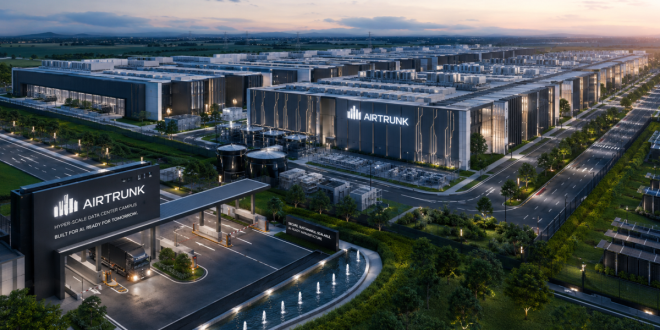
Representing one of the single largest digital infrastructure proposals in the nation’s history, AirTrunk aims to construct over 5 gigawatts (GW) of hyper-scale data center capacity. This massive deployment is explicitly tailored to handle the heavy, parallel-processing computational workloads of generative AI, large-scale cloud computing, and advanced enterprise workloads.
What is AirTrunk? From Asia-Pacific Dominance to India’s Tech Map
Founded in 2015, AirTrunk has rapidly established itself as one of the largest hyper-scale data center providers across the Asia-Pacific (APAC) region. Boasting a massive footprint across Australia, Japan, Singapore, Malaysia, and Hong Kong, the company specializes in building high-density facilities required by global cloud tech giants and internet-scale enterprises.
In 2024, AirTrunk’s strategic value was cemented on the global stage when it was acquired by an institutional consortium led by global asset management titan Blackstone (alongside CPPIB) in a deal valued at approximately A$24 billion. Backed by Blackstone’s deep capital reserves, AirTrunk’s entry into India signals an aggressive expansion into what is quickly becoming the world’s most dynamic digital infrastructure market.
Visualizing 5 GW: The Scale of the India Investment
To appreciate why a 5 GW target is shaking up the tech landscape, one must look at India’s baseline capacity. At the end of 2024, India’s entire nationwide data center capacity hovered around 950 megawatts (MW). AirTrunk’s solo commitment to deploy 5,000 MW (5 GW) by 2030 represents an exponential scale-up that will fundamentally rewrite India’s compute availability.
Key Facets of the AirTrunk Rollout:
-
Capital Velocity: Over $30 billion (₹3 lakh crore) earmarked for deployment before 2030.
-
Next-Generation Architecture: Purpose-built, liquid-cooled “AI factories” featuring ultra-fast networking fabric (like InfiniBand) to prevent algorithmic bottlenecks during deep learning model training.
-
Geographical Diversity: Infrastructure distributed across multiple Indian states and union territories to achieve low-latency connectivity.
-
Hyperscaler Support: Tailor-made hosting for international cloud providers, domestic tech startups, and enterprise operations.
Maharashtra Anchors the Expansion with a 3 GW Mega-Campus
The first massive chapter of AirTrunk’s expansion is set to unfold in Maharashtra. The company has officially signed a Letter of Intent (LoI) for land allocation within the Raigad-Pen Growth Centre, situated on the outskirts of Mumbai.
AirTrunk plans to build an unprecedented 3 GW data center campus at this location, accounting for roughly $21 billion (around ₹2 lakh crore) of its overall budget. Once completed, this single facility is projected to become one of the largest standalone data center campuses in the entire Asian continent.
This geographic selection is highly strategic. It neatly coincides with the regional government’s legislative efforts to build out critical digital infrastructure. By anchoring its flagship project in Raigad-Pen, AirTrunk can directly benefit from state-level financial reliefs while aligning with the broader economic expansion surrounding Mumbai.
Learn more about regional frameworks in the detailed article on Inside Maharashtra’s New Ambitious AI and Data Centre Policy.
The Macro Landscape: India’s $97B+ Digital Infrastructure Boom
AirTrunk’s historic entry arrives amidst an unprecedented hardware spending boom across the subcontinent. Driven by strict data localization laws, data sovereignty needs, and the government’s subsidized ₹10,000 crore IndiaAI Mission, major international technology conglomerates are locked in a race to build localized computing hubs.
Rather than relying on foreign-trained AI models or volatile offshore cloud storage, India is establishing independent, domestic data ecosystems. AirTrunk joins a competitive league of tech giants making deep commitments targeting the 2030 horizon:
| Technology Conglomerate | Committed Indian Infrastructure Investment (By 2030) |
| $15 Billion | |
| Microsoft | $17.5 Billion |
| AirTrunk (Blackstone) | $30 Billion |
| Amazon Web Services (AWS) | $35 Billion |
Furthermore, this corporate blitz isn’t limited to traditional international hyperscalers. Just recently, global tech leader Meta joined forces with Reliance Industries to map out an intensive, built-to-suit 168 MW computing footprint in Jamnagar, Gujarat, utilizing massive green energy resources.
To better understand this broader systemic migration away from legacy file storage toward high-density execution engines, read the comprehensive industry analysis on Beyond Traditional Data Centers: How AI Factories and Sovereign Compute are Rewriting Global Tech Geography.
Long-Term Impact on India’s AI Ecosystem
The structural advantages of injecting 5 GW of hyper-scale compute into India are extensive:
-
Democratic Compute for Startups: By drastically expanding the pool of high-density GPU infrastructure, the cost of training complex neural networks locally will plummet, boosting India’s domestic startup landscape.
-
Ultra-Low Latency: Processing real-time AI model inference within domestic borders ensures lightning-fast execution speeds for automated services across fintech, healthcare, and digital public systems.
-
Massive Job Creation: Building and sustaining these massive computing blocks requires a workforce transformation. The pipeline will stimulate thousands of high-skill roles across hardware engineering, liquid-cooling utility management, green grid maintenance, and MLOps.
-
Sovereign AI Integration: The capacity aligns flawlessly with public programs like BharatGen, ensuring cultural and linguistic nuances are embedded safely within localized foundation models.
For a deeper structural examination of how the nation is executing its independent deep-tech architecture, explore Inside India’s Bold Push for AI Sovereignty: Compute, Culture, and the New Digital Public Infrastructure.
Essential Structural Hurdles: Grid Stability & Clean Energy
While AirTrunk’s ₹3 lakh crore commitment marks a defining milestone, executing a 5 GW rollout demands massive real-world adaptations. Conventional data farms historically relied on standard air-cooling fans. In contrast, modern deep learning server stacks generate intense thermal energy due to continuous matrix math, demanding advanced direct-to-chip liquid cooling or total liquid immersion systems.
More importantly, AI clusters require absolute line-quality continuity from the local electrical grid. A minor power dip can lead to catastrophic hardware errors or interrupt weeks of active LLM training runs.
To secure long-term sustainability, AirTrunk and local municipal authorities must rapidly collaborate on building specialized green energy corridors. The real-world timeline of this 5 GW rollout will depend heavily on how quickly high-voltage clean energy grids can be interconnected directly to these massive facilities.
Track the operational demands, secondary regional tech hubs, and infrastructure bottlenecks by diving into the on-the-ground report, The Hardware Boom: Inside the Relentless AI Data Center Infrastructure Growth in India.
Frequently Asked Questions (FAQ)
1. What is AirTrunk’s total planned investment in India?
AirTrunk has announced a massive investment program exceeding $30 billion (more than ₹3 lakh crore) scheduled to be deployed by 2030.
2. How much data center capacity is AirTrunk planning to develop in India?
The company is planning to develop over 5 gigawatts (GW) of high-density, AI-ready, and cloud-ready hyper-scale data center capacity across the country.
3. Where is AirTrunk building its first major project in India?
AirTrunk’s primary anchor project will be developed in Maharashtra. The company has signed a Letter of Intent (LoI) for a massive 3 GW data center campus located in the Raigad-Pen Growth Centre, worth an estimated $21 billion (₹2 lakh crore).
4. Who owns AirTrunk?
Founded in 2015, AirTrunk was acquired in late 2024 by a major institutional consortium led by global alternative asset manager Blackstone alongside CPPIB in a transaction valued at approximately A$24 billion.
5. Why do AI-enabled data centers require different infrastructure than legacy data centers?
Unlike conventional data centers that primarily store text files and handle basic web requests, AI data centers run continuous deep learning matrix calculations across thousands of heavy GPUs. This requires immense, uninterrupted power inputs, ultra-fast low-latency networking fabrics, and advanced liquid-cooling architectures to handle intense thermal outputs.
Disclaimer: The information provided in this article concerning corporate investments, regional data center policies, and institutional acquisition values is intended for educational, informative, and general analytical purposes only. Large-scale technology infrastructure rollouts, corporate Memorandums of Understanding (MoUs), and Letters of Intent (LoIs) involve long operational execution timelines and are subject to market conditions, local regulatory approvals, clean energy grid deployment speeds, and broader economic realignments. Readers should not treat the structural investments detailed above as financial, legal, or investment advice.