

Mumbai. 15 September 2026
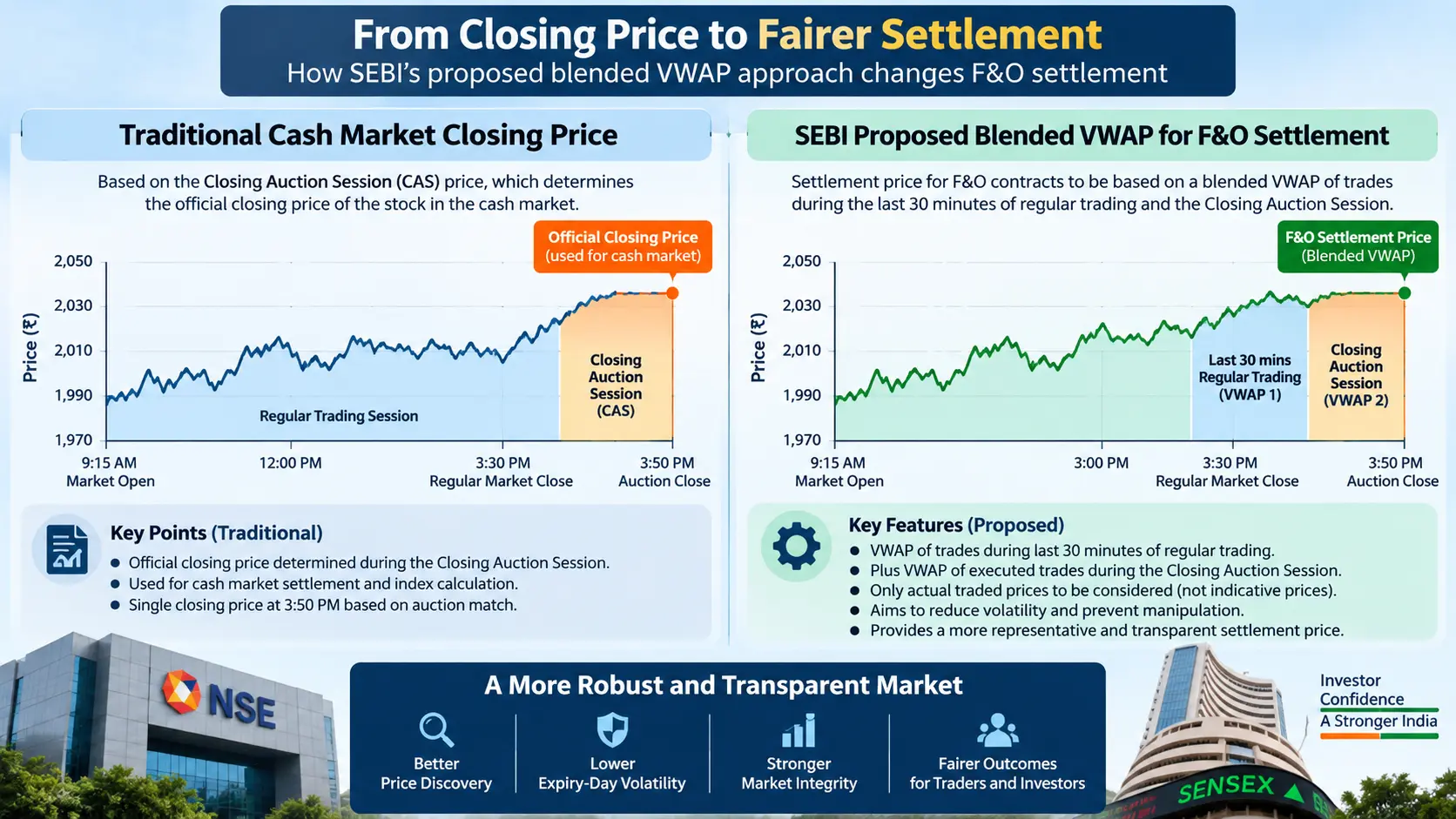
The Securities and Exchange Board of India (SEBI) has released a consultation paper proposing structural changes to the Closing Auction Session (CAS) and the settlement price mechanism for Futures and Options (F&O) contracts. Designed to improve price discovery, limit expiry-day volatility, and mitigate market manipulation, these changes mark a significant shift in how end-of-day market benchmark prices are derived in Indian equity markets.
Why SEBI Is Reviewing the Closing Auction System
The Closing Auction Session was originally implemented across Indian exchanges to create a transparent, centralized price discovery mechanism at market close. However, market participants have raised ongoing concerns regarding end-of-day illiquidity, extreme price swings near contract expiry, and the potential for manipulative order activity during the closing window.
Because derivatives contracts settle against the underlying cash market prices, small price movements during the closing window can disproportionately affect futures and options position outcomes. SEBI’s updated proposals aim to ensure that derivative settlement values accurately reflect broad, executed trading activity rather than temporary order imbalances.
Summary of Proposed Changes
| Feature / Area | Existing Mechanism | SEBI Proposed Direction | Market Impact |
| F&O Settlement Methodology | Derived primarily from short closing auction windows | Blended VWAP (combining Continuous Trading Session + CAS executed volume) | Reduces single-window price ramping and expiry pinning |
| Order Cancellations | Standard order modification limits | Tighter restrictions on limit order cancellations beyond reference bands | Discourages non-genuine spoofing orders |
| Indicative Index Value (IIV) | Displayed live during the closing auction | Possible removal (retaining individual security indicative equilibrium prices) | Prevents misleading signals from unconfirmed index figures |
| Iceberg Orders | Unexecuted quantities handled under standard rules | Unexecuted portions routed into CAS pool | Enhances auction depth and matching liquidity |
| Post-Auction F&O Session | Existing extended window timing | Potential adjustment/reduction of post-auction trading hours | Aligns cash and derivative trading operational timelines |
Detailed Analysis of Key Proposals
1. Blended VWAP for F&O Settlement
SEBI’s primary proposal shifts the derivative settlement price calculation to a blended Volume Weighted Average Price (VWAP). Under the preferred framework, the calculation integrates trades executed during the final segment of the regular Continuous Trading Session (CTS) with actual matched trades from the Closing Auction Session (CAS). By prioritizing executed trade volume across a wider timeframe, the methodology weakens the impact of sudden, low-volume trades executed right at market close.
2. Strict Limits on Order Modifications & Cancellations
To address practices where large non-genuine orders are placed during the auction window to alter market depth perception and subsequently canceled before execution, SEBI proposes locking order modifications once prices move outside dynamic reference bands. This forces participants to exercise greater discipline when submitting auction-window orders.
3. Removal of Indicative Index Values
During the auction, exchanges display an Indicative Index Value (IIV). Because index components calculate simultaneously and continuously adjust, SEBI noted that traders frequently misinterpret the IIV as the finalized settlement level. Removing the IIV while retaining individual security Indicative Equilibrium Prices (IEP) aims to minimize speculative trading driven by non-final index rates.
4. Iceberg Order Integration in CAS
Iceberg orders divide large trades into smaller, visible tranches. SEBI proposes allowing the unexecuted, hidden portions of iceberg orders to auto-participate in the Closing Auction Session. This addition increases hidden liquidity reserves during the matching phase, improving overall execution efficiency.
Impact Across Market Participants
-
Option Buyers & Sellers: Increased calculation stability reduces artificial “pinning” near key strike prices on expiry days, producing settlement prices that closely mirror cash market trends.
-
Futures & Arbitrage Traders: Arbitrageurs and institutional hedgers gain greater predictability in cash-futures basis convergence during the final 30 minutes of trading.
-
Intraday & Algorithmic Traders: Algorithmic strategies relying on last-minute price spikes may see reduced returns, requiring updates to order-routing logic and execution models.
-
Long-Term Investors & Funds: Mutual funds, ETFs, and long-term equity holders benefit from cleaner Net Asset Value (NAV) pricing, as benchmark closing prices become less susceptible to end-of-day market noise.
Frequently Asked Questions (FAQ)
Q1: Are these SEBI F&O closing auction rules currently in effect?
No. The proposals are detailed in a regulatory consultation paper. SEBI is gathering public and institutional feedback before finalizing the framework and issuing operational circulars.
Q2: How does a blended VWAP calculation reduce price manipulation?
A blended VWAP weights prices based on actual executed trading volume across both regular trading hours and the closing auction. Moving price benchmarks requires sustained capital across multiple timeframes, making single-window price ramp-ups ineffective.
Q3: Will long-term stock investors be impacted by these proposals?
The direct operational impact on long-term buy-and-hold investors is minimal. However, institutional portfolios and ETFs gain from more accurate end-of-day valuations.
External Coverage & Related Links
For additional regional reporting and updates on financial market regulatory policy, visit:
Disclaimer
This article is published strictly for informational and educational purposes based on SEBI regulatory consultation documents. It does not constitute investment advice, financial modeling guidance, or formal regulatory interpretation. Market participants should review official circulars issued by SEBI and recognized stock exchanges (NSE/BSE) prior to making trading decisions.