

Stanford, California.
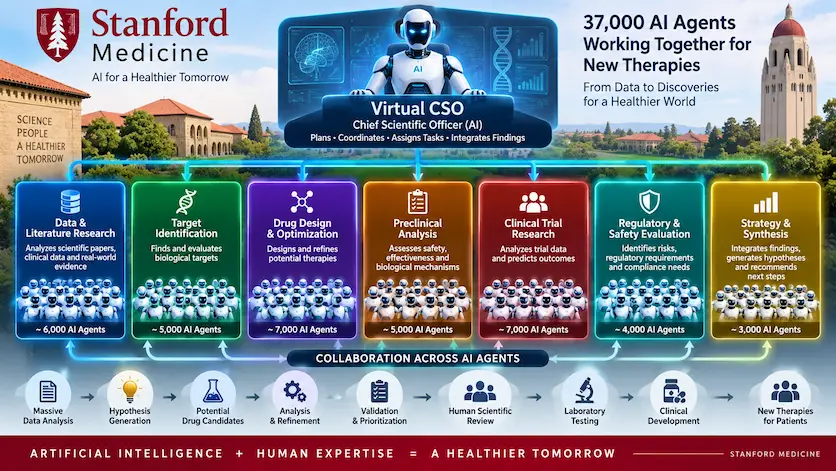
In a groundbreaking leap for biomedical data science, researchers at Stanford University have moved past the era of using artificial intelligence as a simple, single-prompt research assistant. Led by senior biomedical data science faculty, the team has engineered a fully functioning “Virtual Biotech”—a computational enterprise orchestrated by as many as 37,000 specialized AI agents operating in a structured, corporate-like hierarchy.
Rather than relying on a single large language model to sequentially parse complex biology, the Stanford system deploys a central Virtual Chief Scientific Officer (CSO) agent. This coordinating hub divides complex biomedical problems into thousands of granular sub-tasks, delegating them to specialized agent divisions focused on:
- Clinical-trial meta-analysis
- Target identification & multi-omic research
- Biological pathway modeling & spatial transcriptomics
- Therapeutic design and toxicology risk assessment
Key Research Findings: Clinical Trials & Lung Cancer
[Virtual Chief Scientific Officer Agent]
          │
          ├──> [Division A: 37,000 Agents Analyzing 55,000 Clinical Trials]
          │          └──> Discovered cell-type specificity & switch-like gene markers
          │
          └──> [Division B: Spatial Transcriptomics & Oncology Agents]
                     └──> Formulated B7-H3 ADC strategy against tumor-adjacent fibroblasts
1. Unlocking Patterns Across 55,000 Clinical Trials
In one of its largest experiments, the virtual organization assigned thousands of individual agents to cross-examine historical data from over 55,000 late-stage clinical trials. The AI network uncovered critical molecular biomarkers associated with regulatory success:
- Cell-Type Specificity: Experimental drugs targeting proteins unique to specific cell types demonstrated significantly higher progression rates across clinical development phases.
- “Switch-Like” Gene Activity: Proteins exhibiting bimodal, on-off gene expressions correlated with a higher probability of reaching market approval and fewer adverse drug reactions.
2. Decoding the B7-H3 Strategy in Lung Cancer
When tasked with tackling complex targets in lung cancer, the agents evaluated spatial-transcriptomic and gene-expression datasets. The system identified B7-H3 (CD276) expression on fibroblasts surrounding lung tumors, hypothesizing that these stromal cells actively suppress localized immune responses.
To bypass this mechanism, the AI agents designed an Antibody-Drug Conjugate (ADC) pipeline—a precision payload therapy built to bind B7-H3 and deliver cytotoxic agents straight to the tumor microenvironment.
3. Independent Pre-2025 Validation
To test true reasoning capacity, researchers cut off the AI system’s access to data published after January 2025. Working exclusively with older datasets, the virtual biotech derived a B7-H3 ADC strategy almost identical to one developed independently by conventional pharmaceutical researchers in real-world laboratories months later. While B7-H3 was already a known candidate, this experiment confirmed that autonomous multi-agent networks can match human-driven drug hypothesis generation.
AI-Assisted vs. AI-Organized Research
| Dimension | AI-Assisted Research (Legacy) | AI-Organized Swarm Architecture (Stanford Model) |
| Model Structure | Single prompt-response LLMs or dedicated point-models (e.g., AlphaFold) | Hierarchical network of up to 37,000 autonomous, tool-using agents |
| Task Execution | Sequential processing (one inquiry at a time) | Massive parallelization across thousands of sub-questions simultaneously |
| Workflow | Human researchers manually aggregate model outputs | Agents autonomously exchange data, challenge hypotheses, and synthesize reports |
| Primary Output | Single data points or molecular structures | End-to-end therapeutic proposals, complete with safety and mechanism analyses |
The Reality Check: Wet-Lab Validation Remains Essential
Despite the efficiency of the virtual institution, the researchers emphasize that digital models cannot eliminate real-world biological testing.
A hypothesis generated in silicon must still go through rigorous empirical validation:
In-Silico Agent Swarms → In-Vitro Cell Assays → In-Vivo Animal Models → Human Clinical Trials
Because biological systems harbor unpredictable feedback loops, computer-generated proposals require extensive wet-lab verification before reaching clinical applications.
Frequently Asked Questions (FAQ)
Q1: Did Stanford’s 37,000 AI agents invent a totally new, approved cancer drug?
No. The AI agents developed a viable, highly structured therapeutic hypothesis around B7-H3. This strategy matched real-world clinical efforts, serving as a methodological proof-of-concept rather than an immediate FDA approval.
Q2: Why use thousands of AI agents instead of one large AI model?
Drug discovery demands simultaneous synthesis across genetics, chemistry, toxicology, and regulatory history. Hierarchical agent swarms enable massive parallelization—each agent evaluates a micro-question, and lead agents aggregate these findings into a unified strategy.
Q3: Will AI agents replace human pharmaceutical scientists?
No. Agentic systems shift AI’s role from a basic assistant to an organizational engine. Human scientists set objectives, review agent findings, and conduct the wet-lab experiments needed to validate digital predictions.
Disclaimer
This article is intended solely for informational and educational purposes based on recent scientific research reports. It does not constitute medical, pharmaceutical, or investment advice. Any therapeutic strategy discussed must undergo standard pre-clinical and clinical validation by regulatory authorities before therapeutic use.
Related Links & Regional Media References
- Stay updated with international technology and science reporting on the main portal: Matribhumi Samachar English Edition.
- For inquiries, editor details, and organizational credentials, visit the official team registry: Matribhumi Samachar About Us.
