

Mumbai.
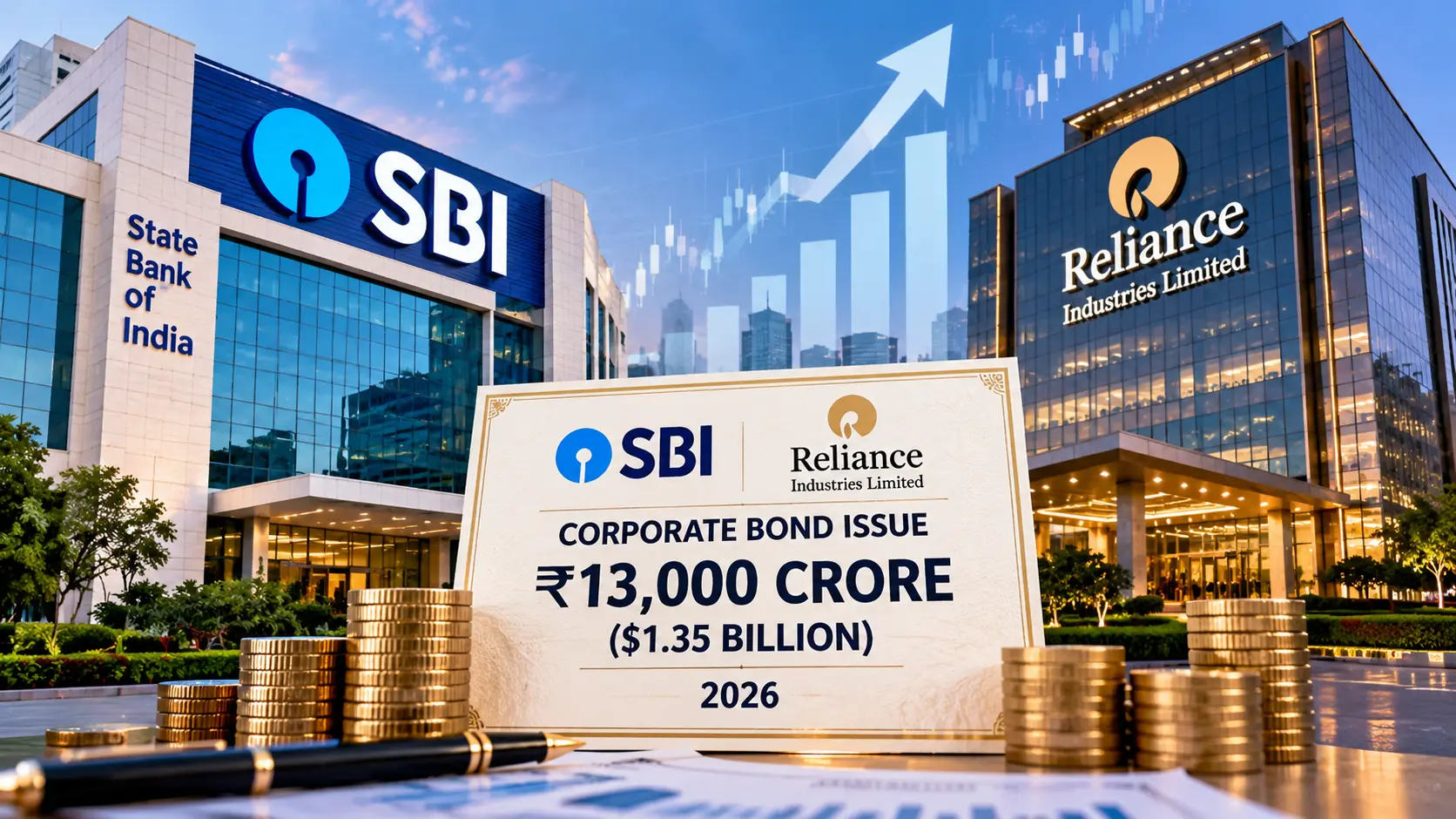
State Bank of India (SBI), India’s largest public sector lender, has taken a pivotal position in Reliance Industries Limited’s (RIL) latest ₹13,000 crore ($1.35 billion) corporate debt offering. By absorbing nearly ₹5,000 crore—roughly 40% of the overall issue—SBI has signaled robust institutional trust in India’s high-grade corporate bond space amidst shifting macroeconomic signals.
The transaction unfolds against a dynamic financial canvas in India, marked by evolving interest rate expectations, elevated global crude prices, and changing government borrowing dynamics.
Core Breakdown: Reliance’s Landmark 10-Year Debt Issue
The ₹13,000 crore 10-year corporate bonds are backed by a AAA rating from premier credit rating agencies, putting them in the top domestic credit bucket. The issuance attracted institutional market leaders, including mutual funds, pension funds, and insurance firms such as ICICI Prudential.
| Metric / Parameter | Value / Details |
| Issuer | Reliance Industries Limited (RIL) |
| Issue Size | ₹13,000 crore ($1.35 billion) |
| Maturity / Tenor | 10 Years |
| Coupon Rate | 7.90% Fixed p.a. |
| Credit Rating | AAA (Crisil / CareEdge) |
| Anchor Investor | State Bank of India (SBI) |
| SBI Allocation | ~₹5,000 crore (~40%) |
| Issue Date | September 30, 2026 |
Comparative Perspective: 5-Year vs. 10-Year September Issuances
This latest fundraising follows RIL’s ₹12,000 crore 5-year bond issuance earlier in September 2026 at a coupon rate of 7.47%. Across both offerings, Reliance secured an aggregate of ₹25,000 crore within a single month from the domestic rupee debt market.
September 2026 Domestic Debt Drive (Total: ₹25,000 Crore)
├── 5-Year Issue (Early Sept) : ₹12,000 Crore | Coupon: 7.47%
└── 10-Year Issue (Sept 30) : ₹13,000 Crore | Coupon: 7.90% (SBI ~40%)
The 43 basis points (bps) spread between the 5-year (7.47%) and 10-year (7.90%) coupons highlights the duration premium demanded by institutional investors. Longer-duration bonds carry greater exposure to market yield fluctuations and interest-rate cycles.
Key Strategic Takeaways
- Locking in Long-Term Capital: Raising long-duration 10-year paper at 7.90% enables Reliance to lock in long-term liquidity and insulate capital budgets from potential interest rate rises.
- Institutional Appetite for AAA Paper: SBI’s substantial 40% bid reflects banks’ preference for high-quality corporate assets to deploy liquidity while maintaining portfolio safety.
- Deepening Rupee Debt Infrastructure: Large corporate originations in the domestic market demonstrate that Indian capital markets can absorb heavy issue sizes alongside central government market borrowing programs.
Frequently Asked Questions (FAQs)
Why did SBI acquire such a large portion (~40%) of the Reliance issue?
SBI acquired nearly ₹5,000 crore of the ₹13,000 crore offering to gain high-yield exposure to a AAA-rated corporate balance sheet. Ten-year AAA bonds offer banks an optimal mix of safety, liquidity, and stable long-term yield.
What is the distinction between coupon rate and yield to maturity (YTM)?
The 7.90% coupon is the fixed annual interest paid on the face value of the bond. Yield to maturity (YTM) represents the total actual return an investor earns if held until maturity, fluctuating based on the market purchase price of the debt security.
How does central government market borrowing impact corporate bond pricing?
When sovereign bond yields rise due to government borrowing supplies, corporate bond yields benchmark upward accordingly to maintain an attractive credit spread over government securities (G-Secs).
Related Coverage on Matribhumi Samachar
For further insights into Indian financial markets, monetary policy, and corporate updates, explore related stories:
- India Central Government Trims FY27 Gross Market Borrowing: Key Takeaways & Yield Impact
- Matribhumi Samachar English – Latest Business & Financial News Coverage
- Union Finance Minister Proposes Support Measures for Indian Enterprise & Credit Flow
- Comprehensive Financial Savings & Interest Rate Comparison Guides
Disclaimer
This article is published purely for educational and news reporting purposes and does not constitute financial, investment, or trading advice. Market investments are subject to risk; readers are advised to consult qualified financial advisors before taking positions in fixed-income or corporate debt instruments.
