

Mumbai.
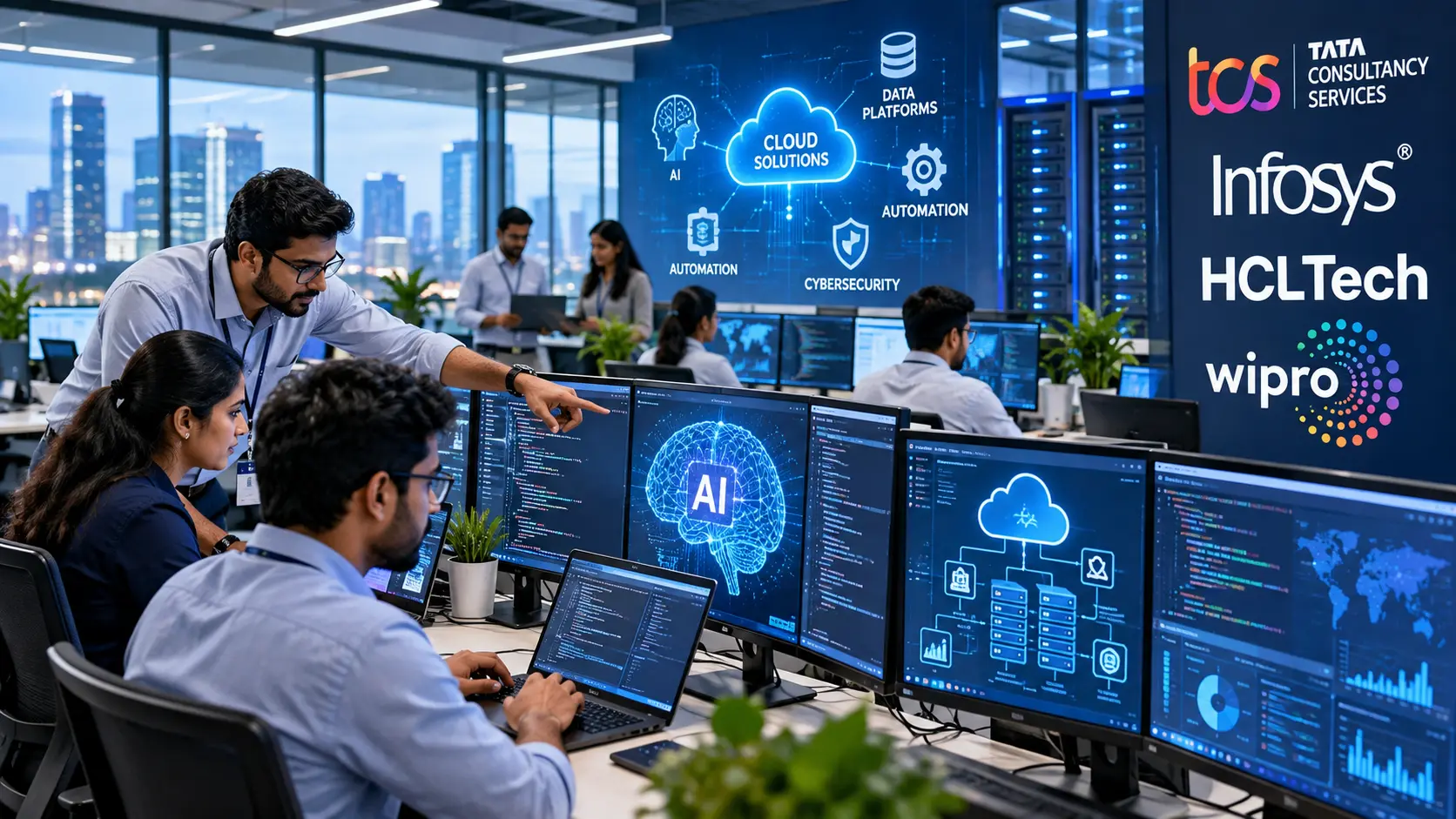
India’s information technology services industry is entering the September 2026 quarter earnings season under pressure from artificial intelligence-driven pricing changes, cautious client spending, and muted discretionary technology demand. Tier-1 technology majors—including Tata Consultancy Services (TCS), Infosys, HCLTech, and Wipro—face a structural transition as generative and agentic AI fundamentally change the economics of traditional IT outsourcing.
For decades, Indian technology firms generated a massive portion of their revenue using manpower-intensive, billable-hour models. The adoption of AI tools is enabling enterprise clients to automate repetitive tasks and demand productivity gains. As a result, clients are seeking contract price reductions, creating a temporary pricing bottleneck where AI productivity gains do not instantly convert into higher top-line revenue.
Enterprise Spending & Key Player Analysis
Global enterprise spending remains selective amid macroeconomic uncertainty and shifting corporate priorities. Performance in the United States—the largest revenue source for Indian IT service exports—remains particularly sensitive to cautious corporate budgets.
Company Insights
Tata Consultancy Services (TCS)
Entering the September quarter, market attention centers on TCS’s large-deal total contract value (TCV) and conversion velocity. While large contracts remain a major driver, AI-related efficiency demands are impacting contract sizing and required headcount. The priority for TCS is optimizing margin performance relative to contract pricing pressures.
Infosys
Infosys enters the earnings season amid expectations of muted growth due to uneven global demand. The firm continues to reallocate resources toward specialized technology roles in data analytics, cloud architecture, cybersecurity, and automation as part of its enterprise transformation strategy.
HCLTech
HCLTech remains focused on AI implementation, cloud operations, and software transformation services. Its quarterly performance hinges on successfully converting recent bookings into organic revenue growth while balancing client demands for productivity savings.
Wipro
Wipro continues to expand its exposure to AI, cloud, and digital transformation verticals while navigating softer demand across legacy service lines. Adapting traditional IT offerings to changing client expectations remains critical to its growth strategy.
Margin Impacts: Potential Risks vs. Strategic Benefits
The integration of artificial intelligence introduces both margin challenges and cost efficiencies for technology service providers.
IT SERVICES MARGIN DYNAMICS IN THE AI ERA
┌───────────────────────────────┬──────────────────────────────┐
│ POTENTIAL PRESSURES │ STRATEGIC BENEFITS │
├───────────────────────────────┼──────────────────────────────┤
│ • Lower billing hours │ • Enhanced employee output │
│ • Client pricing demands │ • Lower execution costs │
│ • Reduced headcount needs │ • New AI consulting revenues │
│ • Legacy contract repricing │ • AI infrastructure management│
└───────────────────────────────┴──────────────────────────────┘
Foreign Exchange Cushion & FY27 Outlook
A weaker Indian Rupee provides a partial margin buffer for export-driven IT providers, given that revenues are primarily earned in foreign currencies (USD, EUR, GBP) while a significant portion of operational expenses is denominated in INR. However, net currency gains remain subject to corporate hedging strategies and settlement timing.
The September 2026 earnings results will provide insight into whether current challenges represent temporary cyclical headwinds or a permanent shift toward AI-native service delivery models.
Frequently Asked Questions (FAQ)
What is the main challenge facing the Indian IT sector in Q2 FY27?
The primary challenge is navigating AI-driven pricing compression on traditional time-and-material contracts alongside cautious corporate technology spending in North America and Europe.
How does generative AI impact traditional IT contract pricing?
Generative AI allows tasks to be completed faster with fewer billable hours, leading enterprise clients to request lower pricing or productivity discounts during contract renewals.
Does rupee depreciation benefit Indian IT companies?
Yes. Rupee depreciation increases local-currency realization for foreign earnings, helping support operating margins, though actual net gains depend on hedging positions.
Disclaimer
The information presented in this article is for informational and educational purposes only and does not constitute financial, investment, or trading advice. Market conditions and corporate performance vary based on broader macroeconomic factors.
Related Coverage from Matribhumi Samachar
- Building the Integrated Digital Flywheel: How AI, Semiconductors, Quantum, Data, Power, and Talent Interlock for India’s Tech Sovereignty
- The Subnational Blueprint: How Indian States Are Architecting a Decentralized AI Revolution
- India’s Next Industrial Revolution: How Semiconductors, AI Infrastructure, and High-Tech Manufacturing Are Driving Economic Growth
