 Matribhumi Samachar English


Guwahati. Monday, 13 July 2026
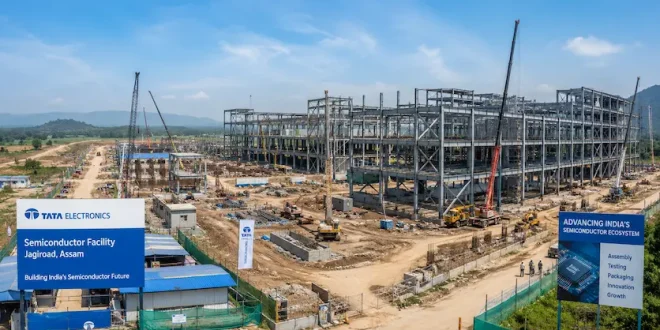
India’s mission to become a dominant global chip hub has hit high gear with massive financial clearance for the Tata Electronics semiconductor project in Assam. In an official disclosure to the Assam State Assembly, the government confirmed a combined subsidy package worth more than ₹14,044 crore, solidifying the long-term financial path for this landmark project.
Developed at the redeveloped site of the defunct Nagaon Paper Mill in Jagiroad (Morigaon district), the ₹27,000 crore high-tech campus is moving at an unprecedented pace. The multi-billion-dollar project marks a profound historical shift, bringing high-value deep-tech industrial infrastructure to Northeast India.
Direct Breakdown of the ₹14,044 Crore Subsidy Structure
The financial commitment from both state and federal authorities highlights the strategic importance of the facility. The incentive framework ensures heavy co-investment to offset initial capital expenditure:
-
Central Government Incentive: ₹10,255 crore approved under the India Semiconductor Mission (ISM).
-
Assam State Government Subsidy: ₹3,789 crore sanctioned specifically by the state to guarantee long-term operational success.
-
Total Private Outlay: Tata Electronics is backing the greenfield plant with an approximate investment of ₹27,000 crore.
Key Timelines, Production, and Global Partnerships
Unlike a traditional wafer fabrication facility (fab), the Jagiroad plant operates as an Outsourced Semiconductor Assembly and Test (OSAT) and advanced packaging facility. The plant acts as the essential backend hub where raw silicon wafers are transformed into finished chips ready for consumer markets.
Union Electronics and IT Minister Ashwini Vaishnaw confirmed that production at the high-capacity facility is expected to commence within the current financial year. Once fully operational, the plant is designed to manufacture an astonishing 48 million semiconductor chips per day.
Tata Electronics has already locked in high-profile global alliances to channel this massive capacity straight into international tech supply chains:
-
Qualcomm: A signed partnership will see the facility manufacture specialized Qualcomm Automotive Modules directly in Assam to power software-defined connected vehicles.
-
Intel: A strategic compute alliance will leverage the plant for cutting-edge AI chip assembly and computing infrastructure.
-
ASML & ROHM: Strategic agreements have been initialized to integrate advanced chip-making equipment, supply chain infrastructure, and power management IC lines.
Technical Insights: Advanced Packaging Portfolio
The Jagiroad OSAT facility handles deep engineering processes rather than simple device assembly. The technical operations will deploy three primary platform architectures:
-
Wire Bond: A foundational interconnection methodology using microscopic gold, copper, or aluminum wire to route power and signals between the chip’s internal components and external pads.
-
Flip Chip: A high-density packaging style where solder bumps are deposited face-down directly onto the circuit board. This drastically shortens the signal pathway, minimizes electronic parasitics, and enhances thermal cooling.
-
Integrated Systems Packaging (ISP): A sophisticated advanced packaging platform that integrates distinct logic processors, memory modules, and sensors into one unified, ultra-compact high-performance package—ideal for high-end AI servers and electric vehicles (EVs).
Transformative Regional and Economic Impact
The project resolves a historical geographic imbalance by embedding a flagship technology ecosystem in Northeast India. The human and economic scale of the plant includes:
-
Employment Boom: The project will generate over 27,000 jobs, broken down into roughly 15,000 direct employment opportunities and 12,000 indirect roles in auxiliary services.
-
Eco-Friendly Infrastructure: The Jagiroad location was explicitly selected for its localized availability of abundant industrial water and green renewable power infrastructure.
-
Ecosystem Magnetism: The plant is structured to draw in ancillary suppliers, precision chemical vendors, and packaging component manufacturers, creating a massive, self-sustaining electronic manufacturing corridor near Guwahati.
Frequently Asked Questions (FAQ)
What is the exact location of the Tata semiconductor plant in Assam?
The plant is being constructed across a sprawling campus at Jagiroad in the Morigaon district of Assam, redeveloping the site of the former Hindustan Paper Corporation’s Nagaon Paper Mill.
When will the Assam semiconductor facility start production?
According to the latest government reviews, production is targeted to begin within the current financial year, with the primary facilities achieving full high-volume operation quickly.
What is the difference between this OSAT facility and the Dholera plant?
The Dholera facility in Gujarat is a front-end semiconductor fabrication plant (Fab) that prints circuits onto raw silicon wafers. The Assam Jagiroad facility is a back-end OSAT plant that cuts, packages, and tests those chips so they can function inside final electronics.
Disclaimer
This article is for informational purposes only. The project details, investment matrices, and timelines reflect official statements released by the Government of India, the Government of Assam, and Tata Electronics. Readers are advised to monitor official corporate announcements for real-time adjustments to project execution schedules.
For localized regional perspectives on major economic and industrial developments across the nation, explore the latest English news dispatches at Matribhumi Samachar English.