 Matribhumi Samachar English


New Delhi | Tuesday, 14 July 2026
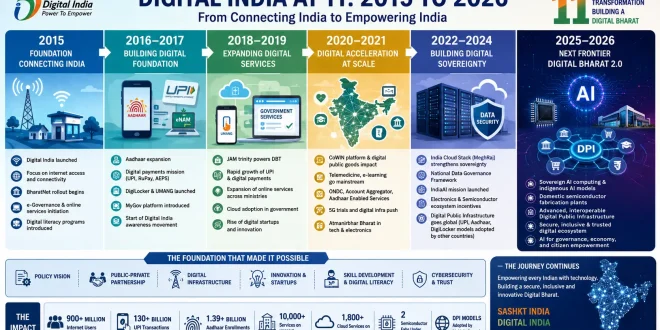
Eleven years after its initial launch, the Digital India program has undergone a massive structural shift. What began in 2015 as a foundational effort to build internet connectivity, roll out digital identity, and digitize basic public services has completely transformed into a sophisticated national strategy. Today, India is pivoting toward a high-tech, innovation-driven economy rooted deeply in Sovereign Artificial Intelligence (AI), Domestic Semiconductor Fabrication, and globally recognized Digital Public Infrastructure (DPI).
As the country navigates this new wave of industrial growth, policymakers are aggressively prioritizing tech-led economic expansion, supply-chain resilience, and cutting-edge digital frameworks.
1. Artificial Intelligence: The New Engine of National Productivity
Artificial intelligence is no longer just a futuristic software layer—it has become core national infrastructure driving major sectors. Instead of relying entirely on external technological ecosystems, India’s current strategy leans heavily toward sovereign computing capability. The state’s primary focus has shifted directly to:
-
Indigenous AI Models: Creating localized large language models (LLMs) trained on diverse regional datasets.
-
Sovereign AI Compute Infrastructure: Deploying massive hyperscale data centers and graphics processing unit (GPU) clusters to power local deep-tech innovation.
-
Cross-Sectoral Adoption: Integrating predictive and generative AI into critical pillars like clinical healthcare diagnostics, supply chain logistics, and automated tax compliance environments like the Goods and Services Tax (GST) system.
From banking institutions utilizing deep core AI operations for lightning-fast micro-lending to state-level programs scaling custom automation policies, artificial intelligence is reshaping public and private sector efficiency.
2. The Silicon Leap: Building a Semi-Conductor Powerhouse
One of the defining shifts of the 2026 digital landscape is India’s aggressive campaign to eradicate its legacy microchip import dependencies. Shifting from a global center known purely for chip design talent, the country is actively building physical fabrication and manufacturing infrastructure.
Through structured frameworks like the India Semiconductor Mission (ISM), massive developments are targeting the entire microchip supply chain:
| Core Focus Area | Primary Objectives |
| Fabrication (Fab) Projects | Securing local sub-nanometer and mature node silicon manufacturing lines. |
| OSAT & Packaging | Building massive Outsourced Semiconductor Assembly and Test facilities to solidify electronics assembly. |
| Talent Development | Engineering highly specialized educational pathways to train workforce pools in hardware architecture. |
This hardware push ensures that foundational industries—ranging from commercial electronics and automotive systems to precision aerospace technologies—remain decoupled from unexpected global supply chain disruptions.
3. Digital Public Infrastructure: Beyond Basic Payments
India’s Digital Public Infrastructure (DPI) has earned massive international recognition, primarily through the success of open payment rails and digital identity schemes. Now, the modern DPI framework is scaling far past retail banking.
The interoperable digital ecosystem is currently building out unified networks across the broader economic fabric:
-
Healthcare Records: Interoperable personal health repositories enabling seamless clinical data sharing.
-
Open Digital Commerce: Democratizing retail networks to allow small businesses to sell across platforms without centralized gatekeepers.
-
Logistics & Business Compliance: Streamlining freight tracking, enterprise transport layers, and real-time regulatory compliance workflows.
4. Hardening Cyber Resilience and Trusted Governance
With mass-scale digitization accelerating across every sector, systemic vulnerability is an ever-present reality. The modern phase of Digital India places heavy structural focus on building an impenetrable cybersecurity and privacy architecture.
Current directives prioritize shielding critical information infrastructure, establishing robust digital trust protocols, and drafting proactive legislation to minimize operational concentration and cloud dependencies. Mitigating algorithmic anomalies, eliminating model bias, and securing complex data flows are now considered non-negotiable baselines for sustaining public and corporate trust.
Navigating the Strategic Bottlenecks
While the technological growth curve remains sharp, realizing the full scale of India’s digital potential requires managing a few distinct bottlenecks:
-
The AI-Ready Workforce: Rapidly training engineering talent to fill high-skilled software engineering and deep hardware architecture needs.
-
The Urban-Rural Divide: Closing persistent broadband and high-speed infrastructure disparities across remote regions.
-
Data Governance Frameworks: Implementing clear legal guardrails that foster deep-tech experimentation while enforcing uncompromised data privacy laws.
As Digital India enters the next decade, the focus has completely pivoted away from basic online access and moved squarely toward global tech leadership and deep physical innovation.
Frequently Asked Questions (FAQ)
Q1: How has the primary goal of Digital India shifted since 2015?
A: In 2015, the focus was entirely on establishing foundational digital elements: broadband internet expansion, rolling out digital identity systems, and bringing basic government interactions online. In 2026, the strategy prioritizes sovereign advanced tech, localized semiconductor manufacturing, cross-industry AI adoption, and resilient cyber infrastructure.
Q2: What is “Sovereign AI” and why is it important for India?
A: Sovereign AI refers to a country’s capacity to build its own native AI models, manage domestic computing infrastructure, and regulate data locally. This avoids structural reliance on foreign technology platforms and customizes AI processing to suit domestic economic priorities.
Q3: How is India expanding its Digital Public Infrastructure (DPI)?
A: Beyond digital identity and the Unified Payments Interface (UPI), modern DPI is branching directly into secure digital healthcare documentation, unified agriculture platforms, open-source e-commerce ecosystems, and synchronized supply-chain tracking networks.
Disclaimer
This article is for informational and educational purposes only. The strategic assessments, policy frameworks, and market analyses detailed here reflect data compiled up through mid-2026 and do not constitute formal policy endorsements or specific financial or investment guidance.
Related Strategic Updates from Matribhumi Samachar:
-
Read about regional computational growth blueprints in Haryana Digital Transformation: Capitalizing on the 2026 AI and Data Centre Policies.
-
Explore localized packaging advancements in India’s Silicon Leap: How the Sanand OSAT Facility Solidifies Domestic Electronics Manufacturing.
-
Dive into how automated public workflows are scaling via How Artificial Intelligence is Quietly Revolutionizing India’s GST System.