 Matribhumi Samachar English


New Delhi. Thursday, 30 July 2026
India’s digital public infrastructure (DPI) has transformed how citizens interact with government services, banks, educational institutions, and employers. At the center of this revolution is DigiLocker, a government-backed platform under the Ministry of Electronics & Information Technology (MeitY) that has evolved far beyond a cloud storage drive.
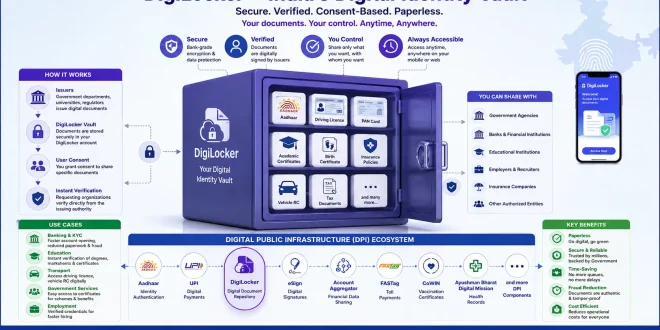
Today, DigiLocker functions as India’s Digital Identity Vault—a secure, consent-driven platform where hundreds of millions of citizens access, store, share, and verify legally recognized documents directly from original issuing authorities. Its success has even led to global expansion, with nations like Kenya and Cuba deploying localized versions of the platform.
What is DigiLocker?
DigiLocker is a flagship initiative of the Digital India Programme. It provides every registered citizen with a dedicated digital wallet linked to their verified identity. Approved issuers—such as the Central Board of Secondary Education (CBSE), state transport departments, universities, and income tax authorities—can push authenticated digital credentials directly into a citizen’s wallet.
  +---------------------------------------------------------------+
  |                      DIGILOCKER ECOSYSTEM                     |
  +---------------------------------------------------------------+
  |  Issuers (CBSE, RTO, Tax Dept) --> Digitally Signed Record     |
  |                                        |                      |
  |                                        v                      |
  |                     Citizen's Digital Document Wallet          |
  |                                        |                      |
  |                                        v                      |
  |  Verifiers (Banks, Employers, Govt) <-- Consent-Based Access  |
  +---------------------------------------------------------------+
Difference Between DigiLocker and Cloud Storage
| Feature | Standard Cloud Storage | DigiLocker |
| Document Source | User-uploaded scans or files | Directly issued by official authorities |
| Verification | Requires manual paper cross-checking | Real-time electronic verification via digital signatures |
| Legal Validity | Varies; often requires physical originals | Legally equivalent to physical documents under IT Rules |
| Ecosystem | Standalone personal storage | Integrated with India’s national DPI |
Why It Is Called a Digital Identity Vault
A digital identity vault goes beyond storing static copies; it actively maintains verified credentials. DigiLocker executes this through three core capabilities:
1. Authentic Digital Documents
Instead of static images or PDFs, fetched documents are digitally signed XML/JSON records issued by original databases. Examples include:
-
Identity Documents (Aadhaar, PAN)
-
Transport Records (Driving License, Vehicle Registration)
-
Academic Credentials (Board marksheets, University degrees)
-
Health & Insurance Records (Vaccination certificates, policy documents)
2. Consent-Based Sharing
Citizens maintain total sovereignty over their personal data. Users decide:
-
Which specific document to share
-
The exact recipient organization
-
The duration and purpose of access
3. Real-Time Verification
Receiving organizations (such as banks or recruiters) verify authentic credentials through automated APIs connected to the issuer’s database, eliminating manual background checks and preventing document fraud.
DigiLocker in India’s DPI Ecosystem
DigiLocker acts as the document repository layer within India’s broader Digital Public Infrastructure network:
| DPI Component | Strategic Role |
| Aadhaar | Biometric identity authentication |
| UPI | Instant, interoperable payment rails |
| DigiLocker | Verified digital document repository |
| eSign | Legally binding electronic signatures |
| Account Aggregator | Secure financial data sharing |
| ABDM / CoWIN | Digital health and vaccination records |
Key Real-World Applications
-
Banking & Finance: Streamlines Know Your Customer (KYC) compliance for bank accounts, loans, and demat accounts.
-
Education & Employment: Universities upload degrees directly (e.g., UP universities issuing tens of thousands of degrees to DigiLocker instantly). Employers verify credentials in seconds during hiring.
-
Transport & Traffic Rules: Drivers present digitally issued Driving Licenses and Vehicle RCs to traffic authorities during road checks.
-
Global Footprint: As part of India’s global DPI cooperation, countries like Kenya and Cuba have adopted DigiLocker frameworks for their own public document governance.
Security, Challenges, and Future Outlook
Security Safeguards
-
Multi-factor & OTP-based access
-
End-to-end encrypted communications
-
Audit trails for user actions and data access
Remaining Challenges
-
Universal Integration: Ongoing onboarding of smaller local bodies and private institutions.
-
Digital Literacy: Need for awareness in rural regions to switch from physical papers to app-based verification.
-
Institutional Familiarity: Upgrading legacy internal processes in organizations that still request physical paper files.
Frequently Asked Questions (FAQ)
1. Are DigiLocker documents legally valid?
Yes. Under the Information Technology (Preservation and Retention of Information by Intermediaries Providing Digital Locker Facilities) Rules, digitally issued documents fetched via DigiLocker are treated at par with original physical documents.
2. How does DigiLocker prevent document fraud?
Documents are pulled directly from the issuing authority’s database (e.g., RTO or Education Board) with cryptographic digital signatures, making forging or altering files nearly impossible.
3. Is DigiLocker available outside India?
While built for Indian citizens, India has signed implementation frameworks to export the DigiLocker platform model to partner nations like Kenya and Cuba.
Disclaimer
This article is published for general informational and educational purposes. Features, partner issuer lists, and regulatory rules regarding DigiLocker and India’s Digital Public Infrastructure are subject to official government guidelines and platform updates.
Related Links
-
Explore regional digital governance coverage and societal updates on Matribhumi Samachar English.