

New Delhi. Sunday, 17 May 2026
In today’s fast-paced academic environment, students are expected to balance classes, assignments, exams, extracurricular activities, and personal responsibilities. Managing all these tasks effectively can feel challenging. Time management is no longer just a useful skill—it has become an essential habit for academic success and personal growth.
Students who manage their time wisely often experience lower stress levels, improved focus, better grades, and a healthier work-life balance. Developing a structured approach early can create long-term benefits that extend beyond school and into future careers.
Why Time Management Matters for Students
Many students struggle not because they lack ability, but because they lack a system for organizing their time. Poor time management can lead to procrastination, missed deadlines, anxiety, and rushed, low-quality work.
When you learn to control your schedule, you gain control over your mental well-being. Effective time management helps students:
Complete assignments on time without the last-minute panic.
Reduce academic stress and eliminate late-night cramming.
Improve concentration and productivity during study sessions.
Create guilt-free time for hobbies, socializing, and relaxation.
Maintain better mental well-being and prevent academic burnout.
Develop discipline and responsibility, which are crucial for career readiness.
Learning how to manage time efficiently allows students to transform from reactive learners (always putting out fires) to proactive learners (staying ahead of the curve).
1. Create Clear Daily Priorities (The Rule of 3)
One of the biggest mistakes students make is writing an exhaustive, 20-item to-do list and trying to accomplish everything at once. This instantly triggers analysis paralysis, leading to procrastination.
Instead, narrow your focus using a modified Rule of 3:
Three major priorities: These are high-value, non-negotiable tasks (e.g., studying for a chemistry midterm, writing an essay introduction, or attending a group project meeting).
Two or three smaller tasks: Lower-stakes activities that take less cognitive energy (e.g., replying to a teacher’s email, organizing your binder, or printing a reading assignment).
By focusing on fewer high-value activities, students can avoid feeling overwhelmed and maintain steady, visible progress every single day.
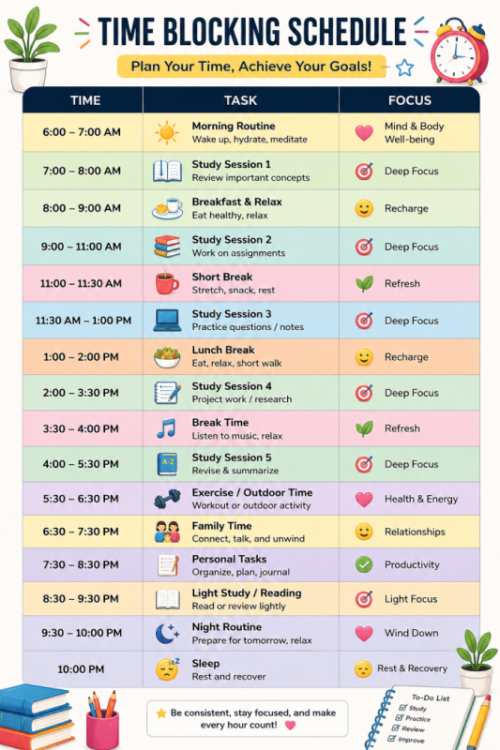
2. Use Time Blocking for Better Organization
Time blocking is a method where you divide your day into predictable blocks of time. Each block is dedicated to a specific task or a group of tasks. Unlike a generic to-do list, time blocking forces you to reckon with when you will get the work done.
Example Student Time-Blocking Schedule:
4:00 PM – 5:00 PM: Mathematics homework (High focus)
5:00 PM – 5:30 PM: Break / Healthy Snack / Walk outside
5:30 PM – 6:30 PM: Science revision & flashcards
6:30 PM – 7:00 PM: Dinner with family
7:00 PM – 8:00 PM: Reading, assignment & journaling
Scheduling specific tasks into fixed time constraints creates psychological urgency, reduces the friction of starting, and increases overall accountability.
3. Try the Pomodoro Study Technique
If you find yourself staring at a textbook for hours without absorbing a single word, your brain is likely fatigued. The Pomodoro Technique is designed to sustain high-level focus while building systematic rest into your workflow.
How to Execute the Pomodoro Cycle:
Choose a single task to work on (e.g., reading a history chapter).
Set a timer for 25 to 50 minutes and work with absolute focus. No phone checking, no opening other tabs.
Take a short 5 to 10-minute break when the timer rings. Stand up, stretch, grab a glass of water, or step away from your desk. Do not scroll social media, as this does not give your brain a true neurological break.
Repeat this process for four cycles.
Take a longer break of 20 to 30 minutes to fully recharge before your next deep-work session.
4. Stop Multitasking (Embrace Single-Tasking)
Many students proudly claim they can watch a lecture, text their friends, and listen to music simultaneously. However, cognitive science proves that human brains cannot process multiple high-attention tasks at once. Instead, the brain rapidly switches back and forth between tasks, creating a phenomenon called context switching.
Context switching drains your mental energy, introduces errors, and extends the time it takes to complete an assignment.
Benefits of Single-Tasking:
Deeper attention span: You dive into a state of “deep work” where complex problem-solving becomes easier.
Enhanced memory retention: Information moves smoothly from your short-term working memory into long-term storage.
Higher study quality: You catch mistakes early and produce deeper analysis.
Elevated productivity: You finish your work significantly faster than you would if your attention were fractured.
5. Plan Weekly, Not Just Daily
While daily planning keeps your day organized, it can leave you blind to upcoming obstacles. Macro-planning on a weekly basis allows you to anticipate heavy workloads before they happen.
Set aside 15 to 20 minutes every Sunday evening to map out the upcoming week. Review:
Upcoming exams and quizzes: This prevents you from realizing you have a test tomorrow morning.
Assignment deadlines & project submissions: You can see which days will require the most effort.
Extracurricular and personal commitments: Balance practice, work shifts, or family gatherings with your study load.
When you see a large project due on Friday, use your weekly plan to break it down into smaller, bite-sized tasks distributed across Monday, Tuesday, and Wednesday. This completely eliminates last-minute panic and rushed submissions.
6. Minimize Digital Distractions
Smartphones, tablets, and social media notifications are custom-engineered to hijack your attention. Every time your phone buzzes, your focus is shattered, and it takes an average of 23 minutes to regain deep focus on your original task.
Practical Ways to Reclaim Your Attention:
Utilize Do Not Disturb (DND) or Focus Modes: Program your devices to silence everything except emergency contacts during study blocks.
The “Out of Sight” Rule: Physically place your phone in another room or inside a zipped backpack. If you have to stand up and walk to get it, you break the unconscious habit of reaching for it.
Install Focus Applications: Use gamified apps like Forest (where a virtual tree grows while you stay off your phone) or website blockers like Freedom or Cold Turkey to lock yourself out of distracting websites during study hours.
7. Prioritize Sleep, Nutrition, and Health
You cannot manage your time effectively if you do not manage your energy. Sacrificing sleep to squeeze in extra hours of studying is a counterproductive trap. A sleep-deprived brain suffers from degraded memory recall, slower cognitive processing, and emotional irritability.
Maintain These Essential Energy Habits:
Protect your sleep: Ensure you get 7 to 9 hours of quality sleep. Sleep is the biological mechanism that consolidates memory and clears out neural waste.
Stay properly hydrated: Dehydration causes immediate brain fog, fatigue, and headaches. Keep a water bottle at your study station.
Incorporate movement: Even a quick 10-minute walk or light stretching can stimulate blood flow to the prefrontal cortex, enhancing problem-solving abilities and alleviating mental anxiety.
Final Thoughts
Time management is not about turning yourself into a rigid robot or filling every single minute of your day with relentless labor. True time management is about intentionality. It is about working smarter during your designated study periods so that you can thoroughly enjoy your personal life without a cloud of academic guilt hanging over your head.
Start small. Choose just one strategy from this guide—whether it is time blocking your afternoon or turning off your notifications for a 25-minute Pomodoro session—and practice it consistently. Small daily adjustments yield massive academic and personal transformation over time.
Relevant Links
For instance, students are increasingly looking at the Top AI Tools for Students 2026: The Ultimate Guide to Smart Learning
For more continuous updates on academic milestones and educational insights, keep an eye on the Matribhumi Samachar Education Category.
Disclaimer:
This article is intended solely for informational purposes. The productivity methods, tips, and external tools mentioned are suggestions for self-improvement and do not guarantee specific academic outcomes. Always consult with educational mentors or professionals for specific advice tailored to your situation.
