

New Delhi. Monday, 6 July 2026
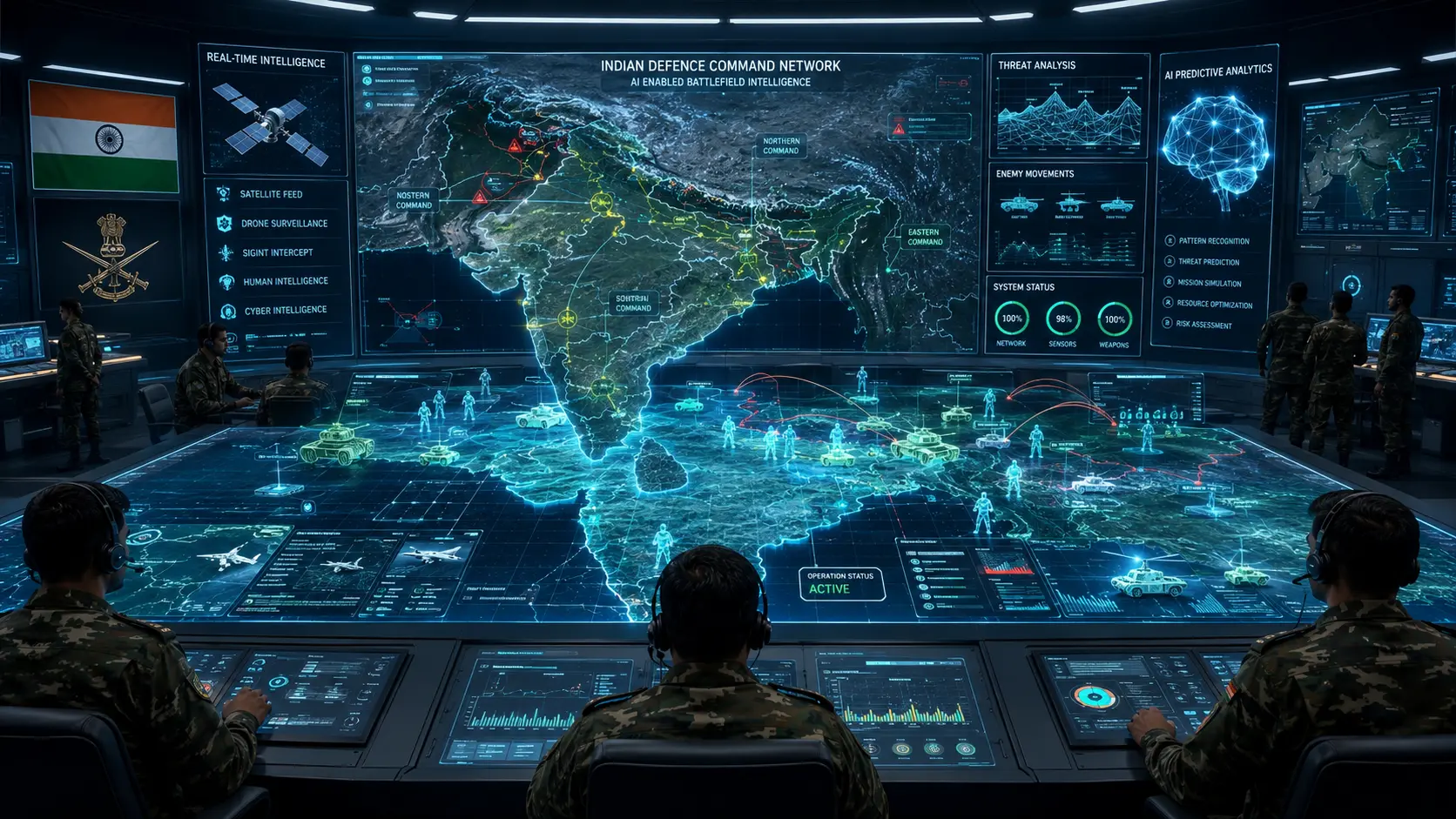
The global matrix of modern warfare has undergone a permanent shift, moving rapidly away from conventional military hardware and heavily toward automated, data-driven systems. In this high-stakes technological race, India is aggressively positioning itself at the forefront. No longer is traditional military superiority determined solely by troop numbers or conventional arsenals; instead, modern capabilities depend on how effectively a nation can collect, analyze, and act upon massive volumes of battlefield data in real time.
By integrating Artificial Intelligence (AI) and Machine Learning (ML) into its future defence strategy, India’s armed forces are shifting their operational readiness into overdrive, mitigating human risk, and fortifying national security across land, air, sea, space, and cyberspace.
Why AI Has Become India’s Strategic Defence Priority
In active military operations and peacetime monitoring alike, AI provides an undeniable edge by compressing the time it takes to turn raw data into actionable commands. Traditional human-led data analysis simply cannot keep pace with modern battlefield speeds.
Implementing AI allows military organizations to achieve several key objectives:
Rapid Intelligence Processing: Analyzing raw battlefield data within seconds to provide immediate situational awareness.
Early Threat Detection: Identifying anomalies and potential border infiltrations long before they escalate.
Enhanced Surveillance: Maintaining continuous overwatch across highly complex terrains, including mountains, deserts, and oceans.
Streamlined Logistics: Automating repetitive administrative and operational supply chain loops.
Advanced Decision Support: Providing commanders with simulated outcomes to help them evaluate multiple scenarios before executing critical orders.
The Rise of Indigenous AI and Unmanned Systems
A core pillar of India’s modernization roadmap is reducing its dependency on foreign original equipment manufacturers (OEMs). This push for technological sovereignty is deeply embedded in policy overhauls like the Draft Defence Acquisition Procedure (DAP) 2026, which fundamentally revolutionizes military procurement by prioritizing indigenously designed, developed, and manufactured (Buy Indian-IDDM) hardware.
This strategic policy shift has given rise to a booming domestic unmanned aerial vehicle (UAV) ecosystem. According to recent insights on The Rise of Indigenous Defence Drones on Matribhumi Samachar, the Indian defence drone sector is entering an unprecedented phase of expansion. Funded by aggressive private-sector innovation and government incubation programs like iDEX (Innovations for Defence Excellence), Indian startups are engineering advanced deep-tech platforms featuring:
Autonomous Navigation: Operating seamlessly in GPS-denied environments using optical flow and terrain-contour matching.
Edge-AI Target Recognition: Real-time classification of military assets, personnel, and camouflage anomalies directly on the drone’s localized payload computer.
Swarm Coordination: Utilizing decentralized mesh networks where dozens of autonomous drones communicate with one another to overwhelm hostile air defenses without a single point of failure.
This domestic tech push mirrors India’s broader macroeconomic focus on data sovereignty, similar to the foundational technological pivots seen in the nation’s digital public infrastructure as documented in the analysis of India’s Sovereign AI Leap.
Multi-Domain AI Applications Across the Armed Forces
1. Intelligent Surveillance and Border Security
India shares some of the world’s most geographically hostile borders. AI-powered intelligent fences and thermal imaging systems automatically flag unusual movements, monitor cross-border drone activity, and dramatically reduce false alarms, allowing security personnel to deploy efficiently.
2. Predictive Maintenance of Heavy Military Hardware
From fighter jets and naval ships to main battle tanks, military assets require intensive upkeeps. AI algorithms monitor equipment health parameters in real time, predicting component failures before they happen. This preserves the lifespan of multi-million dollar assets and maximizes mission-readiness.
3. Advanced Cybersecurity Infrastructure
As cyber warfare evolves into a primary vector for state-sponsored aggression, military networks utilize AI to automatically spot malicious data patterns, identify zero-day vulnerabilities, and deploy instantaneous defense protocols against incoming network attacks.
4. Robotics and Space-Based Intelligence
AI-enabled robotic platforms are taking over highly hazardous tasks, including bomb disposal, tunnel exploration, and battlefield casualty evacuation. Simultaneously, AI is scaling up into orbital data systems, boosting space situational awareness by tracking satellite trajectories and optimizing military communication arrays.
Navigating the Ethical and Operational Boundaries
Despite the distinct advantages, defence experts and policymakers emphasize that military AI integration must be handled with intense caution. Key challenges include maintaining strict human oversight over autonomous weapon systems, guarding against algorithmic bias, ensuring data security, and maintaining compliance with international humanitarian law.
The consensus across India’s military leadership remains absolute: AI must serve as an advanced decision-support mechanism, ensuring that the ultimate responsibility for critical combat decisions stays firmly in human hands.
Frequently Asked Questions (FAQ)
What is the primary focus of India’s indigenous defence drone initiative?
The primary goal is achieving absolute self-reliance (Atmanirbhar Bharat) in unmanned military technology. Developing local hardware, software, and assembly pipelines ensures data security, lowers procurement costs, and allows the Indian Armed Forces to customize equipment for specific regional environments.
How does the Draft DAP 2026 impact domestic defence technology?
The Draft Defence Acquisition Procedure (DAP) 2026 completely updates the procurement process by establishing strict preferences for indigenously designed, developed, and manufactured (IDDM) technologies. It incentivizes private capital, tech startups, and domestic MSMEs to build next-generation military applications on Indian soil.
Does AI replace human commanders in Indian military strategy?
No. Artificial Intelligence functions as an advanced decision-support system. It processes vast arrays of data, coordinates logistics, and runs simulations to provide faster choices for leaders, but humans remain responsible for critical, life-altering combat actions.
Disclaimer: The information presented in this article is based on publicly available policy drafts, official defense statements, and news reports as of 2026. The views expressed regarding strategic defense architectures are intended solely for informational and educational purposes.
