

Mumbai. Friday, 24 July 2026
The global race to build Artificial Intelligence (AI) infrastructure has officially entered a high-stakes second phase. While the first wave centered almost exclusively on semiconductor foundries and GPU design, the tech ecosystem is now rapidly expanding into advanced AI server manufacturing, system integration, and specialized data center hardware.
A major milestone illustrating this shift is Taiwanese electronics giant Wistron opening a US$700 million smart manufacturing facility in Texas. Explicitly built to manufacture Nvidia’s latest AI computing systems—including the Grace Blackwell architecture—the facility represents a structural turning point in how hardware powers the modern AI economy.
Why Traditional Factories Can’t Build AI Servers
Unlike standard Electronics Manufacturing Services (EMS) facilities designed for smartphones, laptops, or tablets, an AI-dedicated factory operates on an entirely different scale of engineering complexity:
Massive Output Requirements: Wistron’s new facility is designed to scale to tens of thousands of high-performance AI system boards every month to satisfy hyperscale cloud orders.
Extreme Thermal & Power Demands: Multi-kilowatt GPU racks require precision liquid cooling loops, heavy-duty power delivery networks, and ultra-high-density Printed Circuit Boards (PCBs).
System-Level Testing: Assembling an AI rack involves deep system integration where GPUs, CPUs, optical interconnects, and cooling manifolds must operate as a single unified supercomputer.
What Powers an AI Data Center?
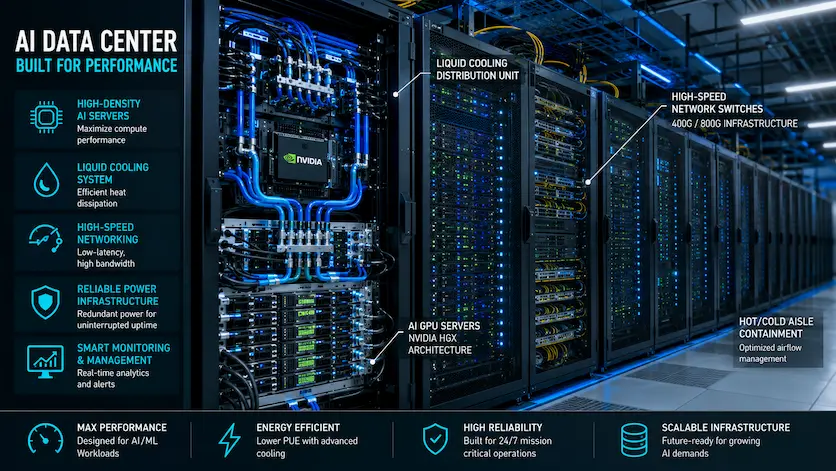
The massive capital spending from hyperscalers like Microsoft, Google, Amazon, Meta, and Oracle extends far beyond buying individual chips. Every modern AI data center requires an interconnected ecosystem of hardware components:
[ AI GPU Servers ] <---> [ High-Speed Networking Switches ]
         |
[ High-Density PCBs ] <---> [ Liquid Cooling & Power Management ]
         |
[ Precision Testing & Server Rack Integration ]
AI GPU & CPU Modules: Custom silicon arrays built for massive parallel processing.
High-Speed Switches: Ultra-low-latency interconnect networks required for distributed AI training.
Advanced PCBs & Memory: Multi-layer circuit boards paired with High Bandwidth Memory (HBM).
Liquid Cooling Infrastructure: Direct-to-chip cooling loops capable of dissipating severe thermal loads.
Supply Chain Realignment: Regionalization Over Centralization
The opening of Wistron’s Texas plant reflects a strategic imperative across the technology sector: geopolitical diversification and regional supply chain resilience.
Rather than relying on single-country manufacturing corridors, global tech supply chains are decentralizing across strategic nodes:
| Manufacturing Region | Primary Strategic Focus |
| United States | High-security, near-market assembly for hyperscalers & defense |
| Taiwan | Cutting-edge wafer fabrication & initial packaging |
| India | High-growth EMS expansion, OSAT facilities, & power electronics |
| Vietnam & Mexico | Regional server assembly, PCB assembly, & component manufacturing |
Opportunities for India’s Tech Ecosystem
India has established a formidable presence in consumer electronics assembly, particularly in smartphone manufacturing. The current AI infrastructure cycle opens a high-value growth runway for India to move up the value chain:
Semiconductor Packaging & Testing (OSAT): Supported by the India Semiconductor Mission.
AI Server & PCB Manufacturing: Leveraging existing EMS capabilities into enterprise hardware.
Power Electronics & Thermal Engineering: Building key sub-systems for hyperscale facilities.
For deeper coverage on how India’s cloud and data center investments are creating new technical career paths, read more at Matribhumi Samachar English.
Frequently Asked Questions (FAQ)
What is the main difference between semiconductor fabrication and AI server manufacturing?
Semiconductor fabrication creates the raw silicon chips (GPUs and CPUs) in specialized foundries. AI server manufacturing takes those chips and integrates them with complex PCBs, memory, cooling manifolds, power supplies, and networking switches into fully functional, rack-mounted computing systems.
Why is liquid cooling becoming mandatory for AI servers?
Next-generation AI chips consume significant power per node, generating heat levels that traditional air-cooling fans cannot safely dissipate. Liquid cooling transfers heat far more efficiently, allowing high-density server racks to maintain performance without overheating.
How does regional manufacturing benefit AI hardware buyers?
Regionalizing production shortens shipping times for massive server equipment, reduces shipping costs, and protects cloud infrastructure providers against trade disruptions and geopolitical risks.
Disclaimer
This article is provided for informational and educational purposes only. Mention of specific companies, technologies, or government programs does not constitute financial, investment, or commercial endorsement.
