

New Delhi.
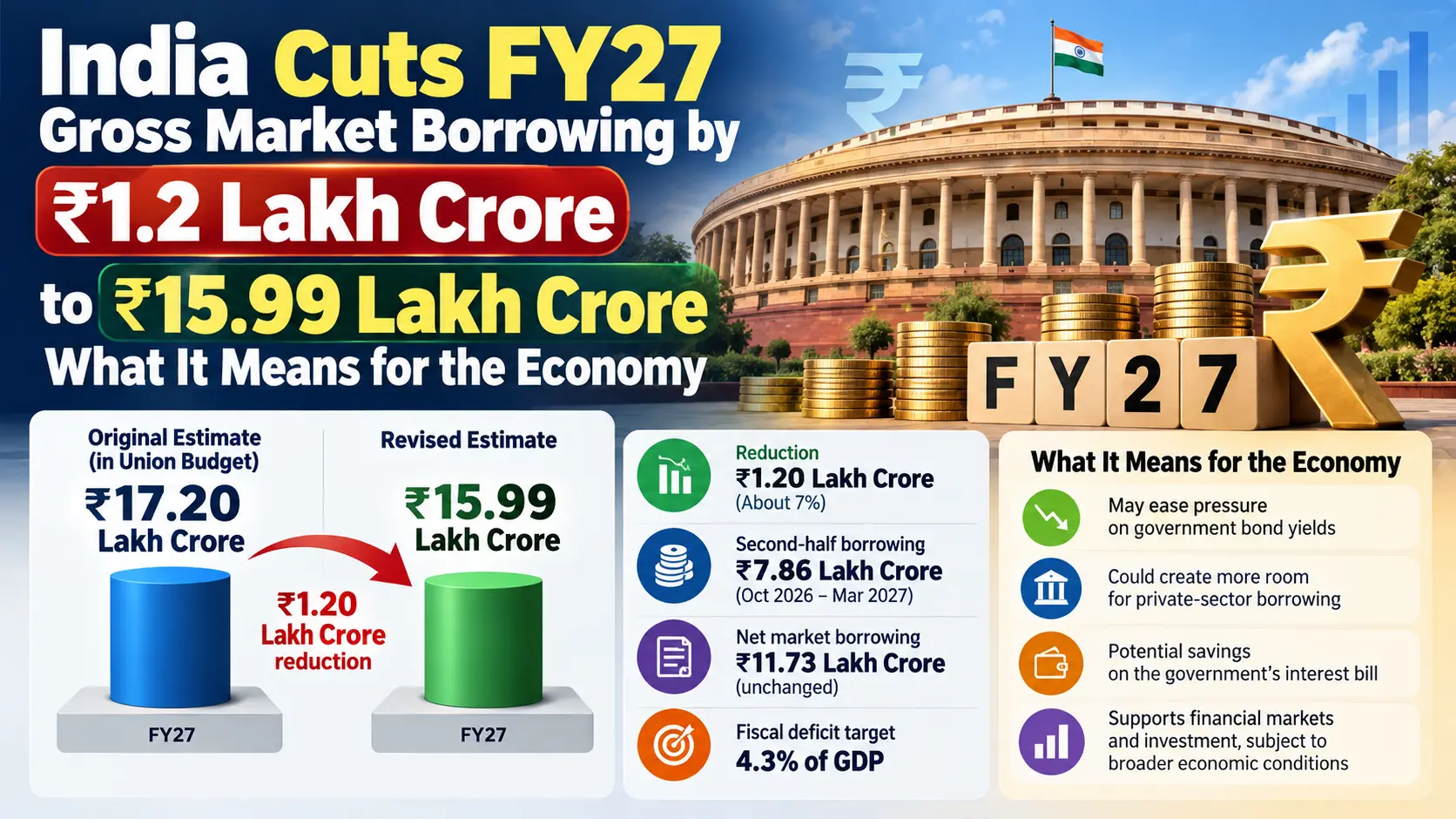
In a major fiscal development, the Central Government of India has revised down its gross market borrowing target for FY 2026–27 (FY27) to ₹15.99 lakh crore, representing a reduction of approximately ₹1.20 lakh crore (about 7%) from the Union Budget estimate of ₹17.20 lakh crore.
The revision highlights the government’s strategic debt management, debt-switching operations, and robust tax/non-tax revenue collections.
Key Highlights of the FY27 Borrowing Revision
| Indicator | Budget Estimate | Revised Estimate | Key Details |
| Gross Market Borrowing | ₹17.20 Lakh Crore | ₹15.99 Lakh Crore | ~₹1.20 Lakh Crore reduction (~7%) |
| Net Market Borrowing | ₹11.73 Lakh Crore | ₹11.73 Lakh Crore | Unchanged (financing fiscal deficit) |
| Second-Half (H2) Borrowing | — | ₹7.86 Lakh Crore | Oct 2026 – Mar 2027 via 23 weekly auctions |
| Fiscal Deficit Target | 4.3% of GDP | 4.3% of GDP | Maintained commitment to fiscal consolidation |
| Sovereign Green Bonds (SGrB) | — | ₹15,000 Crore | Part of H2 FY27 issuance |
1. Why Has the Government Reduced Its Gross Borrowing?
The decision to cut gross borrowing stems from two key factors:
- Stronger Revenue Collections: Higher tax receipts, asset monetisation, CPSE dividends, and disinvestment proceeds have boosted cash flows, lowering reliance on fresh debt.
- Debt-Switching Operations: Active securities-switching has replaced near-term maturing bonds with longer-dated instruments. This spreads out repayment schedules and lowers the gross refinancing burden without altering net borrowing.
2. Implications for the Indian Economy & Bond Markets
- Relief for Bond Yields: Reduced supply of G-Secs helps cap upward pressure on yields, offering relief to debt markets.
- Crowding-In Private Sector: Lower government demand for loanable funds leaves more liquidity for corporate bond issuers.
- Lower Debt Servicing Costs: Potential drops in borrowing costs could reduce future interest liabilities for the Centre.
3. Gross vs. Net Borrowing: Does Fiscal Deficit Fall?
Not necessarily.
- Gross Borrowing covers total debt raised, including refinancing maturing debt.
- Net Borrowing represents new cash raised to fund the budget gap. Because net borrowing remains at ₹11.73 lakh crore, the fiscal deficit target stays unchanged at 4.3% of GDP.
4. H2 FY27 Issuance Pattern & Duration Profile
The Centre plans to raise ₹7.86 lakh crore across 23 weekly auctions between October 2026 and March 2027.
The government has shifted focus toward longer-dated securities to extend its Weighted Average Maturity (WAM) and limit roll-over risks:
- 10-Year Bonds: 26.3%
- 15-Year Bonds: 17.6%
- 5-Year Bonds: 12.1%
- 50-Year Bonds: 9.9%
- 30-Year Bonds: 9.2%
- 7-Year Bonds: 9.1%
- 40-Year Bonds: 8.9%
- 3-Year Bonds: 6.9%
5. Sovereign Green Bonds (SGrB)
The government will raise ₹15,000 crore via Sovereign Green Bonds during H2 FY27 to fund eco-friendly public infrastructure. These are fully integrated within the ₹7.86 lakh crore target.
Frequently Asked Questions (FAQ)
Q1: Why did gross market borrowing fall while net borrowing remained the same?
Gross borrowing fell due to successful debt-switch operations that managed maturing paper. Net borrowing remained unchanged because the actual fiscal deficit gap being financed did not change.
Q2: What is the fiscal deficit target for FY27?
The fiscal deficit target remains at 4.3% of GDP.
Q3: How much will the government borrow in H2 FY27?
The government plans to borrow ₹7.86 lakh crore through 23 weekly auctions from October 2026 to March 2027.
Disclaimer
This article is for informational and educational purposes only and does not constitute financial, investment, or legal advice. Market yields and macroeconomic projections are subject to policy shifts by the Reserve Bank of India (RBI) and global market developments.
Relevant Internal Link: Read more financial policy and national economy coverage on Matribhumi Samachar English.
