
New Delhi.
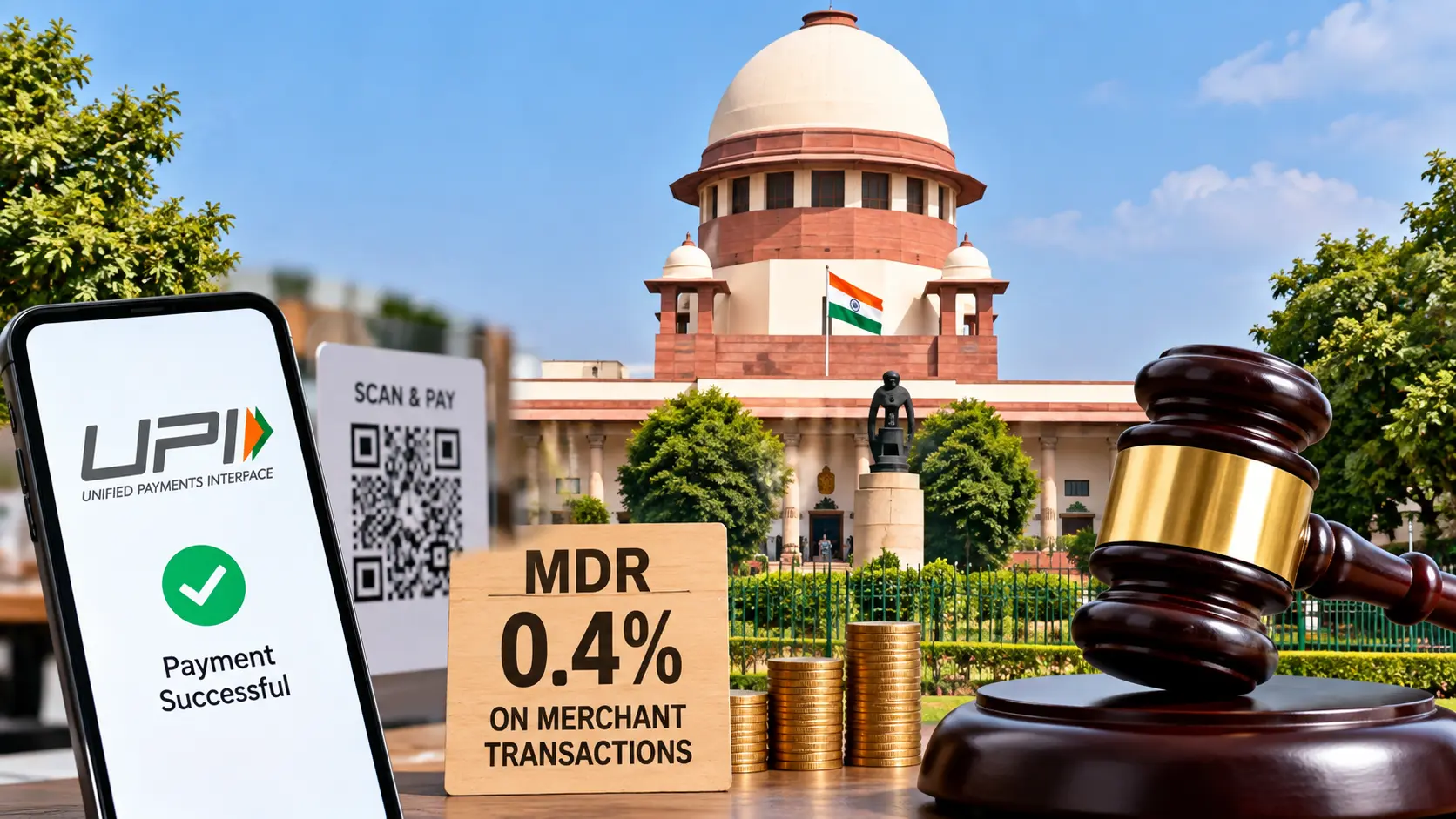
In a significant legal development for India’s digital payments ecosystem, the Supreme Court of India on Monday refused to grant an interim stay on the Union Government’s proposed Merchant Discount Rate (MDR) framework for specified UPI person-to-merchant (P2M) transactions exceeding ₹2,000.
A three-judge bench headed by Chief Justice of India Surya Kant, alongside Justices Joymalya Bagchi and V. Mohana (and Justice Vipul M. Pancholi), declined to halt the implementation of the new payment processing framework scheduled to take effect on October 15, 2026. However, the apex court issued formal notices to the Centre, the Reserve Bank of India (RBI), and the National Payments Corporation of India (NPCI) seeking detailed affidavits within four weeks to explain the legal, executive, and regulatory scope of the levy.
What Did the Supreme Court Say?
The bench heard a Public Interest Litigation (PIL) filed by advocate Anjan Datta, challenging the Ministry of Finance notifications issued earlier this month. The petitioner argued that ending the zero-MDR regime—which has been in place for nearly six years—could discourage digital adoption and push merchants back toward cash transactions.
┌───────────────────────────────────────────────────────────┐
│ SUPREME COURT KEY DIRECTIVES │
├───────────────────────────────────────────────────────────┤
│ 1. Interim Stay: DENIED (Implementation remains Oct 15) │
│ 2. Notices Issued: Union Govt, RBI, NPCI │
│ 3. Reply Deadline: 4 Weeks for Detailed Counter-Affidavits│
└───────────────────────────────────────────────────────────┘
During the proceedings, Additional Solicitor General (ASG) N. Venkataraman, appearing for the Centre, clarified that MDR is neither a tax nor a government fee. Rather, it is a cost-sharing ecosystem charge designed to compensate payment aggregators, sponsor banks, and platform developers for maintaining payment infrastructure. Justice Bagchi noted the legal importance of clarifying the executive authority behind such ecosystem charges, directing authorities to submit comprehensive technical and regulatory justifications.
Breakdown of the New UPI Charges
Under the proposed framework starting October 15, 2026, eligible person-to-merchant (P2M) transactions exceeding ₹2,000 will attract a standard 0.4% MDR, capped at ₹300 for payments equal to or exceeding ₹75,000.
Proposed Fee Structure:
| Transaction Amount | Applicable MDR Rate | MDR Charge Payable |
| ₹3,000 | 0.4% | ₹12 |
| ₹5,000 | 0.4% | ₹20 |
| ₹10,000 | 0.4% | ₹40 |
| ₹25,000 | 0.4% | ₹100 |
| ₹75,000 and above | 0.4% (Capped) | ₹300 (Maximum Limit) |
Which UPI Transactions Will Remain Completely Free?
The Ministry of Finance and NPCI have structured the framework to insulate retail consumers and small vendors. Data submitted in court indicates that approximately 96% of total merchant transactions and all peer-to-peer transfers will remain untouched by the new rate:
- Person-to-Person (P2P) Transfers: 100% free for all users, regardless of transaction amount (accounting for ~70% of total UPI monetary value).
- Merchant Transactions Up to ₹2,000: Zero MDR across all retail and online stores.
- Small Merchants (Zero-MDR Protection): Vendors and micro-businesses under the P2PM category receiving up to ₹1 lakh per month via QR codes pay ₹0.
- Essential & Low-Margin Sectors: Transactions over ₹2,000 in fuel stations, Indian Railways, telecom bill payments, insurance premiums, and agricultural inputs face a fixed flat fee of ₹5.
- Capital Markets: Payments to mutual funds, stockbrokers, and securities transactions incur a lower MDR of 0.02% (capped at ₹300).
Will Consumers Be Affected directly?
The framework explicitly states that MDR is a merchant-side settlement processing fee. Banks and UPI app providers (such as PhonePe, Google Pay, and Paytm) are expressly prohibited from levying direct convenience fees or platform surcharges on end-consumers.
However, market observers note that the long-term impact on retail buyers depends on whether larger commercial merchants absorb the cost or adjust product pricing.
Frequently Asked Questions (FAQ)
Q1. When do the new UPI MDR rules take effect?
The revised UPI MDR framework is set to be implemented on October 15, 2026, as the Supreme Court refused to stay the government notification.
Q2. Will I be charged for sending money to my friends or family?
No. All Person-to-Person (P2P) transfers remain 100% free, regardless of the amount transferred.
Q3. What is the maximum MDR charge possible on a large UPI payment?
The maximum MDR cap for standard transactions is ₹300, which applies to all merchant payments of ₹75,000 or higher.
Q4. Can a shopkeeper charge me extra for paying via UPI?
No. Guidelines issued to banks specify that merchants are not permitted to pass MDR charges directly onto buyers.
Related Links & Reading
- For national regulatory updates, visit Matribhumi Samachar English.
Disclaimer
This news report is prepared for informational and educational purposes based on proceedings at the Supreme Court of India and official circulars from the Ministry of Finance and NPCI. Implementation details remain subject to further final orders from the apex court.
