

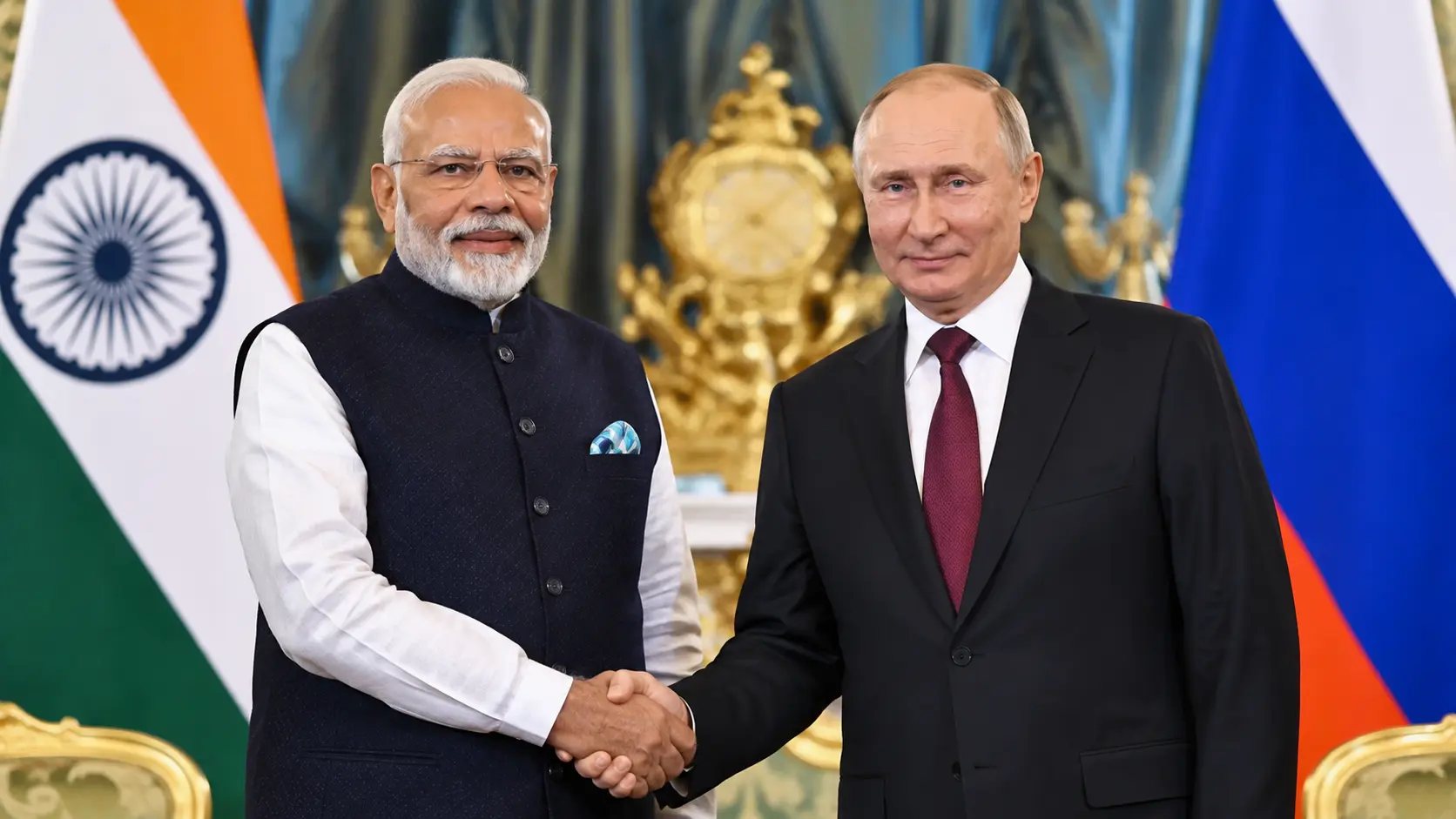
New Delhi.
India and Russia are taking deliberate steps to elevate their Special and Privileged Strategic Partnership through a comprehensive economic framework known as the Programme for the Development of Strategic Areas of India–Russia Economic Cooperation till 2030 (Programme 2030). First detailed following Prime Minister Narendra Modi’s visit to Moscow for the 22nd India–Russia Annual Summit, the roadmap outlines ambitious milestones designed to shift commercial relations beyond traditional hydrocarbon buying and selling toward integrated, balanced industrial partnerships.
The headline target set by both governments is to achieve $100 billion in annual bilateral trade by 2030, alongside a two-way investment target of $50 billion.
1. Baseline Trade Dynamics and the Deficit Challenge
During FY 2024–25, two-way trade between New Delhi and Moscow stood at approximately $68.7 billion. While this represents significant commercial volume, the current flow is disproportionately weighted toward Indian imports from Russia.
| Trade Indicator | FY 2024–25 Baseline Value |
| Total Bilateral Trade | $68.7 billion |
| India’s Imports from Russia | $63.8 billion |
| India’s Exports to Russia | $4.9 billion |
| India’s Trade Deficit | $58.9 billion |
Reaching the $100 billion benchmark requires an increase of roughly 45.6% over the baseline figure. A major focus of Programme 2030 is rebalancing this trade flow by significantly expanding Indian manufacturing, technological, and agricultural exports.
2. Sectoral Analysis: Key Import and Export Drivers
Primary Indian Export Streams
To reduce the $58.9 billion trade deficit, Indian businesses are targeting high-growth manufacturing and agricultural sectors in the Russian market:
- Pharmaceuticals & Healthcare: Active Pharmaceutical Ingredients (APIs), formulations, and generic medications.
- Chemical Industry: Organic and inorganic industrial compound feeds.
- Engineering & Metals: Iron, steel, heavy equipment components, and automotive spares.
- Agro-Products & Marine: Spices, tea, processed foods, and fresh seafood.
Essential Russian Import Streams
Russia remains a fundamental anchor for India’s energy and resource security:
- Energy Commodities: Crude oil, petroleum products, and coking coal.
- Agricultural Inputs: Fertilizers critical for India’s food security.
- Edible Oils: Sunflower and vegetable oils.
- Precious Goods: Raw diamonds, precious metals, and industrial gems.
3. Transport Corridors and Strategic Connectivity
Physical logistics and trade infrastructure represent a major focus under the 2030 vision. Both nations are modernizing maritime and multimodal networks to lower transit duration and freight costs:
- International North–South Transport Corridor (INSTC): A multi-modal network using sea, rail, and road routes across India, Iran, and Russia to bypass congested European maritime bottlenecks.
- Chennai–Vladivostok Maritime Route: An eastern sea corridor designed to link India’s east coast directly to the resource-rich Russian Far East.
- Northern Sea Route: Exploratory collaboration on Arctic maritime shipping pathways.
- Digital Customs Systems: Joint efforts to deploy paperless clearance and streamline cross-border customs processing.
- Financial Infrastructure and Settlement Channels
Facilitating smooth payment flows without exchange rate friction remains essential for long-term commercial engagement. Programme 2030 focuses on:
- National Currency Settlements: Expanding Rupee–Ruble trade processing to insulate transactions from third-currency volatility.
- Digital Payment Interoperability: Integrating domestic financial messaging and card systems.
- Banking Access: Streamlining correspondent banking relationships to assist small and medium Indian exporters.
Frequently Asked Questions (FAQ)
What is the main objective of the India–Russia Programme 2030?
Programme 2030 is a economic framework aimed at expanding bilateral trade to $100 billion, encouraging $50 billion in two-way investment, improving logistics corridors, and diversifying commercial ties beyond commodity purchasing.
Why is trade rebalancing a priority for India?
In FY 2024–25, India faced a $58.9 billion trade deficit with Russia due to high crude oil and fertilizer imports. Boosting exports in sectors like pharmaceuticals, engineering, and chemicals is key to creating a sustainable trade relationship.
What logistics corridors support the 2030 trade target?
The core corridors include the International North–South Transport Corridor (INSTC), the Chennai–Vladivostok Eastern Maritime Corridor, and potential Arctic shipping routes along the Northern Sea Route.
Disclaimer
This article is intended for informational and educational purposes based on public policy announcements and official diplomatic documentation. Bilateral trade figures, policy targets, and commercial frameworks represent government ambitions and remain subject to market conditions, international trade regulations, and independent commercial evaluations.
Related Coverage
For further reporting on regional developments, international trade, and national affairs, read the latest coverage from Matribhumi Samachar English Edition.
