 Matribhumi Samachar English


New Delhi. Monday, 6 July 2026
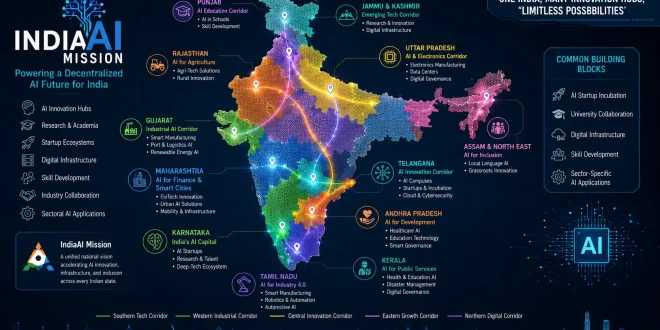
Artificial intelligence is no longer confined to national policy papers or elite urban boardrooms. Across India, a quiet but massive structural shift is underway. State governments are emerging as the principal architects of an AI-led economic transformation. Rather than waiting for a centralized, uniform directive, individual states are designing independent, highly specialized strategies tailored to their unique geographic, industrial, and social competitive advantages.
Anchored by the central government’s ₹10,370 crore IndiaAI Mission, this grassroots approach is laying the foundation for a resilient, distributed digital network. By investing heavily in compute infrastructure, deep-tech incubators, local language models, and targeted skilling, India’s states are proving that the future of next-generation technology is thoroughly decentralized.
The Strategic Catalyst: Why States are Seizing the Reins
For regional policymakers, adopting artificial intelligence is an urgent economic imperative. Deploying localized frameworks brings tangible, population-scale advantages:
-
High-Value Jobs & Startup Hubs: Creating specialized deep-tech corridors prevents regional brain drain and draws global venture capital.
-
Hyper-Localized Public Governance: Automating welfare distribution, emergency services, and administrative checks to remove institutional friction.
-
Targeted Regional Infrastructure: Transforming local industries by establishing edge data centers and high-speed regional grids.
Instead of replicating a uniform tech playbook, states are strategically aligning AI deployments with their existing economic strengths.
Regional Micro-Ecosystems: The State-by-State Breakdown
1. Karnataka: The Deep-Tech Capital
Leveraging Bengaluru’s status as a global tech epicenter, Karnataka focuses on deep-tech incubation, semiconductor ecosystem development, and cutting-edge research laboratories. The state acts as the primary sandbox for international venture capital and frontier enterprise AI solutions.
2. Telangana: Enterprise Adoption & Innovation Campuses
With Hyderabad expanding rapidly, Telangana has built dedicated AI innovation campuses. The state actively bridges the gap between laboratory research and commercial enterprise adoption, focusing heavily on cybersecurity, cloud scaling, and digital governance.
3. Tamil Nadu: The Industry 4.0 Industrial Powerhouse
Tamil Nadu is integrating machine learning directly into its vast manufacturing corridors. By prioritizing smart factories, automotive AI, predictive maintenance, and industrial robotics, the state is transforming into a global hub for automated manufacturing.
4. Uttar Pradesh: Leapfrogging to Regional Tech Infrastructures
Uttar Pradesh is executing a massive technological pivot. Under the UP AI Mission, the state is rolling out a network of 62 AI & Data Labs to democratize technology access in Tier-2 and Tier-3 cities, establishing India’s first dedicated AI City in Lucknow, and utilizing Noida as a dominant destination for hyper-scale data centers.
5. Maharashtra: Financial Innovations & Urban Systems
Combining the financial muscle of Mumbai with the tech talent of Pune, Maharashtra leads in FinTech, banking AI, and automated risk management frameworks. Concurrently, the state deploys smart city architectures to optimize urban mobility and municipal planning.
6. Gujarat: Industrial Logistics & Automated Supply Chains
Gujarat’s business-friendly policy framework is geared toward industrial optimization. The state is actively embedding machine learning algorithms into port automation, smart logistics networks, and regional renewable energy management systems.
7. Kerala: Public Service Delivery & Responsible Governance
Capitalizing on high digital literacy rates, Kerala focuses intensely on citizen-centric welfare. The state uses AI to power rural healthcare diagnostics, emergency disaster management platforms, and accessible educational technology models.
8. Punjab: K-12 Educational Foundations
Punjab is playing the long game by focusing squarely on structural workforce development. By introducing artificial intelligence, data science, and basic robotics directly into the curriculum of government schools, the state is building a future-ready talent pipeline.
9. Goa: Diversification & Cultural AI Development
Goa is focusing on research laboratories, academic partnerships, and local language AI tools. This deliberate focus allows the state to diversify its service economy while building systems that respect regional cultural contexts.
The Shared Blueprint and Systemic Bottlenecks
While execution varies geographically, successful state frameworks share five identical building blocks: Startup Incubation, Industry-Academia Collaboration, Digital Infrastructure Subsidies, Mass Skilling Initiatives, and Sector-Specific Deployments.
However, scaling this decentralized network is not without friction. States are actively navigating a near-term dependence on imported AI accelerators, regional funding gaps for early-stage deep-tech startups, and the challenge of preparing traditional workforces for automated workflows. Furthermore, as AI tools scale across critical sectors like banking and agriculture, ensuring algorithmic compliance and verifiable outputs remains a vital regulatory hurdle.
Frequently Asked Questions (FAQs)
Q1: How does decentralized AI growth in Indian states benefit the rural population?
A1: Decentralized growth allows states to build localized solutions, such as voice-first regional language agricultural assistants or AI-powered healthcare diagnostic tools in understaffed rural clinics, bypassing traditional English-centric digital divides.
Q2: Why are Tier-2 and Tier-3 cities vital to India’s AI future?
A2: Initiatives like Uttar Pradesh’s 62 AI & Data Labs bring advanced machine learning training and startup incubation resources directly to smaller cities. This lowers operating costs for new businesses and democratizes technical talent across the country.
Q3: How do state AI policies align with national initiatives like the IndiaAI Mission?
A3: The central government’s IndiaAI Mission provides the overarching financial and structural bedrock, creating national data repositories and compute grids. State policies act as localized execution layers that utilize this national backbone to solve region-specific problems.
Disclaimer: The information outlined in this article regarding state development roadmaps, regional budgets, and policy frameworks is based on public administrative updates and official mission outlines for 2026. Readers seeking professional investment or enterprise planning advice should conduct independent due diligence.