 Matribhumi Samachar English


Mumbai. Saturday, 18 July 2026
Just days after the historic India–UK Comprehensive Economic and Trade Agreement (CETA) officially came into force on July 15, 2026, Indian manufacturers, exporters, and Micro, Small, and Medium Enterprises (MSMEs) are already reporting robust economic signals. The landmark pact, hailed as a monumental turning point for post-Brexit international commerce, is dramatically reshaping bilateral trade dynamics. By eradicating or significantly slashing tariffs on a vast spectrum of goods, CETA has instantly amplified India’s price competitiveness in one of the world’s most lucrative consumer landscapes.
Early adoption indicators suggest that export-heavy conglomerates and nimble domestic manufacturing hubs were well-prepared for the transition, dispatching cross-border shipments under the new preferential tariff frameworks within hours of implementation.
A Closer Look at the Symmetric Wins and Sectoral Dynamics
The strategic framework of CETA introduces an ambitious tariff-liberalization design engineered to foster mutual growth while protecting fragile local industrial ecosystems:
-
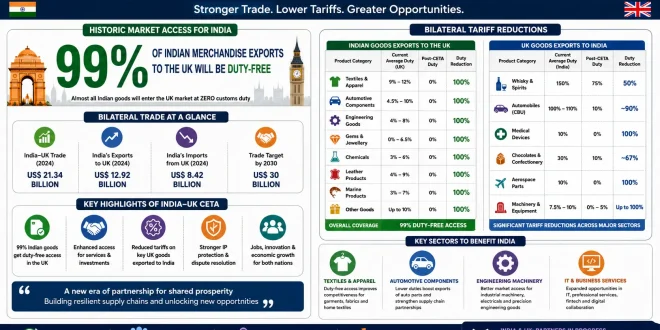
Immediate Victory for Indian Merchandise: The United Kingdom has eliminated duties on 99% of Indian exports from day one, giving massive leverage to competitive, labor-intensive sectors.
-
Reciprocal Access for Iconic British Goods: India is executing a gradual, phased approach, liberalizing roughly 90% of its tariff lines. Consumers in India will notice enhanced market access for luxury British passenger vehicles, high-end cosmetics, and iconic Scotch whisky, which saw its steep baseline tariff halved immediately from 150% to 75%.
-
A Historic First for Automotive Trade: Under an innovative Tariff Rate Quota (TRQ), British internal combustion engines (ICE) and electric vehicles (EVs) gain concessions to enter the Indian market at lowered tariffs down to 10% by year five, opening long-term avenues for clean automotive collaboration.
The Textile and Garment Boom: Leveling the Global Playing Field
India’s textile, apparel, and home furnishing industries are emerging as the most explosive immediate beneficiaries of CETA. Prior to July 15, Indian textile shipments faced UK import duties vacillating between 4% and 16%. The total eradication of these tariffs has erased the competitive pricing delta that rival Asian suppliers historically enjoyed through special developing-country concessions.
Garment manufacturing clusters spanning from Amritsar to Tirupur are anticipating a sustained influx of high-volume export orders in the coming quarters. Industry promotion bodies emphasize that while this tariff shield offers an unprecedented head start, retaining market share long-term will depend heavily on local enterprises consistently advancing automated supply chain efficiencies and adhering to stringent Western eco-compliance parameters.
Propelling Engineering, Steel, and Auto Components Under ‘Make in India’
Engineering goods and advanced machinery constitute a monumental pillar of India’s outbound trade. The dismantling of non-tariff barriers and customs friction under CETA gives precision engineering units, electrical equipment producers, and industrial machinery manufacturers a clear path into British corporate supply chains.
Simultaneously, the steel sector has acquired stable, legally guaranteed market access, bringing much-needed market diversification and commercial certainty for Indian metallurgical plants. These provisions directly feed into the core ambitions of the Indian government’s “Make in India” initiative, establishing the subcontinent not just as an affordable backup option, but as a premier, high-quality global production powerhouse.
The Social Security Game-Changer: Double Contribution Convention (DCC)
While physical merchandise has dominated early headlines, the services frontier has received an equally profound financial upgrade via the parallel operationalization of the Double Contribution Convention (DCC).
Historically, skilled Indian professionals dispatched to the UK on temporary contracts were legally mandated to sacrifice roughly 23% to 25% of their pay to UK National Insurance, despite being ineligible to reap the long-term domestic benefits. Under the new DCC framework, Indian workers on assignments lasting up to 60 months (5 years) are entirely exempt from these UK social security deductions, provided their contributions continue back home. This reform is projected to save over 75,000 Indian specialists and 900 businesses thousands of crores annually, vastly lowering bidding overheads for domestic IT giants contesting UK enterprise tenders.
Frequently Asked Questions (FAQ)
Q1: What exactly is the India–UK CETA, and when did it start?
A: The Comprehensive Economic and Trade Agreement (CETA) is a modern, deep-integration free trade agreement signed between India and the UK to liberalize goods, services, digital trade, and investment. It officially came into force on July 15, 2026.
Q2: Which Indian sectors stand to gain the most immediately?
A: Labor-intensive and export-driven sectors benefit immediately from duty-free access, particularly textiles and garments, auto components, engineering products, leather goods, footwear, marine products, and chemicals.
Q3: How does the agreement protect small businesses (MSMEs)?
A: CETA features a dedicated, pioneering standalone chapter for small and medium-sized enterprises. It streamlines custom clearance protocols (endeavoring to release standard goods within 48 hours), eliminates paper-heavy commerce through recognized digital signatures, and hosts centralized web portals so smaller firms can easily navigate cross-border trade guidelines.
Q4: What is the Double Contribution Convention (DCC) included in the deal?
A: The DCC is a highly beneficial social security arrangement. It exempts skilled Indian professionals working temporarily in the UK (for up to 5 years) from paying double social security or national insurance taxes, saving companies and workers massive compliance costs.
External References and Resources
To follow localized reporting, breaking editorial viewpoints, and official economic analytical metrics surrounding this trade development, visit the global media coverage via the English portal at Matribhumi Samachar English.
Disclaimer: The analytical insights, trade projections, and regulatory points detailed in this report are compiled based on the official bilateral frameworks and early industrial implementation reports available up to July 2026. Actual long-term commercial trajectories may vary based on macroeconomic fluctuations, supply-chain variables, and corporate compliance factors.