

New Delhi. Tuesday, 21 July 2026
As the global energy transition accelerates, our everyday tech demands are shifting rapidly. From electric vehicles charging in minutes to massive artificial intelligence data centers operating round-the-clock, standard silicon microchips are reaching their physical boundaries.
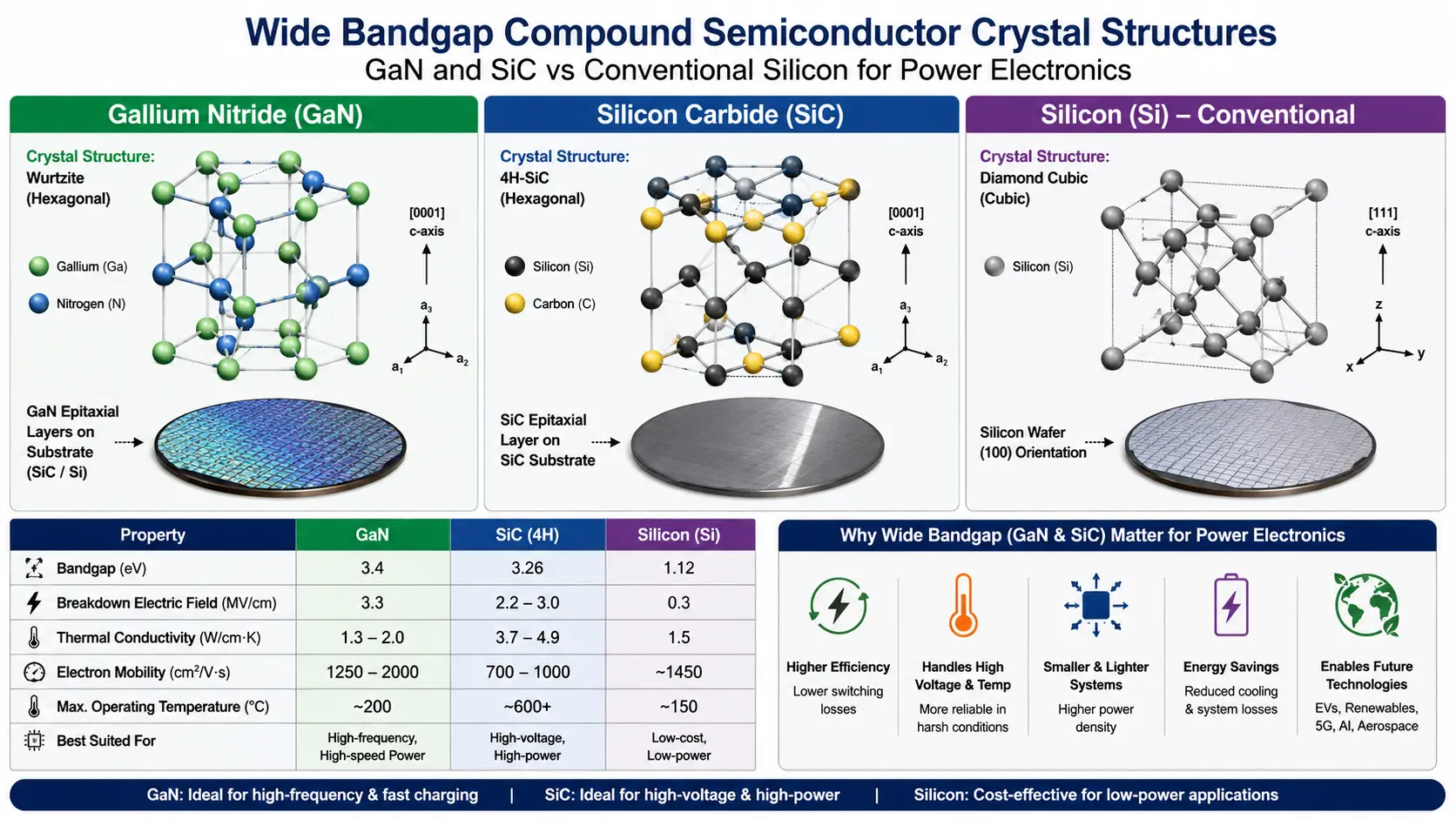
Enter compound semiconductors—specifically Gallium Nitride (GaN) and Silicon Carbide (SiC). These wide bandgap (WBG) materials handle higher voltages, faster switching speeds, and extreme temperatures with significantly lower power loss compared to classic silicon. For India, this technological inflection point represents a golden opportunity to establish global leadership in next-generation electronics manufacturing.
What Are Compound Semiconductors?
Unlike traditional semiconductor chips carved from single-element silicon, compound semiconductors combine two or more chemical elements.
Gallium Nitride (GaN): Merges Gallium and Nitrogen to excel at high frequency, rapid switching, and high efficiency in low-to-medium voltage environments.
Silicon Carbide (SiC): Fuses Silicon and Carbon to withstand extreme high-voltage, high-temperature, and heavy-power demands.
                   Energy Bandgap Comparison
  ┌─────────────────────────────────────────────────────────────┐
  │ Silicon (Si)         ███ 1.1 eV                             │
  │ Silicon Carbide (SiC)█████████ 3.2 eV                       │
  │ Gallium Nitride (GaN)██████████ 3.4 eV                      │
  └─────────────────────────────────────────────────────────────┘
The fundamental advantage lies in their bandgap energy—the amount of energy required for an electron to jump into a conducting state. Because GaN (~3.4 eV) and SiC (~3.2 eV) feature bandgaps nearly three times wider than silicon (~1.1 eV), they sustain higher electric fields before breakdown. This allows engineers to build thinner drift layers, drastically reducing internal electrical resistance and wasted heat.
Head-to-Head Comparison: GaN vs. SiC
| Feature | Gallium Nitride (GaN) | Silicon Carbide (SiC) |
| Primary Domain | High-Frequency & Ultra-Fast Switching | High-Voltage & Heavy Power Loads |
| Voltage Capability | Low to Medium (80V – 900V) | Medium to Very High (600V – 3.3kV+) |
| Heat Tolerance | High | Extremely High |
| Best Used For | 5G Telecom, Fast Chargers, AI Server Power, Satellite Radars | Electric Vehicles, Solar Inverters, Power Grids, Heavy Trains |
Where These Next-Gen Chips Power the World
1. Electric Vehicles & Clean Energy (Driven by SiC)
Every major electric vehicle relies on converting DC battery power into AC motor power cleanly. Using SiC inverters yields up to 5-10% greater driving range, speeds up high-voltage charging, and reduces cooling equipment bulk. Combined with critical material security initiatives like India’s Rare Earth Permanent Magnet Schemes, localizing SiC production strengthens the full EV supply chain.
2. AI Data Centers & Wireless Telecom (Driven by GaN)
Hyperscale AI clusters draw immense electrical currents. Integrating GaN power modules into rack power supplies slashes energy conversion losses, allowing data centers to shrink power unit sizes and boost compute density. Furthermore, GaN power amplifiers serve as the backbone for 5G base stations and upcoming 6G mobile infrastructure.
3. Defence and Aerospace Electronics
Radar arrays, military drones, and satellite communications demand lightweight platforms capable of operating under harsh thermal stress. As explored in the rise of Indigenous Defence Drones and Autonomous Aviation, securing compound semiconductor chips locally shields critical military systems from global supply disruptions.
India’s Strategic Advantage in Compound Semiconductors
Creating advanced 2nm silicon logic foundries costs upwards of $10 to $20 billion per fab and demands extreme ultraviolet lithography (EUV). Compound semiconductors, however, utilize mature process nodes (typically 90 nm to 180 nm) where performance depends on chemical purity and specialized substrate growth rather than extreme miniaturization.
Under the India Semiconductor Mission 2.0 Framework, India is deploying strategic capital to build out compound fabs, power module assembly lines, and OSAT (Outsourced Semiconductor Assembly and Testing) units:
Lower Capital Entry Barrier: Compound fabs require significantly lower upfront capital ($100M – $500M) compared to sub-5nm logic foundries.
Domestic Market Alignment: India’s booming EV market, solar grid installations, and expanding 5G networks guarantee high local demand.
Value Addition: Packaging, testing, thermal module design, and substrate processing offer immediate high-value engineering opportunities for local tech talent.
By cultivating deep expertise in Gallium Nitride and Silicon Carbide manufacturing, India isn’t just catching up—it is positioning itself as an indispensable hub in the global power electronics supply chain.
Frequently Asked Questions (FAQ)
Q1: Why are GaN and SiC called “wide bandgap” semiconductors?
A: They are called wide bandgap semiconductors because the energy required for electrons to jump from the valence band to the conduction band (~ 3.2 to 3.4 eV) is roughly three times greater than that of traditional silicon (~1.1 eV).
Q2: Will GaN and SiC completely replace silicon chips?
A: No. Traditional silicon will continue to dominate microprocessors, CPUs, memory chips, and low-cost consumer electronics. GaN and SiC are designed specifically to replace silicon in high-power, high-voltage, high-frequency, and extreme thermal applications.
Q3: How does compound semiconductor manufacturing help India’s Semiconductor Mission?
A: Compound semiconductor manufacturing requires significantly lower setup costs and uses mature process nodes. It directly aligns with India’s expanding domestic industries—such as electric vehicles, solar grids, 5G telecom, and defense equipment—making it an achievable entry point to build end-to-end chip manufacturing capabilities.
Disclaimer
This article is intended solely for informational, educational, and analytical purposes. The technical specifications, economic outlooks, and industrial policy references regarding compound semiconductors and the India Semiconductor Mission are based on publicly available data, industrial reports, and policy updates as of July 2026.
